


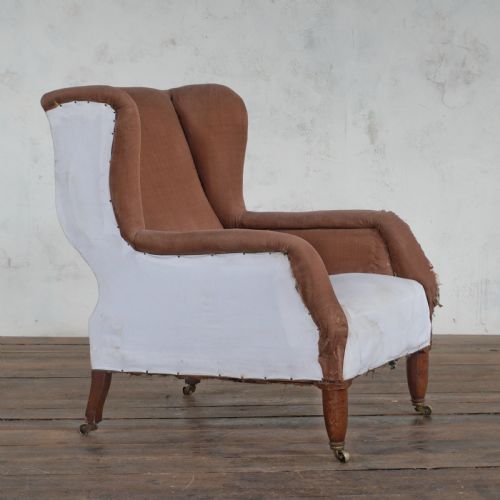


Brass Castor Wing Chair
A brass castor wing chair brings traditional comfort and period presence to a room, offering high sides and sturdy mobility.
Brass Castor Wing Chair
A brass castor wing chair is a traditional upholstered armchair designed with protective side panels and fitted wheels for ease of movement. Buyers searching this phrase often encounter examples spanning the Georgian, Victorian, and Edwardian eras, reflecting enduring domestic utility.
The selections available here showcase significant variety in timber frames and upholstery treatments, ranging from simple calico undercovers to decorative damask and velvet. Most pieces belong to the nineteenth and early twentieth centuries, displaying classic proportions tailored for fireside seating.
Forms vary from standard high-backed winged armchairs to barrel back designs and bergère styles. These seating options combine structural hardwood framing with functional metal fittings beneath the legs.
Construction materials and techniques
Frames are constructed predominantly from mahogany, walnut, and general hardwood, providing the structural strength required to support deep upholstery and daily use. These timbers are shaped and joined to form the characteristic high back and protective wings.
Upholstery techniques rely on traditional layers of hessian, calico, and stuffing, finished with top coverings of fabric, damask, or velvet. Small metal wheels in brass are attached to the base of the legs to allow smooth repositioning across heavy carpets and wooden floors.
Some winged chairs feature deep side panels specifically engineered to trap the heat from an open coal fire.
Evaluating quality and finish
Quality rests upon the integrity of the underlying hardwood frame and the proportion of the wings and arms. Superior examples exhibit balanced lines and sturdy timber construction that maintains stability over generations.
The execution of the upholstery and the original condition of the brass fittings contribute significantly to the character of each piece. Retaining period components enhances the overall cohesion of the armchair.
Howard And Sons·Thomas Sopwith
The Brass Castor Wing Chair Glossary
- Castor
- A small wheel mounted on a swivel assembly attached to the bottom of a furniture leg. This allows heavy seating to be moved across floors with minimal effort.
- Wingback
- An armchair featuring high side panels attached to the backrest. These panels were originally designed to shield the sitter from draughts.
- Bergère
- An enclosed armchair with woven cane or upholstered panels set into the wooden frame. This style offers a lighter visual weight than fully upholstered alternatives.
- Barrel back
- A seating form where the upholstered back curves continuously into the arms in a circular shape. This design provides an enveloping posture for the occupant.
Brass Castor Wing Chair: Frequently Asked Questions
What is a brass castor wing chair?
A brass castor wing chair is an upholstered fireside seat featuring protective wings and small metal wheels on the legs. These additions allowed the furniture to be repositioned near warmth.
Such chairs date across multiple historic periods, combining functional timber framing with soft textiles to create a comfortable domestic seat.
How do I identify a Georgian wing chair?
Georgian examples display specific proportions and timber framing characteristic of the eighteenth century. They often feature mahogany supports and traditional joinery.
Examining the underframe and the shape of the wings helps distinguish these earlier pieces from later nineteenth-century interpretations.
Why are brass castors important?
Brass castors provide a durable rolling mechanism that protects floor coverings and enables movement. They are typically fixed directly to the base of the legs.
These metal fittings vary in design according to the period of manufacture, adding functional detail to the lower portion of the chair.
How should I care for vintage upholstery?
Caring for vintage upholstery involves gentle surface cleaning and protecting the fabric from direct sunlight. Regular maintenance preserves the condition of the outer textile layer.
Maintaining the surrounding room climate also helps protect the internal hardwood structure and the stability of the joints.