



Brass Castor Music Canterbury
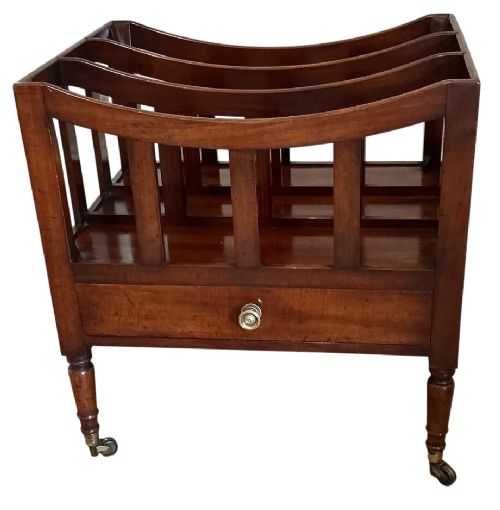
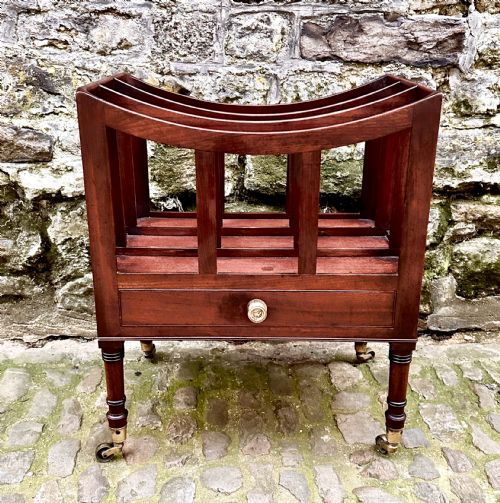
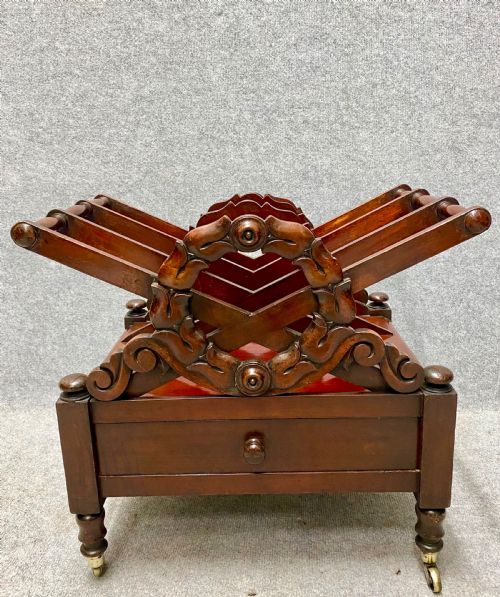
These brass castor music canterbury pieces are timber stands with divided tiers for holding folios and papers, mounted on small wheels for easy movement.
Brass Castor Music Canterbury
A brass castor music canterbury is a low, multi-tiered stand designed to hold sheet music, folios, newspapers, and magazines in a domestic setting. These pieces appear in forms such as boat-shaped racks, four-division stands, and combined what-not shelves.
The versions most commonly met on this page date from the Regency, Georgian, and Victorian periods. Makers employed dense timbers like mahogany, rosewood, and ebonised mahogany to construct these functional furniture items.
How they were made
Cabinet makers utilised solid and veneered timbers including mahogany and rosewood to build the partitions and frames of each stand. Woodturners shaped upright supports and finials while joiners fitted the slatted divisions together securely.
Cast brass wheels, known as castors, were fixed to the feet to allow the loaded stand to roll smoothly across carpets and floors. Craftsmen constructed these pieces in forms ranging from standard four-division racks to oversized country house folio stands.
Listings feature mahogany and rosewood timbers shaped into music stands and magazine racks across the Regency, Georgian, and Victorian periods.
What varies in quality
The refinement of the timber selection dictates much of the distinction between examples, with figured mahogany and rich rosewood marking out superior items. Fineness in the turning of upright supports and the crispness of joinery separate standard production from more ambitious workshop output.
Proportion and scale also define the standing of a piece, demonstrated by oversized country house models or sophisticated boat-shaped designs. The quality of the brass castor mountings and the integration of auxiliary shelves or drawers further distinguish individual pieces.
Gillows of Lancaster·J C Loudon
The Brass Castor Music Canterbury Glossary
- Canterbury
- A low stand with vertical divisions used for holding music sheets, folios, or periodicals. The name is traditionally linked to an Archbishop of Canterbury who requested such a stand for his music.
- Castor
- A small swivelling wheel attached to the base of furniture for ease of movement. These are typically cast in brass on the pieces found here.
- Folio stand
- A larger version of a book or music rack designed to hold oversized sheets and unbound volumes flat or upright. Examples often feature robust frames suited to country house proportions.
- Ebonised
- Wood finished to imitate ebony, usually through a staining and polishing process. This dark treatment appears on specific Victorian examples.
- Boat-shaped
- A curved hull-like contour seen in the outline of certain Regency trays and stands. This profile gives the timber framework a distinct sweeping silhouette.
Brass Castor Music Canterbury: Frequently Asked Questions
What is a music canterbury used for?
These stands were designed to hold sheet music, scores, and literary folios near a piano or seating area. They kept domestic paper clutter organised and accessible.
Over time, owners also utilised them to store newspapers and magazines as reading habits shifted. The divided sections kept bound and unbound materials upright.
How do I identify a Regency canterbury?
Regency pieces often display characteristic architectural restraint, clean lines, and dark timbers like mahogany or rosewood. They frequently feature boat-shaped bodies and neat turned supports.
Turned legs fitted with brass castors are typical of this period. Makers focused on balanced proportions and straightforward joinery without heavy ornamentation.
Were these stands made for sheet music?
Many were built specifically to hold music folios for home entertainment in the eighteenth and nineteenth centuries. The upright partitions prevented large sheets from bending or creasing.
Some later or larger variants served dual purposes as general newspaper racks or combination what-not shelves with storage below.
What timber are most canterburys made from?
Mahogany is the primary timber found across these listings, valued for its strength and deep warm grain. Rosewood also appears in finer Regency and Victorian examples.
Selected pieces feature ebonised mahogany finishes which provide a dense black surface. Cabinet makers chose these hardwoods to withstand daily domestic handling.