

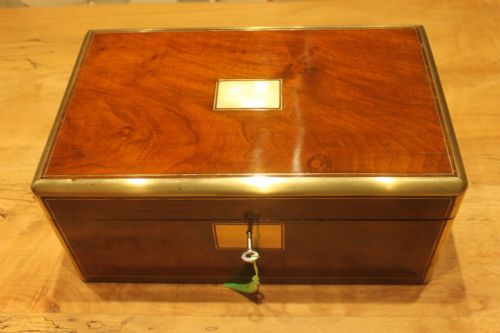
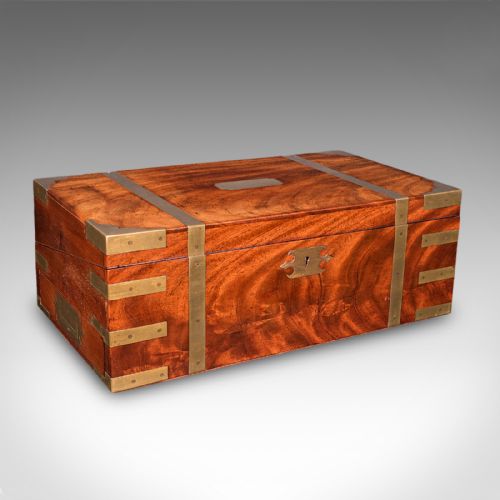


Brass Bound Correspondence Box
These robust timber brass bound correspondence box examples are built to organise letters and travel safely through the nineteenth century.
Brass Bound Correspondence Box
A brass bound correspondence box is a secure desk accessory designed to hold stationery, letters and writing implements during travel or home use. The pieces seen here encompass Victorian, Regency, William IV and Georgian eras, spanning the nineteenth century.
The forms vary from traditional writing slopes and bi-fold boxes to dedicated letter cabinets, stationery boxes and folding book rests. Walnut, mahogany, rosewood and coromandel timbers dominate the selection, frequently reinforced with metal strapping.
Buyers are most likely to encounter Victorian and 1880 examples executed in walnut or mahogany, often with campaign styling and fitted interiors. Irish and Anglo-Indian origins also appear among the selection, alongside black leather travelling variants.
Materials and construction
Cabinet makers constructed these boxes from dense hardwoods including mahogany, rosewood, walnut and coromandel, occasionally employing burr walnut veneers for decorative impact. Teak and leather also feature in specific travelling iterations.
Heavy brass binding, corners and mounts were countersunk and screwed into the timber to protect the edges and joints from the knocks of transit. Secret drawers, internal compartments and slope mechanisms were integrated into the wooden carcasses.
Brass Bound Correspondence Box Retail Price Guide 2026
Typical asking prices for brass bound correspondence box among the pieces listed under this phrase on Sellingantiques today, from the lower quarter to the upper quarter. They describe what is for sale here now, not the wider market.
Some nineteenth-century letter boxes hide secret drawers behind false partitions, keeping private missives safe from prying eyes.
Judging quality in a brass bound correspondence box
Quality rests on the selection of figured timber veneers, the precision of the brass inlay work and the integrity of the internal fittings. Heavy, well-proportioned carcasses demonstrate superior craftsmanship compared to lighter commercial output.
The presence of functioning secret drawers, original leather writing surfaces and intact stationery partitions elevates a piece. Superior examples maintain crisp mitres and unsparing use of solid brass hardware rather than plated alternatives.
The Brass Bound Correspondence Box Glossary
- Writing slope
- A box with an angled hinged lid designed to provide a slanted writing surface when opened. Inside, compartments hold paper, inkwells and pens.
- Campaign box
- Portable furniture and writing equipment made for military officers on active service. These pieces feature flush brass handles and reinforced corners for rough transit.
- Bi-fold
- A folding construction where two panels open outwards to reveal internal compartments or writing surfaces. This format preserves desk space while offering dual storage.
- Coromandel wood
- A dense, heavily figured timber imported from Asia, valued for its dark brown colour and striking black stripes. It was utilised on high-end nineteenth-century desk accessories.
- Secret drawer
- A concealed compartment accessed by releasing a hidden spring or removing a specific partition. They were built into writing slopes to secure valuables and private letters.
Brass Bound Correspondence Box: Frequently Asked Questions
What is a brass bound correspondence box?
A portable wooden container reinforced with brass corners and straps, designed to store writing paper, envelopes and letters. They range from simple stationery boxes to complex writing slopes with internal compartments.
Most date from the nineteenth century and reflect the heavy reliance on handwritten correspondence before the telephone.
How were these boxes used?
Owners used them at home on a desk or packed them into luggage for travel. The sturdy timber and brass reinforcement protected ink, quails and paper from damage on the road.
Inside, compartments kept wax seals, stamps and stationery orderly while the hinged lid doubled as a writing desk.
How do I date a correspondence box?
Examine the timber, brass work and construction style to determine the period. Regency and Georgian pieces often display restrained elegance, while Victorian examples frequently utilise coromandel or burr walnut with heavier mounts.
Makers' marks, lock stamps and screw types also provide clues to whether a piece originates from the early nineteenth century or the 1880s.
How do I care for a wooden box?
Keep the timber away from direct sunlight and sudden temperature shifts to prevent the wood or veneer from splitting. Apply a suitable wax polish occasionally to nourish the surface.
Ensure brass mounts remain dry, and avoid placing damp items inside the unlined compartments.