





Brass and Marble Candlesticks
Brass and marble candlesticks bring together weighty stone bases and cast metal mounts to light a room with classical dignity.
Brass and Marble Candlesticks
Brass and marble candlesticks combine solid metal components with smooth stone bases, taking forms from simple single candle holders to multi-branched candelabras. Buyers searching for brass and marble candlesticks will find pairs configured for tables or mantelpieces, often featuring classical figures or ornate cast metal work.
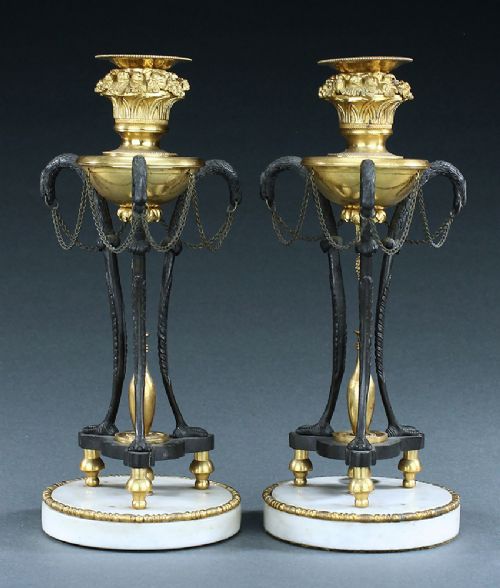
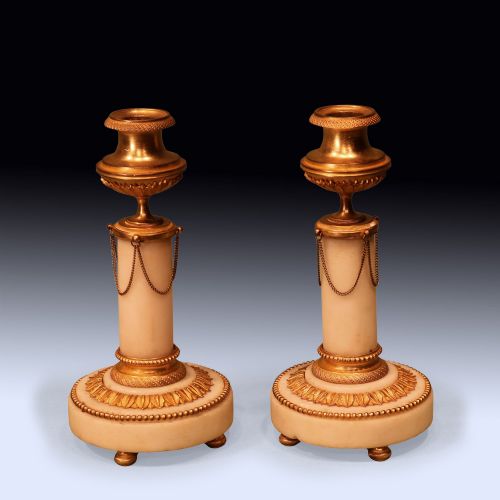
The pieces appearing on this page span the nineteenth century, including Victorian examples alongside items fashioned in the French Empire and Louis XVI styles. Alongside standard candlesticks, the selection includes converted table lamps and candelabras with multiple arms for candles.
Origins stretch across European workshops, with French designs strongly represented alongside Russian Empire and Victorian English pieces. White marble, green marble, brass, bronze, and ormolu recur across the inventory, creating substantial decorative objects.
Materials and Construction
Makers shaped the metal elements through casting in bronze, brass, or gilt metal, sometimes applying mercury gilding or ormolu finishes to create bright reflective surfaces. Patinated bronze appears alongside bright parcel gilt details, giving contrast to the metallic sections of each piece.
Stonemasons turned and polished the marble for the bases, utilising white and green varieties to anchor the heavy metal work above. Components were joined with internal threaded rods or screws, securing the cast metal figures, sconces, and drip pans firmly to the stone plinths.
Brass and Marble Candlesticks Retail Price Guide 2026
Typical asking prices for brass and marble candlesticks among the pieces listed under this phrase on Sellingantiques today, from the lower quarter to the upper quarter. They describe what is for sale here now, not the wider market.
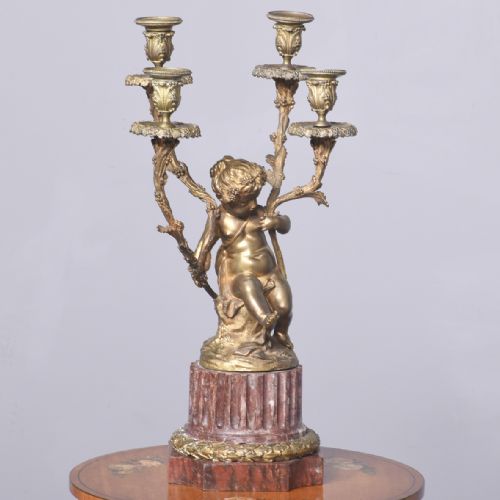
Victorian foundry workers clearly enjoyed sculpting chubby cherubs, balancing heavy multi-branched candelabras on their heads with remarkable nonchalance.
Distinctions in Quality
The integration between the stone and metal components dictates overall success, with better examples showing seamless joints and unified stylistic ambition across the design. Ormolu finishes that retain their original warmth and varied lustre distinguish high-end workshop production from standard commercial output.
The Brass and Marble Candlesticks Glossary
- Ormolu
- Gilded bronze, produced by applying a mercury and gold amalgam to a bronze base and heating it to drive off the mercury. This technique creates a durable golden surface seen on many nineteenth-century mounts.
- Candelabra
- A branched candlestick holding multiple candles on separate arms. These lighting pieces often sit upon marble plinths and feature cast figures or foliage.
- Athenienne
- A tripod stand or vessel form derived from classical antiquity, often adapted for use as a candlestick or decorative support. Examples frequently incorporate bronze supports on marble bases.
- Patinated bronze
- Bronze that has been chemically treated or aged to produce a dark, uniform surface colour. This finish contrasts against bright gilt metal mounts.
- Louis XVI Style
- A neoclassical design style reviving classical Greek and Roman motifs, characterised by symmetry, straight lines, and refined ornamentation. It heavily influences nineteenth-century French metalwork.
Brass and Marble Candlesticks: Frequently Asked Questions
How do I clean marble bases safely?
Dust the marble regularly with a soft, dry cloth to prevent dirt settling into the stone pores. Avoid harsh chemical cleaners or acidic substances, which can etch and dull the polished surface.
For stubborn marks, use a damp cloth with mild soap, drying the stone immediately afterward. Keep moisture away from any metal mounts to prevent tarnishing or corrosion.
Were these originally wired for electricity?
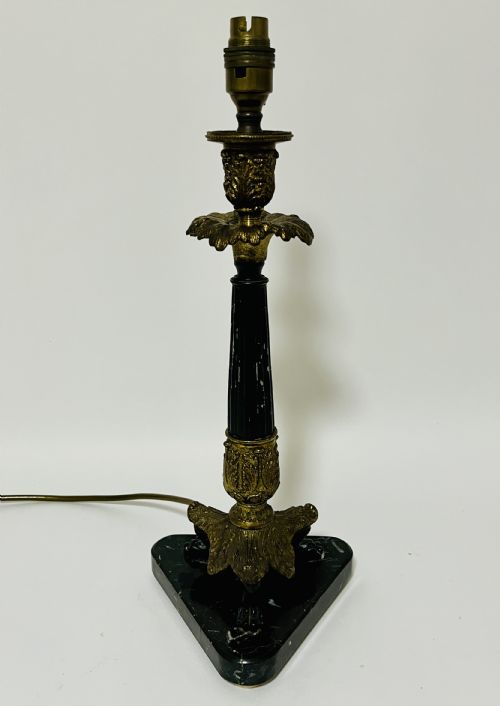
Nineteenth-century pieces were designed exclusively for wax candles or oil before later being adapted for electric lighting. Many surviving examples retain their original candle nozzles, whilst others were converted into table lamps during the twentieth century.
Buyers should inspect the fittings to understand whether the wiring is modern or if the piece remains in its original lighting configuration. Conversion methods vary from reversible setups to alterations made to the central shaft.
How do I distinguish French Empire from Victorian styles?
French Empire pieces rely heavily on strict neoclassical symmetry, military motifs, and rich ormolu mounts inspired by antiquity. They often feature dark patinated bronze figures contrasted against bright gilded brass and marble.
Victorian pieces incorporate a wider mixture of revivals, including Rococo curves and heavier, more ornate casting. They frequently utilise cherubs, floral garlands, and multi-branched arms suited to grand domestic interiors.
Can I use real candles in antique candelabras?
Real candles can be used provided the nozzles and drip pans are stable and secure. Ensure the candles fit snugly in the sockets to prevent wax dripping onto the marble or gilt surfaces.
Extinguish candles before they burn down to the metal sconce to protect the antique material. Keep burning candles away from draughts to maintain an even flame and avoid uneven wax pooling.