

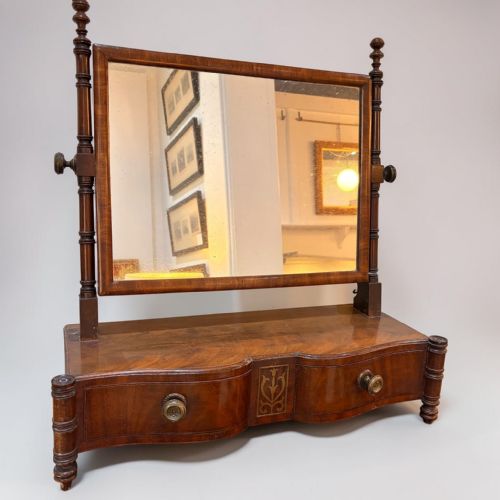
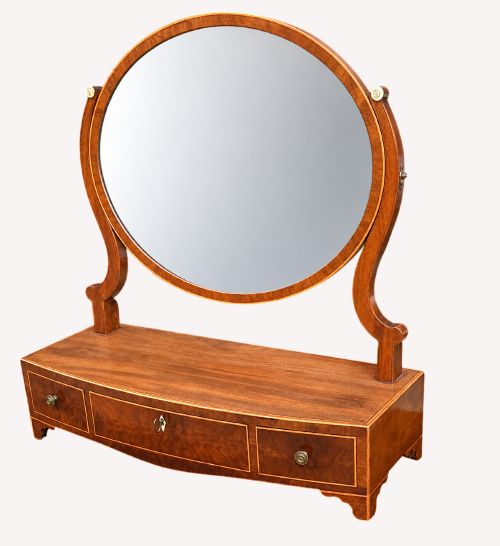
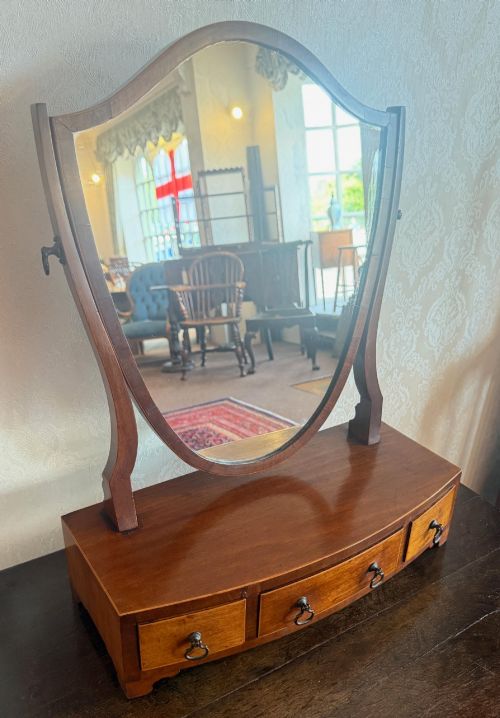

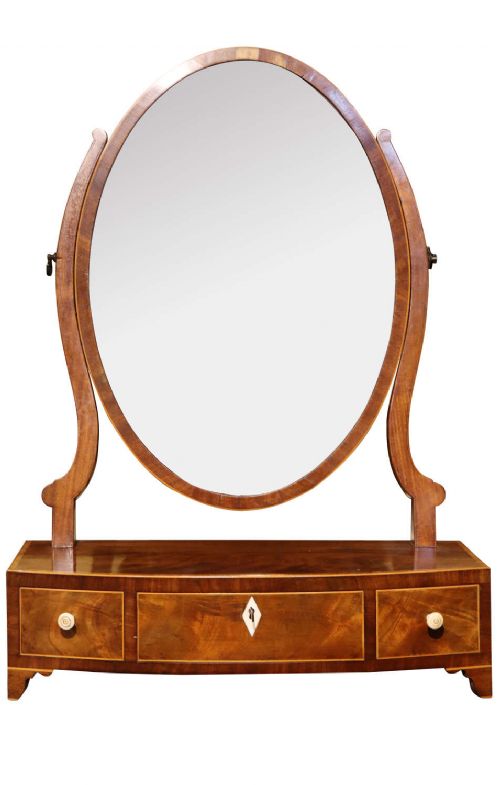


Bowfront Vanity Mirror
These bowfront vanity mirror pieces bring timeless dressing table elegance to a room, offering practical reflection alongside classic period proportions.
Bowfront Vanity Mirror
A bowfront vanity mirror sits upon chests or tables, serving as an essential dressing accessory that combines a curved front base with an adjustable mirror plate. Collectors encounter these pieces chiefly from the Georgian, George III, and Regency periods, spanning the late eighteenth century into the nineteenth century.
The primary forms appearing here include dressing table mirrors, toilet mirrors, and table mirrors. Most examples feature mahogany construction, often highlighted by flame mahogany veneers or boxwood inlay work, paired with original or period mirror glass.
Materials and construction methods
Cabinet makers utilised solid mahogany and rich flame mahogany veneers for the curved frames and box bases, frequently incorporating delicate boxwood inlay or bone details. The curved bowfront shape required precise woodworking skill to bend or shape the timber gracefully without compromising structural integrity.
Brass fittings, including pivot screws and small bracket feet, support the movable mirror frame above the stationary base drawers. The glass panels were silvered by hand, mounted securely within moulded wooden surrounds to allow smooth tilting adjustments.
Bowfront Vanity Mirror Retail Price Guide 2026
Typical asking prices for bowfront vanity mirror among the pieces listed under this phrase on Sellingantiques today, from the lower quarter to the upper quarter. They describe what is for sale here now, not the wider market.
Listings feature mahogany, burr maple, and brass materials across eighteenth and nineteenth-century periods.
Distinguishing quality across examples
The sophistication of the timber figure largely determines the visual hierarchy, with richly patterned flame mahogany and burr maple sitting at the upper end of the scale. Subtle decorative additions, such as fine crossbanding and contrasting stringing, separate standard workshop output from finer cabinet work.
Proportion and the integration of small drawers within the bowfront base dictate overall refinement. Pieces that maintain balanced lines between the curved lower section and the pivoting mirror plate demonstrate superior historical craftsmanship.
The Bowfront Vanity Mirror Glossary
- Bowfront
- A curved exterior front that sweeps outward in a convex arc. This shape adds visual depth and refinement to the base cabinet.
- Crossbanding
- A narrow strip of veneer laid around the border of a panel so that the grain runs at right angles to the central wood. It frames the primary timber with a neat decorative edge.
- Flame mahogany
- A distinct wood figure resembling flickering flames, created by cutting across the branch junctions of the tree. It was highly prized for principal display surfaces.
- Toilet mirror
- A traditional period term for a dressing table mirror used during personal grooming. These items usually incorporate small storage drawers beneath the glass.
- Bone inlay
- Small decorative sections of bone set flush into the wooden surface to create contrasting patterns. It provides pale geometric detail against dark tropical hardwoods.
Bowfront Vanity Mirror: Frequently Asked Questions
Where should I place a bowfront vanity mirror?
These mirrors suit dressing tables, low chests of drawers, or console tables in bedrooms and hallways. Their compact footprint allows them to sit securely on top of existing furniture without dominating the floor space.
Ensure the supporting surface matches the period depth of the base so the piece remains stable during daily use.
How do I identify a Georgian mirror?
Look for characteristic construction details such as hand-cut dovetails on the internal drawer boxes and traditional timber secondary woods. Styles from this era typically display restrained classical proportions and rich mahogany surfaces.
Hardware components like brass adjustment knobs also offer reliable clues regarding the manufacturing date.
Are the mirror plates original?
Many surviving examples retain their original mirror glass, which often exhibits gentle foxing, small age spots, or slight distortion. These natural signs of ageing confirm the antiquity of the glass plate.
Replacement glass occasionally appears in pieces that have undergone practical restoration over the centuries.
How do I care for the wood surface?
Maintain the mahogany finish by dusting gently with a dry, soft cloth and avoiding modern silicone-based polishes. Natural beeswax applied sparingly helps preserve the warmth of the vintage timber.
Keep the piece away from direct sunlight and excessive humidity to protect the wood veneers and prevent the frame from warping.