


Bowfront Bedside Chest
A bowfront bedside chest offers curved fronts and compact storage, bringing distinct period character and practical elegance beside a bed.
Bowfront Bedside Chest
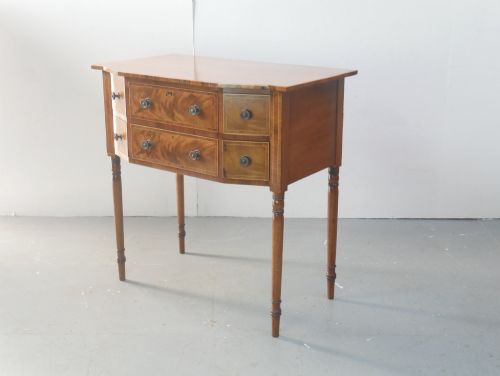
When you search for a bowfront bedside chest, you find compact wooden storage pieces featuring gently curved front facades designed to sit beside a bed. The inventory spans several distinct periods, including Victorian, Edwardian, and earlier Georgian eras, showcasing how cabinetmakers adapted full-scale case furniture for smaller bedroom spaces.
Most examples you encounter on this page are constructed from mahogany, often featuring figured grain patterns like flame mahogany or satin mahogany. Alongside traditional timbers, you will find variants in walnut, burr walnut, oak, and painted wood surfaces reflecting different regional tastes and stylistic revivals.
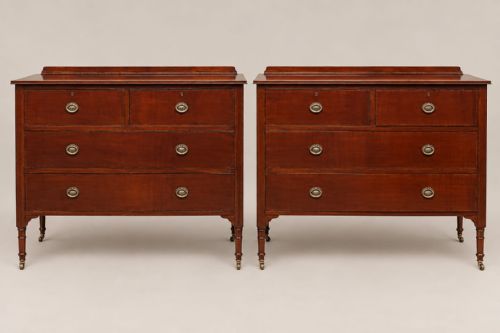
These items take various forms such as bedside tables, small chests of drawers, side cabinets, and commodes. Whether you meet a matched pair from the late nineteenth century or a single Georgian piece, each version provides enclosed storage with a characteristic convex profile.
How they were made
Cabinetmakers built these pieces using solid timbers and decorative veneers applied to secondary woods, shaping the characteristic curved front using steam-bending or segmented block construction. Drawer frames and carcases relied on traditional joinery methods such as dovetailing to ensure structural stability over centuries of use.
Surface finishing involved hand-applied polishes like shellac or varnish to highlight the natural figures of mahogany, walnut, and satinwood. Hardware components typically include cast brass handles, ring pulls, and keyhole escutcheons secured to the drawer fronts.
The inventory spans styles from Georgian and Regency to Victorian, Edwardian, and subsequent revival periods.
What varies in quality
The degree of refinement in timber selection marks the difference between standard items and superior examples, particularly where figured veneers like flame mahogany or burr walnut are matched across the drawer fronts. Cabinetmakers who took extra care ensured that grain patterns flowed continuously or mirrored symmetrically from the centre outwards.
Construction details also dictate overall quality, visible in the precision of the dovetail joints, the thickness of the drawer linings, and the smoothness of the curved drawer operation. Pieces retaining original brass hardware, stable carcases, and well-fitted backs demonstrate superior original craftsmanship.
Edwards and Roberts
The Bowfront Bedside Chest Glossary
- Bowfront
- A convex, outward-curving front facade characteristic of certain case furniture and chests of drawers. This curved shape softens the rectangular profile of the furniture and demands skilled woodworking.
- Flame mahogany
- A highly figured wood veneer displaying a distinctive flame-like pattern caused by the way the tree grain grew. Cabinetmakers reserved this decorative timber for prominent surfaces like drawer fronts.
- Dovetail
- A traditional interlocking woodworking joint used to join the sides of a drawer to its front and back. Its interlocking wedge shape provides exceptional tensile strength without relying on metal fasteners.
- Escutcheon
- A protective metal plate surrounding a keyhole designed to prevent the wood from wearing around the lock. They are often cast in brass and styled to match the drawer pulls.
- Commode
- A low piece of furniture featuring doors or drawers, originally designed to house a chamber pot. In later periods, the term describes decorative bedside cabinets and small chests.
Bowfront Bedside Chest: Frequently Asked Questions
What periods do these pieces come from?
The inventory includes items from the eighteenth, nineteenth, and early twentieth centuries, spanning Georgian, Victorian, and Edwardian eras. You will also encounter pieces influenced by Queen Anne and Sheraton revival styles.
Craftsmen across these periods retained the signature curved front while adapting decorative details and secondary woods to suit changing domestic fashions.
Are pairs common for bedside use?
Many listings feature pairs of chests or cabinets, often originating from bedrooms where symmetry was preferred. These matched sets share identical timber grains, heights, and hardware.
Finding a matched pair from the nineteenth century is typical for this category, though single tables and cabinets also appear frequently.
What materials were used?
Mahogany is the predominant timber, appearing alongside walnut, burr walnut, oak, and satinwood. Some examples feature painted wood surfaces or decorative veneers like flame mahogany.
Hardware components are typically made of cast brass, adding metallic contrast to the polished wooden surfaces.
How were they used historically?
These cabinets served as bedside storage for personal items, nightwear, and chamber pots within domestic bedrooms. Their compact proportions allowed them to fit neatly beside sleeping quarters without obstructing room flow.
Over time, their surface tops also supported chamber lamps, clocks, and books.
How do I identify a revival style?
Revival pieces incorporate design elements from earlier centuries, such as Queen Anne or Sheraton motifs, but were manufactured in later eras like the Victorian or Edwardian periods. Makers during these times reinterpreted classic forms using contemporary workshop techniques.
Examining the internal woods and secondary construction details helps distinguish a later revival piece from an original eighteenth-century example.