



Antique Bowfront Nightstands
These antique bowfront nightstands are curved bedside cabinets and cupboards built to hold bedroom essentials with elegance.
Antique Bowfront Nightstands
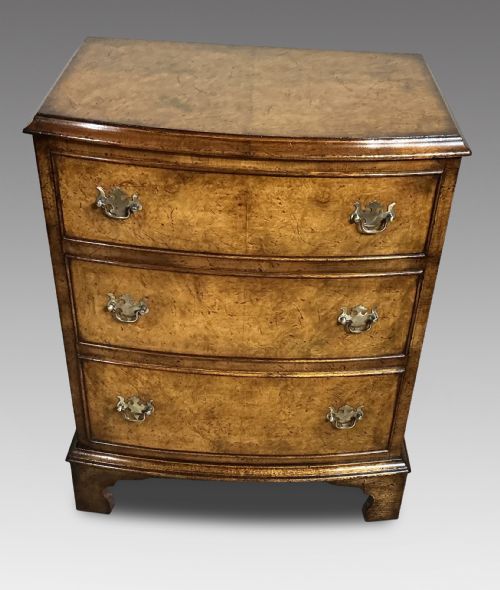
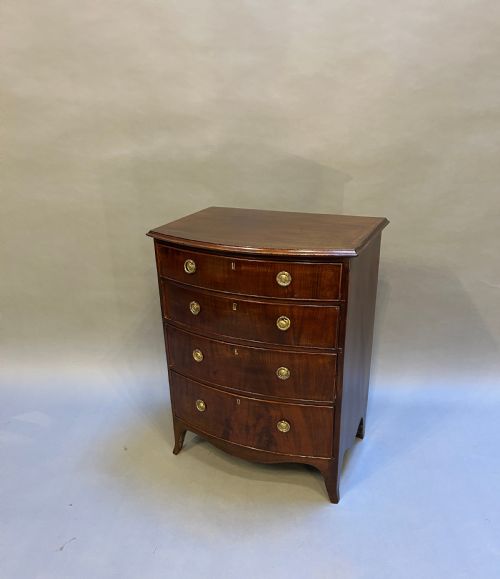
Antique bowfront nightstands combine curved fronts with compact proportions designed for the bedroom. These pieces appear across Georgian, Victorian, and Edwardian periods, taking the form of bedside cabinets, cupboards, and small chests of drawers.
The most common examples on this page are mahogany bedside cabinets and cupboards featuring the characteristic outward-curving front. Buyers also encounter satinwood, walnut, and burr walnut versions spanning from the eighteenth century to the early twentieth century.
How they were made
Cabinetmakers utilised solid timbers and figured veneers, applying flame mahogany and burr walnut to the curved drawer fronts and cabinet doors. Fine examples incorporate contrasting ebony inlay and satinwood banding to accentuate the sweeping lines.
Hardware such as brass handles and pulls complete the construction, paired with internal shelving or compartment space suited for bedside use.
What varies in quality
The grade of timber and figure of the veneer largely distinguish simpler utility pieces from high-end cabinetmaking. Rich flame mahogany and carefully matched burr walnut veneers demonstrate superior workshop standards.
The refinement of the joinery along the curved front, the presence of delicate stringing or ebony inlay, and original brass hardware further separate standard production from exceptional pieces.
Gillows
The Antique Bowfront Nightstands Glossary
- Bowfront
- A convex, outward-curving front profile typical of these bedside cabinets and chests. This curved shape requires advanced woodworking skill to construct cleanly.
- Mahogany
- A durable hardwood prized for its deep reddish-brown tone and smooth grain. It serves as the primary structural and surface timber across many Georgian and Victorian listings.
- Marquetry
- Decorative patterns formed by fitting together thin slices of wood veneer. This technique creates elaborate surface ornamentation on select bedside tables.
- Commode chest
- A low cabinet or chest of drawers designed for bedroom storage. Several pieces in this category take this enclosed form.
Antique Bowfront Nightstands: Frequently Asked Questions
What periods do these nightstands come from?
The pieces span from the Georgian era through the Victorian and Edwardian periods up to the early twentieth century. Styles range from George III and Regency designs to later Edwardian and Sheraton Revival interpretations.
Construction details and timber choices typically reflect the prevailing aesthetics of each respective decade.
How were these cabinets originally used?
These bedside cabinets and cupboards functioned as compact storage next to the bed for chamber pots, personal items, and nightwear. Their enclosed doors and small drawers kept bedroom accessories neatly out of sight.
Today, they serve a similar practical purpose while adding period character to contemporary bedrooms.
Are matched pairs common for these bedside cabinets?
Makers occasionally produced pairs of bedside cupboards or chests to flank a larger bed frame. Surviving pairs appear alongside single cabinets within the selection.
Matching sets demand closer attention to timber grain and proportion to verify their pairing.
What timber varieties should I look for?
Mahogany forms the primary material for the majority of pieces, often enhanced by flame figuring. Walnut, burr walnut, and satinwood also feature prominently in later Victorian and Edwardian examples.
Inlay work frequently incorporates ebony and lighter exotic woods to frame the curved drawer fronts.