


Flame Mahogany Bowfront Cupboards
Flame mahogany bowfront cupboards bring together curved fronts and striking timber figures, offering practical storage with a distinct Georgian or Regency presence.
Flame Mahogany Bowfront Cupboards
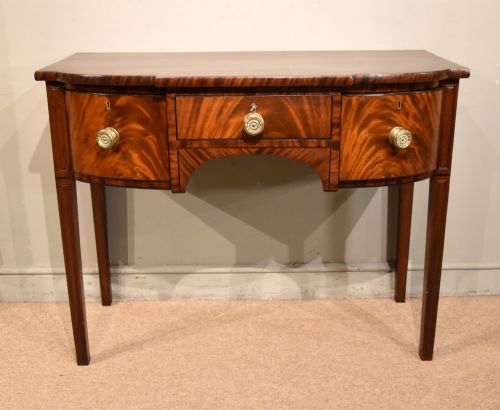
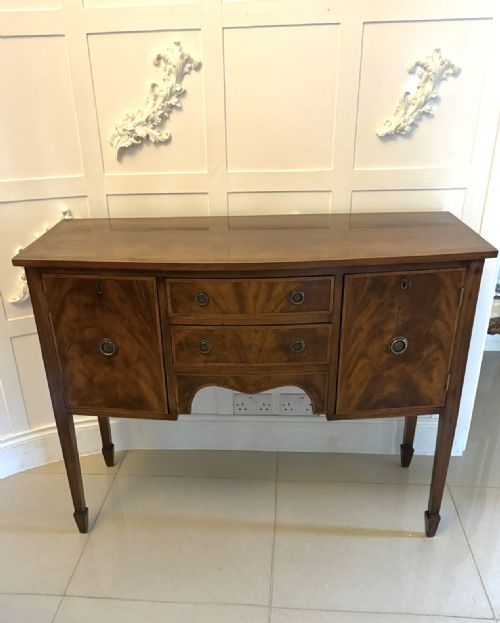
When you search for flame mahogany bowfront cupboards, you are looking at items designed with a gracefully curved front that softens the corners of a room. The selection spans George III, Regency, and later revival periods, bringing together corner cabinets, wall cupboards, and side cabinets.
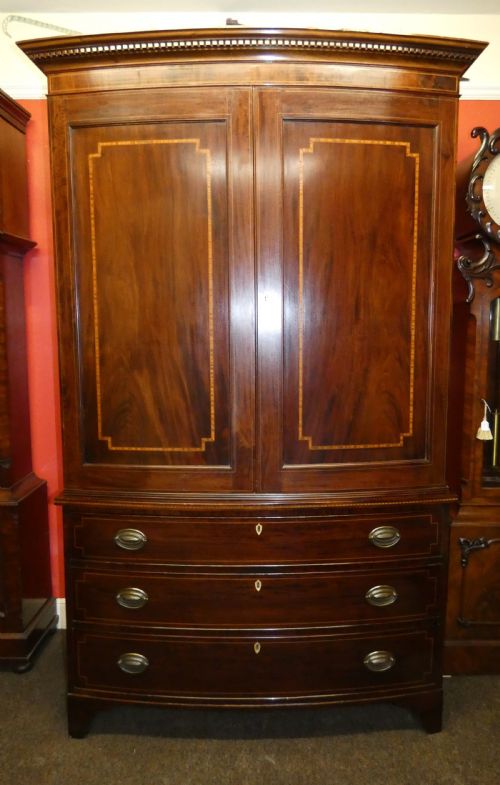
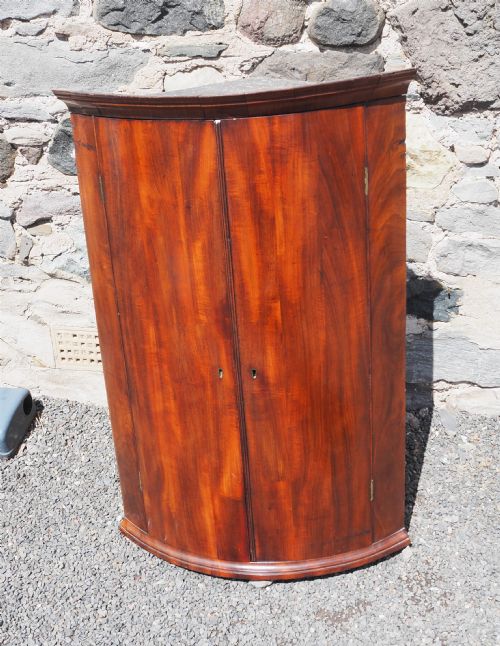
You are most likely to meet hanging corner cabinets or larger floor-standing linen presses and sideboards. These pieces utilise solid mahogany carcases combined with figured veneers to create movement across the front surfaces.
The domestic interiors of the eighteenth and nineteenth centuries relied on these cabinets for storing china, linen, or personal provisions out of sight. Their distinct silhouettes reflect the shift from rectilinear furniture to softer, curved architectural lines.
How they were made
Cabinet makers selected mahogany for its stability and rich natural tone, laying down thin veneers of flame mahogany to achieve dramatic, fiery patterns across the bow fronts. Crossbanding in satinwood, boxwood, or ebony often frames the doors and drawers.
Secondary timbers such as oak provide sturdy interior framing and drawer linings, ensuring structural integrity behind the decorative exterior. Brass handles, escutcheons, and hinges finish the construction, reflecting the hardware styles of the Georgian and Regency eras.
Listings feature brass, mahogany, oak, satinwood, boxwood, and ebony across Georgian, Regency, and Edwardian periods.
What varies in quality
The grade of the timber veneer sets the visual hierarchy, with symmetrical, deeply figured flame mahogany commanding attention over plain grain. The precision of the curved bow front and the tightness of the mitre joints indicate the skill of the original workshop.
Secondary wood selection and the crispness of inlaid stringing also separate standard items from finer productions. Original brasses and well-fitted interior shelving preserve the integrity of the piece.
Gillows
The Flame Mahogany Bowfront Cupboards Glossary
- Bowfront
- A convex, outwardly curved front elevation typical of many cabinets and sideboards from the Georgian and Regency periods. This shape softens the profile of the furniture.
- Flame mahogany
- A veneer cut from the fork of the mahogany tree where branches meet the main trunk, producing a rippling, flame-like pattern. It is prized for its decorative movement.
- Linen press
- A tall storage piece comprising upper shelving enclosed by doors and lower drawers, originally intended for storing household textiles flat. Many examples feature the characteristic curved bow front.
- Corner cabinet
- A specialist storage unit designed to fit squarely into a room angle, available in hanging wall versions or standing floor models. They maximise space in smaller rooms.
- Inlay
- A technique where contrasting woods such as boxwood, satinwood, or ebony are embedded into the primary surface to form decorative lines and borders.
Flame Mahogany Bowfront Cupboards: Frequently Asked Questions
Where should I place a corner cabinet?
These cabinets suit awkward room angles or empty corners where standard rectangular furniture would jut out too far into the floor space.
Hanging versions work well above a small table or desk, while standing models anchor an empty corner while providing enclosed shelving.
How do I care for flame mahogany veneer?
Keep the timber away from direct sunlight and strong heat sources to prevent the polish and veneer from drying out.
Dust gently with a dry cloth and apply a traditional beeswax sparingly to maintain the natural lustre of the wood.
How can I distinguish Georgian from Edwardian pieces?
Georgian pieces date from the eighteenth or early nineteenth century and show period construction methods with hand-cut dovetails and native secondary woods.
Edwardian items often reflect revival styles like Hepplewhite or Chippendale, utilising machine assistance alongside traditional hand-finishing techniques.
What was a linen press used for?
Households used these tall cupboards to store freshly laundered sheets, tablecloths, and garments flat on internal sliding trays or shelves.
The deep lower drawers accommodated bulkier items that did not fit onto the upper shelves.