
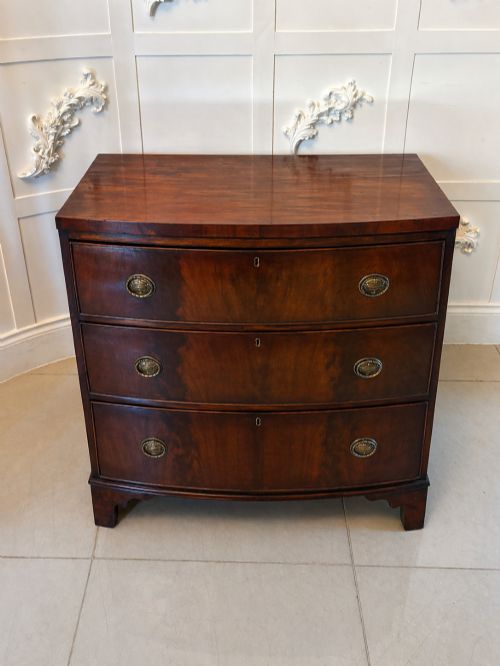
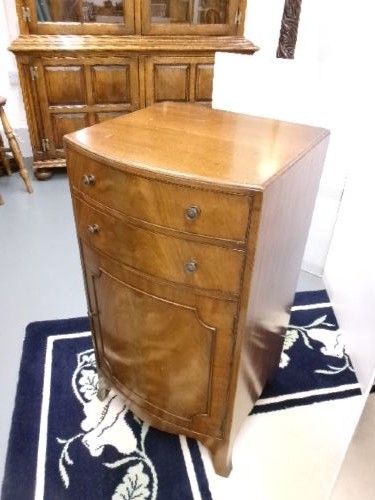
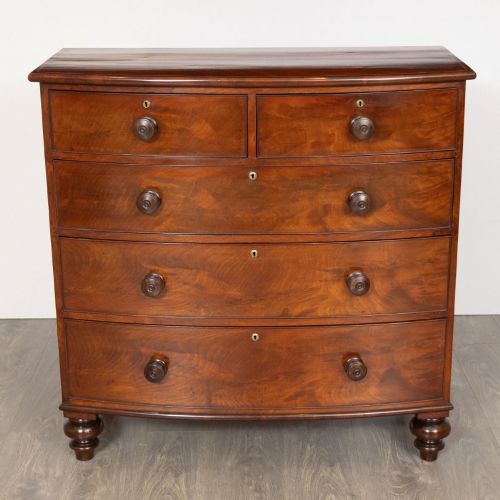
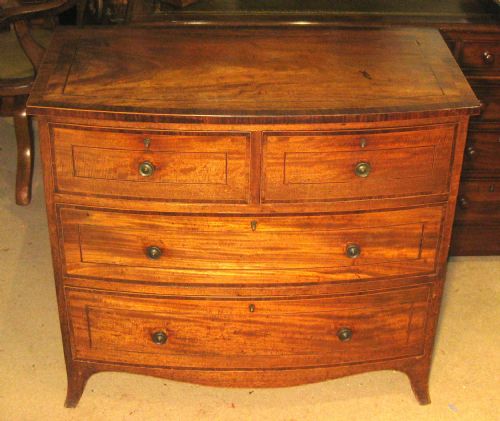
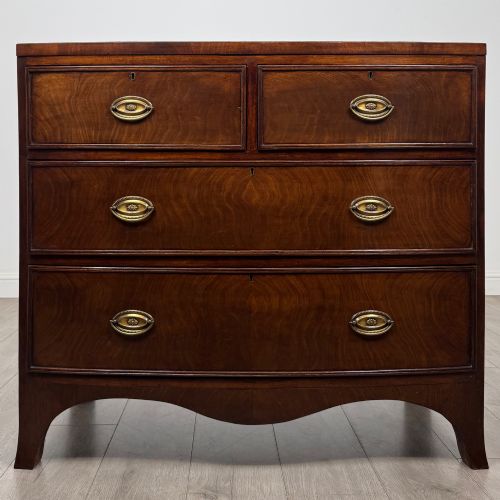
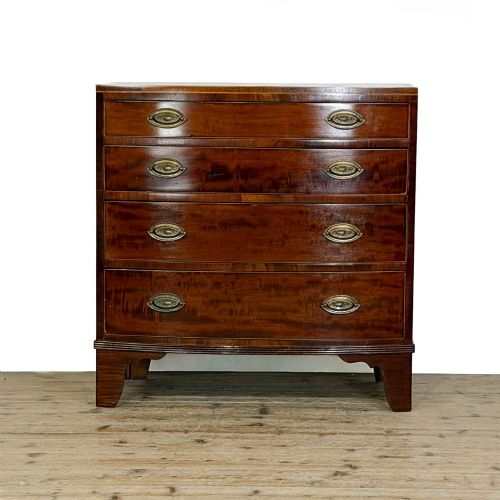
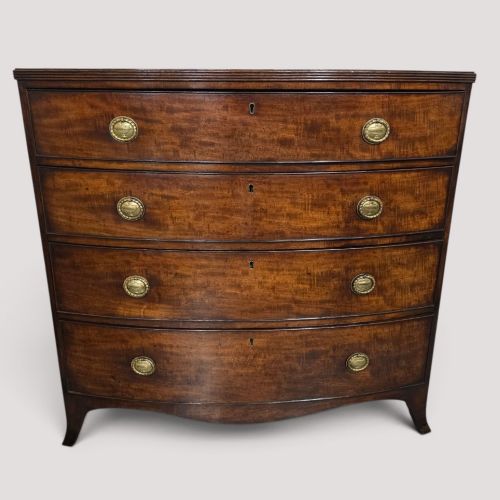
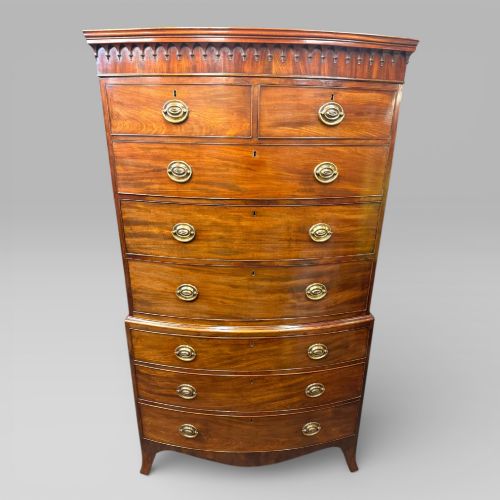
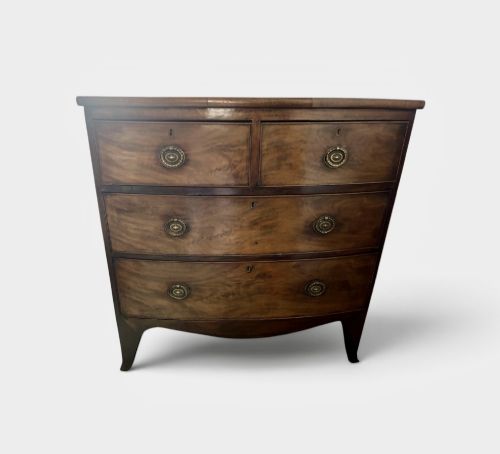
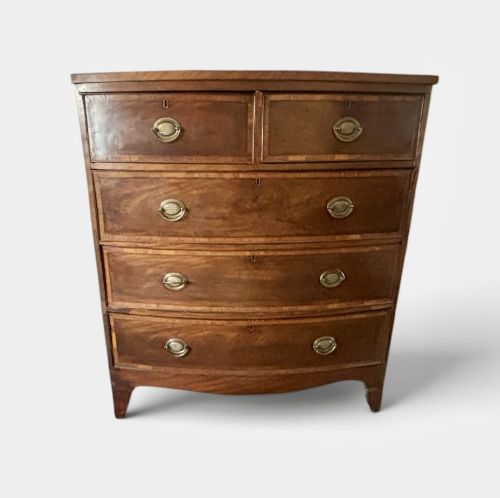
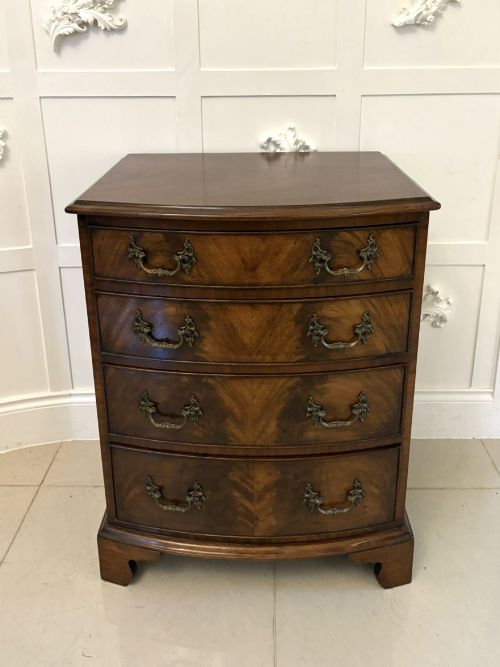
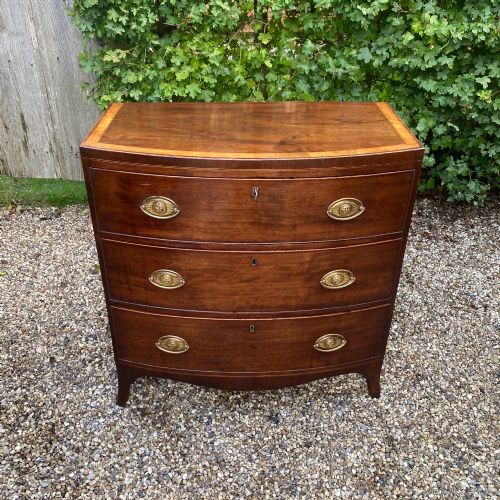
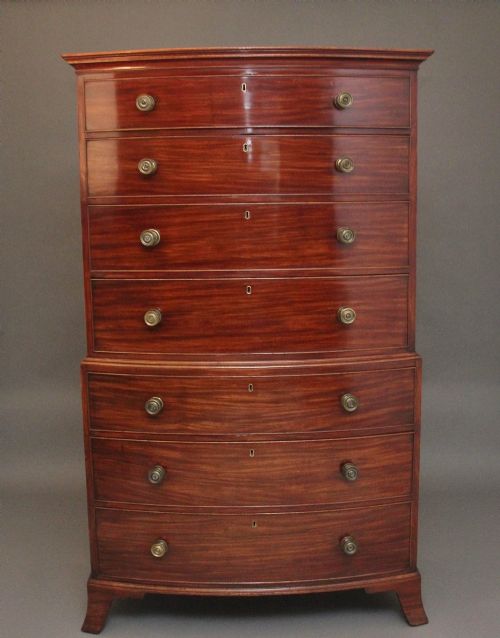
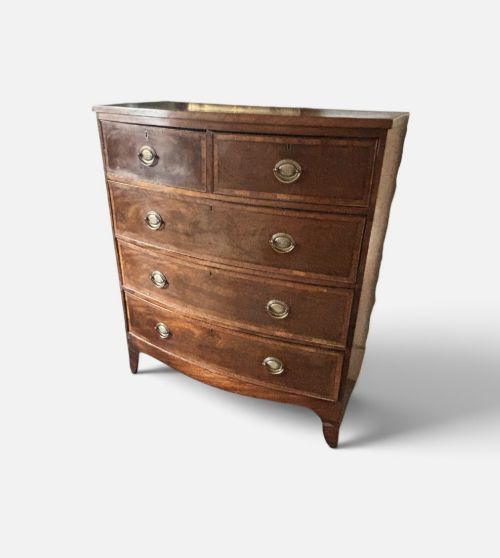
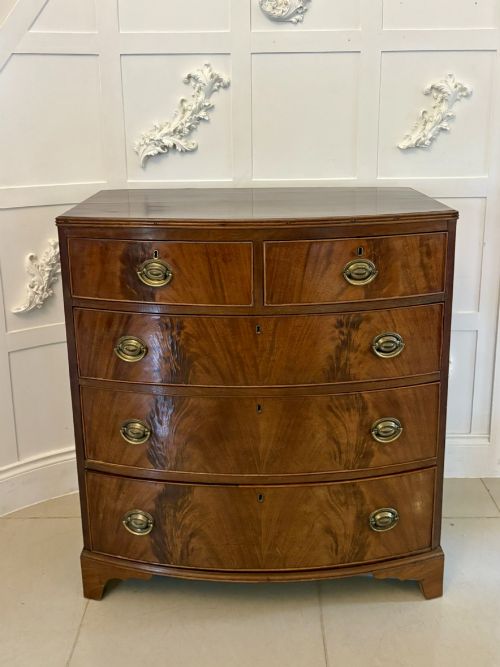
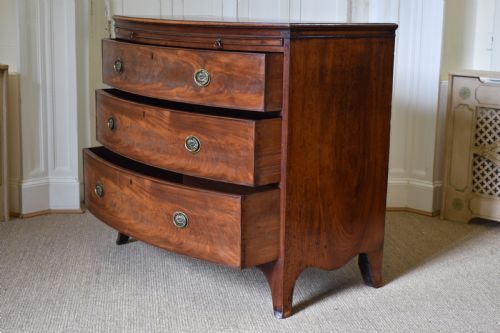
Bowed Mahogany Chest
A bowed mahogany chest combines the generous storage of a traditional drawer set with the elegant curve of a rounded front.
Bowed Mahogany Chest
A bowed mahogany chest is primarily encountered as a chest of drawers spanning the Georgian, Regency, and Victorian periods. Buyers search for this phrase to find case furniture that softens a room's geometry through a curved front facade.
The selection ranges from full-scale Georgian and Regency models down to small bedside cabinets, dressing tables, and miniature furniture. Most examples date from the eighteenth and nineteenth centuries, constructed with multiple graduated drawers.
Regional variations include Scottish and Welsh pieces, alongside occasional sideboards and tallboys. The recurring form is a case piece raised on bracket feet or short legs, featuring the characteristic convex curve across the drawer fronts.
Materials and construction
Makers built these pieces using solid mahogany and pine for the primary and secondary framing. Surfaces often display figured mahogany or flame mahogany veneer, selected for rich grain patterns.
Satinwood banding and crossbanding frequently accent the drawer edges and top surfaces, paired with brass hardware for handles and escutcheons. Cabinetmakers shaped the carcase timbers to achieve the signature bow front.
Several chests hide secret drawers tucked away behind the main mouldings, built for stashing small valuables out of sight.
Distinctions in quality
Quality rests in the selection of timber veneers and the precision of the curved drawer construction. Pieces utilising matched flame mahogany or delicate satinwood stringing demonstrate superior craftsmanship.
The handling of secondary woods like pine inside the drawer linings and the crispness of the cockbeading around the drawer edges separate utilitarian items from finer Georgian and Regency examples.
The Bowed Mahogany Chest Glossary
- Bow front
- A convex curved front on a piece of furniture that projects outward in an arc. This shape defines the primary profile of these chests.
- Flame mahogany
- Timber veneer cut from the branch forks of the mahogany tree to create a distinctive flickering flame pattern. It appears on finer Regency and Georgian pieces.
- Crossbanding
- A narrow strip of veneer laid across the grain of the primary surface to form a decorative border. Satinwood is frequently used for this purpose.
- Graduated drawers
- A series of drawers that decrease in depth from the bottom to the top of the chest. This proportioning creates visual balance.
- Brushing slide
- A pull-out shelf integrated above the top drawer for folding clothes or writing. This feature occurs on selected Georgian examples.
Bowed Mahogany Chest: Frequently Asked Questions
How do I date a bow front chest?
Dating relies on stylistic details, timber choices, and construction methods. Georgian and Regency pieces typically show hand-dovetailed drawer linings and simpler bracket feet, while Victorian examples often feature heavier proportions and different internal framing.
Secondary woods like pine and the presence of satinwood banding also help narrow the period. Examining the drawer construction reveals the working methods of the era in which the cabinetmaker operated.
Where were these chests placed originally?
These pieces served primarily in bedrooms and dressing rooms for storing garments and linens. Smaller variants functioned as bedside cabinets or compact dressing chests.
Their decorative fronts also suited them for placement in hallways and reception rooms where storage met a formal aesthetic.
What is flame mahogany?
Flame mahogany is a decorative wood veneer harvested from the junction where branches meet the main trunk. The grain catches the light with a distinctive swirling pattern.
Cabinetmakers applied this veneer to the most prominent surfaces of high-status furniture during the Georgian and Regency periods.
Are all bow front chests Georgian?
While many examples originate in the Georgian and Regency periods, production continued through the Victorian era and into the early twentieth century. Edwardian workshops and later makers produced both full-sized chests and miniature furniture in this style.
Checking the construction timbers and secondary woods clarifies whether a piece belongs to the eighteenth century or a later revival.