




Bow Front Side Cabinet
A bow front side cabinet offers a curved profile that softens a room while providing useful storage in mahogany, satinwood, or burr walnut.
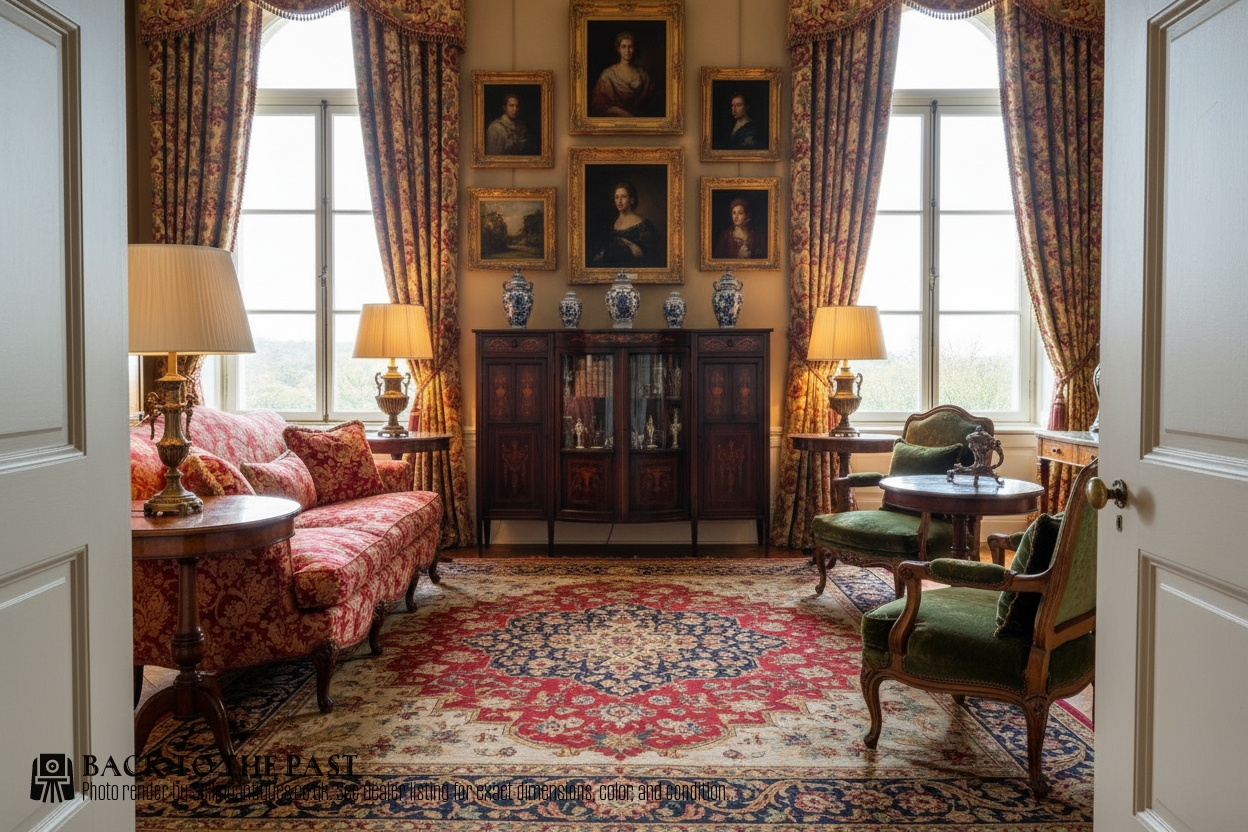
Bow Front Side Cabinet
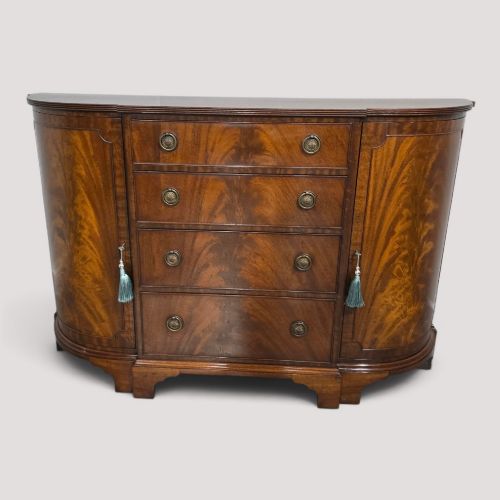
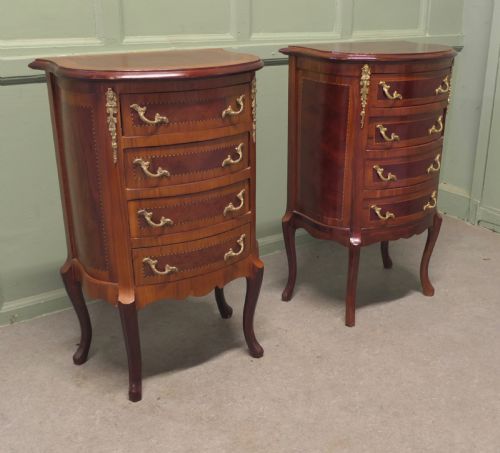
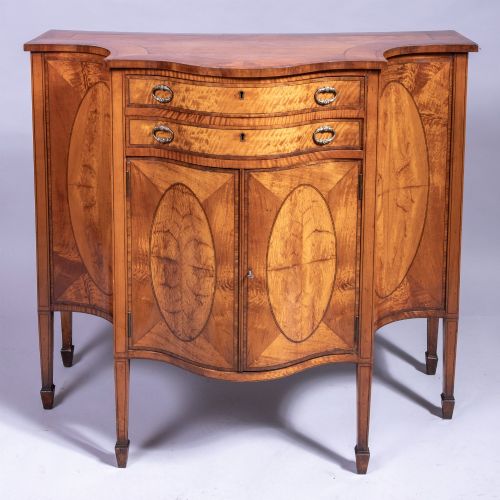
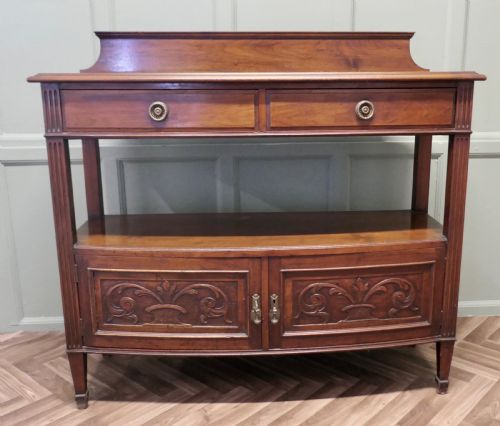
A bow front side cabinet provides compact or substantial storage with a characteristic convex curved front that defines its aesthetic. The selection encompasses smaller bedside cupboards alongside larger sideboard forms originating from the Georgian period through to the early twentieth century.
Makers and manufacturers produced these pieces in varied formats including sideboards, commodes, and narrow display cabinets. Mahogany and burr walnut dominate the pieces seen, often enriched with marquetry, inlay, or painted decoration reflecting Sheraton Revival and Edwardian tastes.
How They Were Made
Cabinetmakers constructed the curved carcasses using solid and veneered timbers such as flame mahogany, satinwood, and burr walnut over secondary woods. Bending timber to form a consistent bow shape required precise carpentry, often supplemented by shaped blocking and dovetailed drawer construction.
Surface ornamentation involved intricate crossbanding, stringing, and marquetry panels, alongside hand-painting or gilt mounts on continental and revival pieces. Brass handles, escutcheons, and occasional marble tops completed the construction of these decorative storage items.
Listings span multiple periods from the eighteenth to the mid-twentieth century, with mahogany and burr walnut as the predominant materials.
What Varies in Quality
The choice of timber veneer dictates much of the visual impact, with deeply figured flame mahogany or richly patterned burr walnut marking the higher end of production. Subtlety and precision in the hand-cut inlay, stringing, and marquetry distinguish finer workshops from simpler commercial outputs.
Structural integrity is evident in the alignment of the curved doors and drawers within their frames, alongside the quality of internal carpentry and original brass hardware. Pieces retaining matching pairs or bearing maker attribution demonstrate greater desirability among collectors.
Edwards and Roberts·Gillows
The Bow Front Side Cabinet Glossary
- Bow front
- A convex curved cabinet front that projects outward in an arc. This shape gained popularity during the Georgian era and returned in later revival styles.
- Satinwood
- A dense, lustrous timber with a yellowish colour often used as a fine veneer. It provided a pale canvas for painted decoration and contrasting stringing.
- Marquetry
- Decorative patterns formed by fitting together small pieces of veneer into wooden panels. It often depicts floral or neoclassical motifs on cabinet doors.
- Crossbanding
- A border of veneer laid with the grain running perpendicular to the central panel. This technique frames the top or drawer fronts of better cabinets.
- Commode
- A low cabinet or chest of drawers, frequently with a decorative French or serpentine influence. The term appears across continental and English furniture listings.
Bow Front Side Cabinet: Frequently Asked Questions
What is a bow front side cabinet?
A bow front side cabinet is a storage piece featuring a rounded, convex front facade. These items serve as functional furniture in bedrooms, living rooms, or hallways.
They appear in various timber finishes and stylistic revivals spanning the eighteenth to the twentieth centuries.
Where were these cabinets placed?
Smaller versions function as bedside cupboards or lamp tables to hold nighttime essentials. Larger formats act as sideboards or display units in dining rooms and drawing rooms.
Their curved profiles allow them to occupy corners or narrow spaces without sharp projecting corners.
How do I identify a revival piece?
Sheraton Revival and Queen Anne Revival pieces emulate earlier Georgian aesthetics using late nineteenth or early twentieth-century manufacturing techniques. Examination of secondary woods, interior linings, and construction hardware helps determine the true age.
Inlaid satinwood and burr walnut frequently characterise these later revival interpretations.
What woods were commonly used?
Mahogany remains the primary timber found in these listings, appearing in plain, figured, and flame varieties. Burr walnut and satinwood also feature prominently, often enhanced by contrasting stringing and marquetry.
Occasional examples incorporate marble tops, gilt bronze mounts, or painted surface details.