
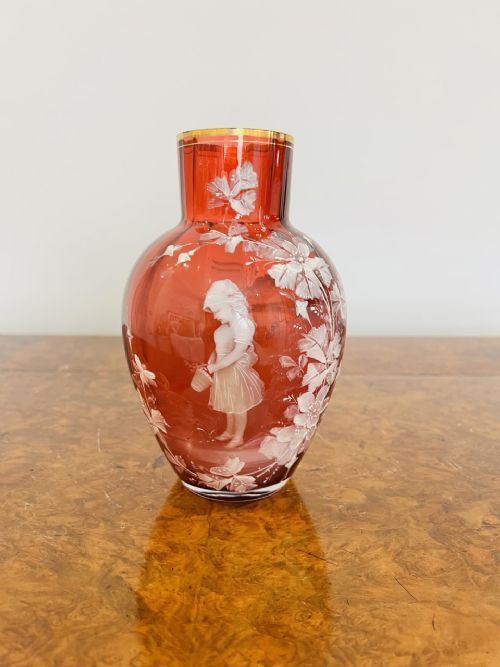


Bohemian Red Glass Vase
A bohemian red glass vase catches the light with deep crimson and ruby tones, offering a striking centrepiece for any room.
Bohemian Red Glass Vase
A bohemian red glass vase draws the eye with its rich ruby hue and decorative presence, making it a distinct choice for collectors of coloured glassware. These decorative objects range from Victorian mantle lustres adorned with crystal drops to panelled ovoid vessels and geometric Art Deco designs.
The pieces available span from the Victorian era up to the nineteen-thirties, reflecting shifts in taste from elaborate ornamentation to cleaner geometric lines. Most examples date from the nineteenth century, often featuring rich red or cranberry tones combined with contrasting white enamel or gilt details.
Buyers encounter various forms including pairs of lustres, goblets, and standalone vases. Originating largely from Bohemian workshops, these items demonstrate the enduring appeal of Central European glassmaking traditions.
Production and materials
Master makers shaped these vessels using traditional glassblowing techniques, often employing flash glass methods to fuse a vibrant ruby layer over a clear or lighter glass body. This layered construction allowed artisans to cut through the outer red glass to reveal contrasting colours underneath.
Decoration often involved the application of gold leaf, gilt accents, and detailed white enamel painting, as seen in traditional Mary Gregory style motifs. Cut crystal elements and hanging prisms further enhanced the visual weight and reflective quality of the pieces.
Victorian mantle lustres doubled as sparkling room jewellery, catching every flicker of coal fire and candle flame.
Distinguishing quality
Quality rests in the depth and uniformity of the ruby colour, alongside the precision of any cut glass panels or overlaid work. Superior pieces display crisp facet cutting and cleanly applied enamel or gold leaf rather than hastily painted surface details.
The presence of matching pairs, intact crystal lustres with original drops, and crisp decorative motifs elevate a piece. Finer examples maintain crisp boundaries where the coloured overlay meets the clear glass base.
The Bohemian Red Glass Vase Glossary
- Ruby Glass
- A rich red glass coloured typically by the addition of gold or copper compounds during the melting process. This intense hue forms the foundational look of many nineteenth-century Bohemian pieces.
- Flash Glass
- A technique where a thin layer of coloured glass is fused over a base of clear or contrasting glass. Artisans cut away parts of this top layer to create complex two-tone patterns.
- Mary Gregory Glass
- Coloured glass decorated with white enamel silhouettes depicting children in natural settings. These scenes often feature woodland backdrops and delicate framing.
- Mantle Lustre
- A decorative vase fitted with hanging crystal prisms designed to catch and refract candlelight. These pieces usually stood on drawing room fireplaces during the Victorian period.
Bohemian Red Glass Vase: Frequently Asked Questions
How do I date a ruby glass vase?
Dating relies heavily on the stylistic clues of the period, such as Victorian aesthetic details or later Art Deco geometric forms. Examining the depth of the ruby glass and the type of enamel or gilt decoration also helps determine the era.
Nineteenth-century examples often feature heavier moulding and hand-painted white enamel work, whereas nineteen-thirties pieces tend towards opaque glass and streamlined shapes.
What is flash glass?
Flash glass consists of a clear or pale glass body coated with a very thin outer layer of intensely coloured glass. This method allowed makers to achieve deep red tones without making the entire vessel from heavy solid coloured glass.
Artisans could then grind or cut through the thin ruby layer to reveal the clear glass underneath, producing sharp contrast in patterns.
Where were these vases made?
Many of these decorative vessels originated in the Bohemia region of Central Europe, renowned for its skilled glass houses. Master craftsmen in this area pioneered various colouration and cutting techniques.
Production later spread and evolved into the twentieth century, incorporating Czech modernist designs alongside traditional Victorian styles.
How do I display a lustre vase?
Lustre vases look best placed where natural light can pass through the ruby glass and activate the hanging crystal prisms. Placing them on a mantlepiece or a well-lit cabinet shelf highlights their reflective qualities.
Ensure they sit on a stable surface away from busy household traffic to protect any hanging crystal drops from accidental knocks.