

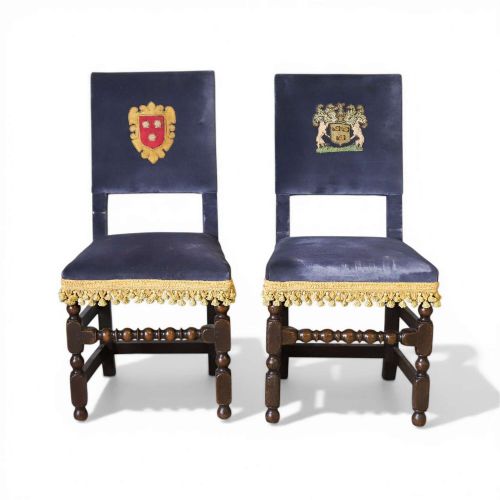
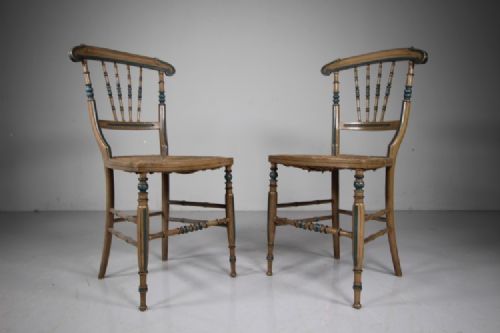


Bobbin Turned Hall Chair
These bobbin turned hall chair pieces offer robust turned framing and timber substance, combining functional seating with distinct profile work.
Bobbin Turned Hall Chair
A bobbin turned hall chair brings structural turned woodwork into domestic interiors, utilising spindle-moulded framing. The pieces appearing here span from the 17th century through the Victorian era and the Regency period.
Buyers encounter regional forms like South Yorkshire and Lancashire backstools, alongside later rosewood interpretations and walnut Gothic Revival armchairs. Oak forms the primary timber backbone for the earlier centuries.
Both side chairs and armchairs populate this grouping, some featuring cane seating, velvet upholstery, or painted and decorated surfaces.
Materials and construction
Makers shaped structural components primarily from solid oak and rosewood, applying lathe-turned bobbin profiles to legs, stretchers, and uprights. Walnut also appears in later Gothic Revival armchairs.
Seating areas incorporate woven cane inserts or padded squabs covered in fabric and velvet, sometimes trimmed with metallic fringe. Brass elements and painted finishes complete specific decorative schemes.
Bobbin Turned Hall Chair Retail Price Guide 2026
Typical asking prices for bobbin turned hall chair among the pieces listed under this phrase on Sellingantiques today, from the lower quarter to the upper quarter. They describe what is for sale here now, not the wider market.
Some chairs bear clan crests, suggesting ancestors took heraldry very seriously while sitting down.
Judging quality in turned seating
Quality rests upon the crispness of the bobbin turnings and the structural integrity of the joined framing. Uniformity in the lathe work distinguishes finer workshops from more basic production.
The choice of primary timber and the survival of original surface treatments dictate the standing of an individual piece. Integration of upholstery materials like cane or velvet affects the overall coherence of the design.
Liberty and Co
The Bobbin Turned Hall Chair Glossary
- Bobbin turning
- A form of lathe turning that produces a series of rounded, spool-like shapes along the length of a wooden shaft. This technique defines the visual rhythm of the framing.
- Backstool
- An early form of seating without arms, essentially an upholstered or panelled stool fitted with a vertical backrest. These pieces often originate from regional English workshops.
- Cane
- Woven rattan material used to form resilient seat panels or back panels. It offers lightweight flexibility within a rigid wooden frame.
- Armorial
- Bearing heraldic crests or armorial bearings, frequently carved into wooden panels or embroidered onto upholstery. This indicates association with specific families or clans.
Bobbin Turned Hall Chair: Frequently Asked Questions
What is a bobbin turned hall chair?
A bobbin turned hall chair is a seating piece characterised by spool-moulded wooden turnings along its structural framing. These chairs appear in various timbers and periods, serving functional and decorative roles.
Examples range from early joined oak backstools to later rosewood and walnut variations equipped with cane or upholstered seats.
How were these chairs used historically?
Historically, such chairs occupied entrance halls, corridors, and reception rooms where durable seating was required. Their decorative turned profiles provided visual interest in public areas of a home.
Armchairs and side chairs accommodated guests and family members, often displaying regional styles or heraldic motifs.
How do I identify a 17th century piece?
Seventeenth-century pieces typically feature joined oak construction, heavy timber framing, and regional characteristics associated with areas like South Yorkshire or Lancashire. Surface wear and construction joints reflect early hand-tool methods.
Later Victorian interpretations often utilise rosewood or walnut, adopting Gothic Revival or Moorish Revival stylistic elements rather than seventeenth-century vernacular forms.
How should I care for antique turned wood?
Antique turned wood benefits from stable indoor humidity and protection from direct sunlight to prevent timber drying and splitting. Regular dusting with a soft, dry cloth preserves the finish.
Upholstery elements and cane seats require gentle handling, avoiding harsh cleaning agents that could damage natural fibres or painted surfaces.