
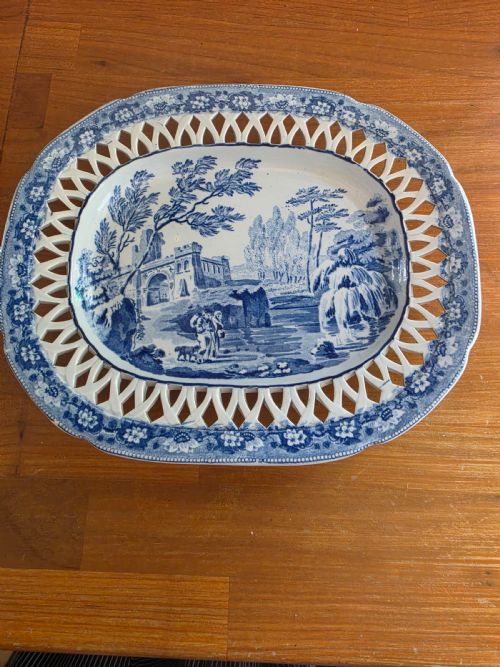
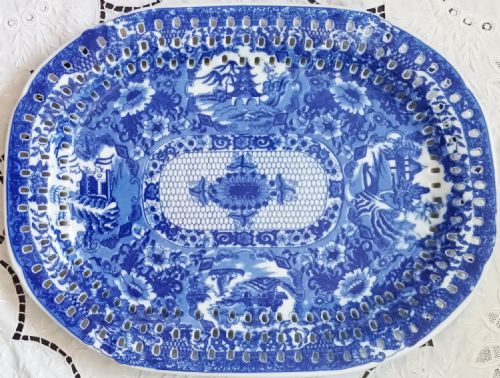


Blue White Pearlware Platter
A blue white pearlware platter brings crisp cobalt decoration and substantial earthenware form to the table, offering a durable centrepiece for historic dining.
Blue White Pearlware Platter
A blue white pearlware platter is a ceramic serving dish shaped as a platter, tray, or serving dish, originating primarily in the Georgian and 19th Century periods. These pieces often display transfer-printed designs in cobalt pigment upon an earthenware body with a characteristic bluish glaze.
The selection on this page centres on English country and Chinoiserie styles, featuring patterns such as the Willow pattern, net patterns, and pictorial views. Forms range from standard serving platters to pieces incorporating reservoirs and pierced elements for culinary use.
Most examples date from the Regency era through to the early Victorian period, reflecting the height of Staffordshire pottery production. Buyers meet large serving dishes alongside smaller stands and chargers intended for substantial household hospitality.
Evaluating quality in blue white pearlware platter examples
Quality rests upon the clarity and crispness of the cobalt transfer print against the underlying pearlware glaze. Sharp registration in detailed pictorial scenes distinguishes superior examples from those with blurred or smudged printing.
The structural complexity of the piece also dictates standing, particularly where pierced borders, intricate net patterns, or functional reservoirs are integrated into the earthenware body. Well-preserved glazes with minimal crazing and even colour distribution represent the upper tier of surviving items.
Some platters include clever built-in gutters to trap the Sunday roast gravy before it escapes onto the parlour tablecloth.
Davenport·Thomas Lakin·Brameld and Co·John Rogers and Son·Spode
The Blue White Pearlware Platter Glossary
- Pearlware
- A refined earthenware developed in the late 18th century featuring a white or bluish-tinted glaze designed to imitate Chinese porcelain. This body forms the foundation of many early 19th century serving vessels.
- Transfer printing
- A decoration technique utilising a paper impression from an engraved copper plate to transfer complex blue designs onto ceramic ware. This method allowed intricate pictorial patterns to be applied efficiently across multiple pieces.
- Cobalt pigment
- The metallic oxide used to produce the deep blue colour seen in transfer-printed ceramics. It withstands high firing temperatures without losing its vivid tone.
- Reservoir
- A recessed channel or well integrated into the surface of a serving platter to catch juices during meat carving. This functional addition appears on larger dining pieces from the 19th century.
- Chinoiserie
- A European artistic style reflecting Chinese motifs and landscapes, frequently adapted by English potteries. This style dominates many early transfer-printed platters and dishes.
Blue White Pearlware Platter: Frequently Asked Questions
How do I date a blue white pearlware platter?
Dating relies on stylistic clues, glaze characteristics, and potter marks found on the underside of the earthenware body. Earlier pieces often display the distinct bluish tint characteristic of pearlware development around eighteen hundred, while later examples transition toward heavier ironstone.
Maker marks and specific transfer pattern names also provide a reliable window of production, particularly for pieces originating from prominent Staffordshire potteries during the Regency period.
How should I clean my antique platter?
Careful washing in warm water with mild detergent preserves the delicate glaze and historical earthenware body. Avoid automated dishwashers and harsh scrubbing agents that can damage the historical cobalt transfer print.
Patina and fine glaze crazing accumulated over centuries require gentle handling to maintain the structural integrity of the ceramic surface.
What is the difference between pearlware and ironstone?
Pearlware utilises a refined earthenware recipe paired with a blue-tinted glaze intended to mimic Chinese porcelain aesthetics. It tends to appear on pieces from the late 18th and early 19th centuries.
Ironstone, developed later in the 19th century, provides a denser, more vitrified body designed for maximum durability against heavy daily kitchen and dining use.
Can I hang a heavy ceramic platter on the wall?
Displaying large platters securely requires specialist wall fixings that distribute the weight evenly across the entire earthenware base. Spring-loaded hangers must fit the rim dimensions precisely without putting undue pressure on the antique ceramic material.
Ensuring the wall anchor fastens directly into solid masonry or a stud prevents accidental displacement of heavy serving dishes.