
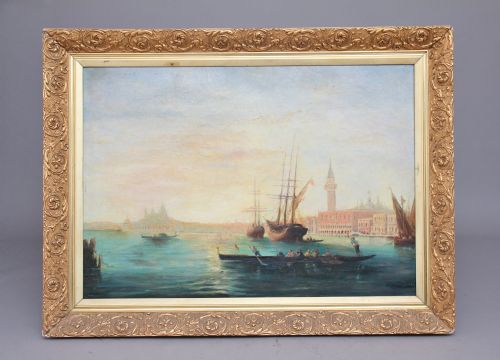


Blue Venetian Landscape Art
Blue venetian landscape art captures the watery light and iconic architecture of Italy through historic paintings and watercolours.
Blue Venetian Landscape Art
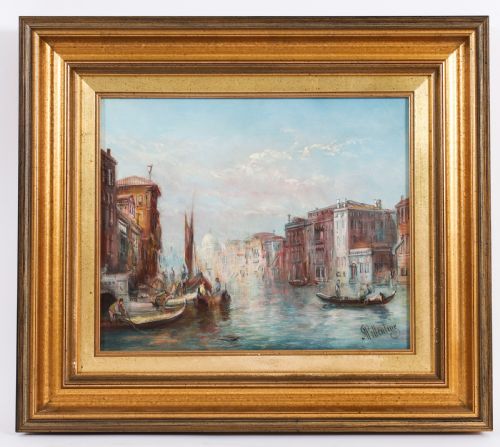
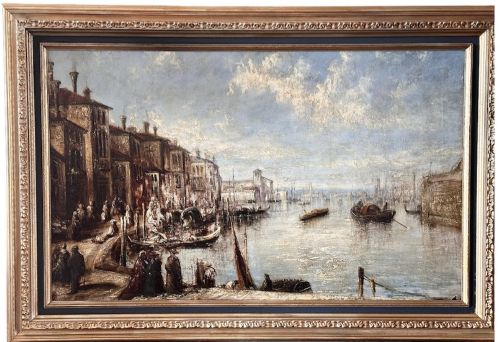
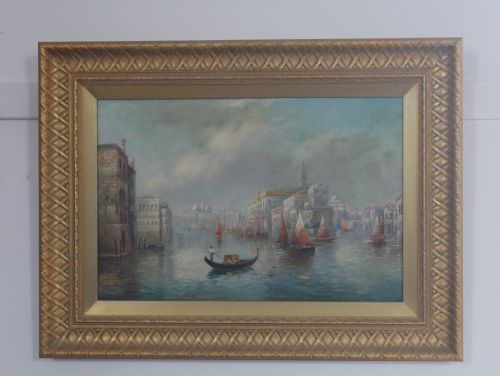
Blue venetian landscape art encompasses paintings and watercolours depicting the Grand Canal, the Venetian lagoon, and historic palazzos. These works range from the nineteenth century into the mid-twentieth century, capturing the shifting light over the water.
The pieces on this page are predominantly oil paintings on canvas and paper-based watercolours. They record celebrated cityscapes including the Doge's Palace, Santa Maria della Salute, and the Bridge of Sighs.
Materials and technique
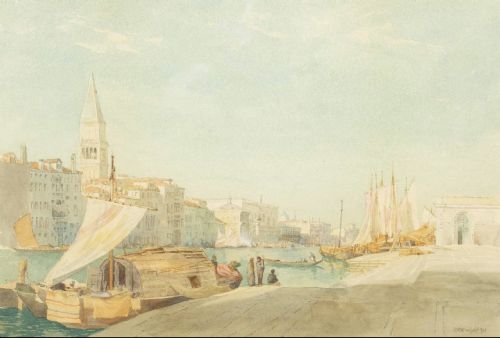
Artists deployed oil paint upon canvas, board, and wood panels to build rich layers of blue pigment across expansive skies and shimmering canals. Watercolour pigment applied to paper captures a lighter, translucent atmospheric quality.
Framing often involves gilded wood to enclose the canvas or watercolours, providing a traditional border that complements the period aesthetic of these Italian scenes.
Gondolieri persist in silently ferrying passengers under stone bridges across every single decade represented here.
Distinctions in quality
Quality rests in the artist's handling of perspective, water reflection, and the distinct blue tones of the lagoon. Works by established named painters demonstrate superior draughtsmanship in rendering complex architectural forms like palazzos and bridges.
The preservation of the canvas or paper surface, alongside the depth of the pigment used for the water and sky, marks the difference between standard topographical records and compelling fine art.
Alfred Pollentine·Francis Moltino·Antonietta Brandeis·William Raymond Dommersen·Frank Wasley·David Law·George Stanfield Walters·Wilfred Knox
The Blue Venetian Landscape Art Glossary
- Lagoon
- The shallow body of water separated from the Adriatic Sea by land spits, surrounding the city of Venice. It provides the signature expanse of blue in these landscapes.
- Palazzo
- A grand residential building or palace in Italy, frequently positioned along the canals in these compositions. Their facades feature prominently in nineteenth-century cityscapes.
- Watercolour
- A painting method where fine pigment is suspended in a water-based solution on paper. It yields transparent washes ideal for capturing airy skies.
- Gilded wood
- Timber treated with gold leaf or a gold-coloured finish to form a decorative frame. This surrounds many of the oil paintings on this page.
Blue Venetian Landscape Art: Frequently Asked Questions
What periods do these pieces span?
The works originate largely from the Victorian era and the nineteenth century, extending through the early twentieth century up to nineteen-sixty.
This broad timeline demonstrates how artists continually returned to the same Venetian canals and lagoons across successive generations.
What is the difference between oils and watercolours here?
Oils utilise heavy pigment on canvas or board to build rich textures and deep blue tones of the water and sky.
Watercolours rely on pigment washes on paper to achieve a lighter, more luminous impression of the Venetian atmosphere.
Which specific views appear most often?
Compositions frequently centre on the Grand Canal, Santa Maria della Salute, the Doge's Palace, and the Giudecca Canal.
Artists also depicted the lagoon itself and gondolieri navigating beneath structures like the Bridge of Sighs.
How should I frame and display these?
Many oil paintings arrive in their original gilded wood frames, which suit the traditional aesthetic of the period.
Watercolours require protective glazing and mounting under glass on a wall sheltered from direct sunlight to preserve the pigment.