
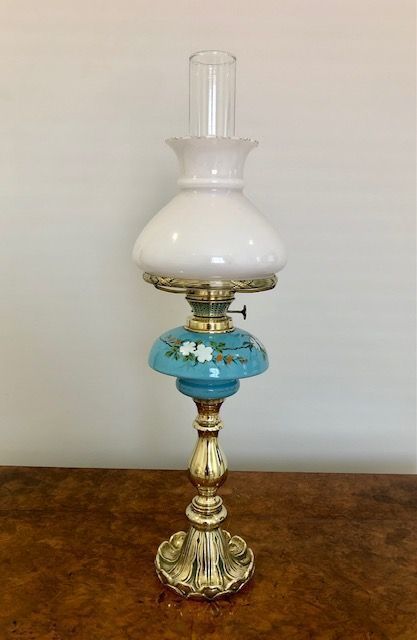


Blue Glass Paraffin Light
A blue glass paraffin light brings brilliant Victorian colour to a room, offering a warm and functional piece of history for your home.
Blue Glass Paraffin Light
A blue glass paraffin light is a form of Victorian oil lamp that combines a vibrant coloured glass font with brass, ceramic, or glass structural elements. These domestic lighting pieces range from simple table models to wall-mounted bracket fixtures designed to illuminate interior spaces before the widespread adoption of electricity.
The versions most commonly met on this page date from the late nineteenth century, spanning the Victorian and Edwardian eras. They typically feature moulded glass reservoirs paired with embossed brass collars, decorative bases, and occasionally matching glass shades.
Makers and manufacturers during this period produced various configurations, including table lamps with terrestrial globes and wall lamps fitted with functional metal brackets. The combination of colourful glass and sturdy metalwork defines the enduring appeal of these antique lighting items.
Materials and construction
Makers constructed these lamps by combining pressed or moulded glass fonts with brass components, ceramic elements, and occasionally cast iron or black glass bases. The coloured glass reservoirs were shaped using moulds to achieve patterned textures, while brass provided durable collars, burners, and wall brackets.
Current listings feature nineteenth-century and early twentieth-century pieces, spanning the Victorian and Edwardian periods with brass, ceramic, and glass materials.
Judging quality and workmanship
Quality in a blue glass paraffin light rests on the crispness of the moulded glass details and the substantial weight of the brass components. Better examples feature richly saturated glass colours and finely embossed metalwork that remains crisp and well-defined.
The integration of the various materials determines the overall cohesion of the piece, where heavier brass bases and matching original shades elevate the construction. Finer lamps demonstrate careful assembly between the glass font, the metal collar, and the support structure.
Hinks
The Blue Glass Paraffin Light Glossary
- Font
- The reservoir that holds the paraffin or oil, typically made from coloured or moulded glass in these pieces.
- Burner
- The metal mechanism mounted at the top of the font that regulates the wick and flame.
- Bracket
- A metal wall-mounting arm that holds certain oil lamps securely off the table surface.
- Globe shade
- A rounded glass shade designed to enclose the flame and diffuse the light across the room.
- Opaline glass
- An opaque or translucent pale glass used in the production of Victorian lighting components.
Blue Glass Paraffin Light: Frequently Asked Questions
How do I date a blue glass paraffin light?
You can date these pieces by examining the construction methods of the brass burners, the style of the base, and the characteristics of the glass moulding. Victorian and Edwardian examples often feature specific patent burners and aesthetic traits typical of the late nineteenth century.
Comparing the manufacturing marks on the metal mechanisms alongside the overall design helps place the lamp within its correct decade, from the eighteen-sixties through to nineteen hundred.
Were these lamps used on tables or walls?
These lighting pieces were produced in multiple configurations to suit different rooms within a Victorian home. Table models stood independently on heavy bases, while bracket-mounted versions attached securely to walls for targeted illumination.
Each style served a practical purpose in domestic spaces, allowing homeowners to place the light wherever it was most needed before electric lighting became common.
Can I still burn paraffin in these lamps?
While these items were originally engineered to burn paraffin for daily illumination, modern owners typically treat them as decorative antiques. Using them safely requires a thorough inspection of the burner mechanism and the glass font for any hairline fractures.
Many collectors prefer to preserve the lamps in their original, unlit state to protect the antique glass and metal components from heat damage.
What is a terrestrial globe shade?
A terrestrial globe shade is a spherical glass cover shaped to resemble a map or featuring decorative globe patterns, designed to fit over the top of an oil lamp. These shades served to soften the brightness of the flame while adding a decorative element to the lamp.
Finding a lamp complete with its original matching shade is a notable aspect of these nineteenth-century lighting pieces.