


Black Writing Desk Drawers
These black writing desk drawers bring dark timber, ebonised surfaces, and painted finishes straight into a room for practical use.
Black Writing Desk Drawers
When you search for black writing desk drawers, you encounter a selection of historic furniture forms designed for paperwork and storage. The pieces meeting this description span the eighteenth, nineteenth, and early twentieth centuries, capturing shifts in domestic workspace design.
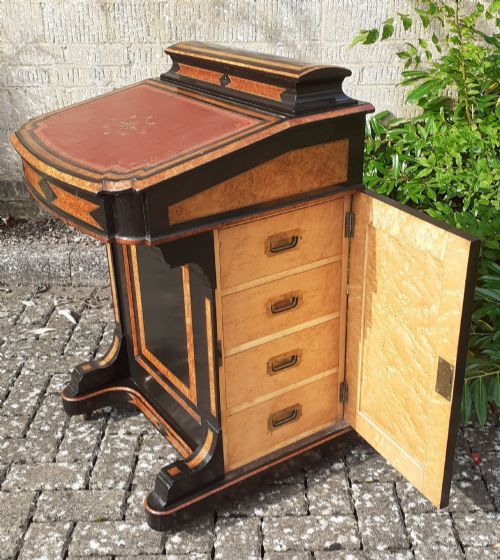
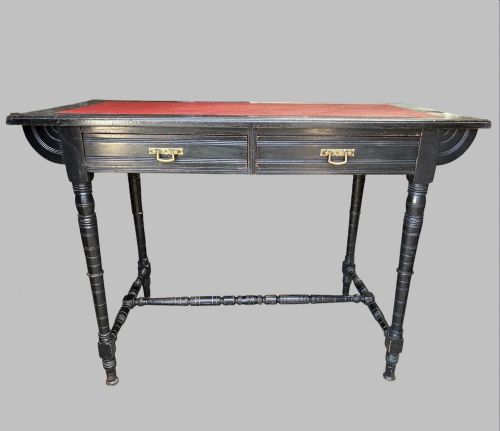
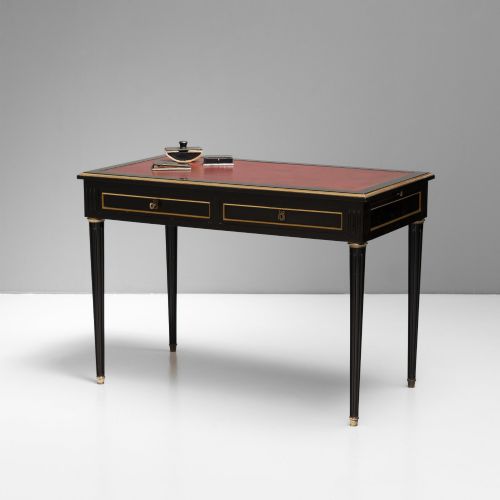
The objects take several distinct shapes on this page, ranging from Davenport desks and kneehole tables to bureaux and pedestal office desks. Many feature integrated drawer compartments alongside writing surfaces finished in leather or polished wood.
Origins vary across English country workshops and international revival styles, including Louis XVI and Empire influences. You will frequently find ebonised finishes, hand-painted geometric tops, and lacquered surfaces defining the visual character of these items.
Materials and construction methods
Maker construction relies heavily on solid timbers such as oak, mahogany, and amboyna, often treated with ebonised finishes or dark paint to achieve the desired tone. Brass hardware frequently appears on drawer pulls and handles, adding functional contrast to the dark wood.
Writing surfaces are frequently inset with leather panels, while decorative examples incorporate hand-painted geometric details or lacquered finishes. Cabinetmakers joined these elements using traditional dovetail joints for the drawers and sturdy mortise and tenon frames for the main bodies.
Some desks hide secret compartments inside the drawer stacks for keeping private letters away from prying eyes.
Distinguishing quality across pieces
The refinement of the timber preparation and the crispness of applied ebonising set finer examples apart from simpler utilitarian pieces. Superior items display well-figured woods beneath dark finishes and precise hand-painted or lacquered motifs.
Interior construction reveals the maker's hand through neatly dovetailed drawer boxes that run smoothly within their housings. The integration of original brass fittings and intact leather writing inserts further elevates the status of a desk.
The Black Writing Desk Drawers Glossary
- Ebonised wood
- Timber treated with a dark finish to imitate expensive ebony. This technique was popular during the Victorian period for achieving a formal black surface.
- Davenport desk
- A compact writing desk featuring a sloping top and drawers opening to the side. It provides a functional workspace with built-in storage.
- Kneehole desk
- A table or desk with a central recess for the user's legs, flanked by pedestals of drawers. This form became standard for domestic and office use in the eighteenth and nineteenth centuries.
- Bureau
- A desk featuring a sloping fall-front that opens to reveal a fitted interior of small drawers and pigeonholes. It combines storage capacity with a concealed writing surface.
Black Writing Desk Drawers: Frequently Asked Questions
What periods do these desks cover?
The items span from the eighteenth century through the Victorian era and into twentieth-century revivals. You will find pieces reflecting Georgian proportions, Victorian ebonising, and later Art Deco or Empire styles.
Dates range from the 1700s up to the 1940s, capturing diverse cabinet-making traditions across different centuries and design movements.
How were these drawers used historically?
These desks served as private workspaces for correspondence, record-keeping, and estate management. The built-in drawers held stationery, inkwells, and important documents.
In domestic settings, they provided a dedicated surface for writing letters, while pedestal versions functioned as early office desks for professional administration.
How do I care for ebonised surfaces?
Maintain ebonised wood by dusting gently with a dry, soft cloth to prevent abrasive particles from scratching the dark finish. Avoid placing the furniture in direct sunlight or near heat sources to protect the wood from drying out.
Apply professional furniture wax sparingly only when the finish appears dry, buffing gently to maintain a soft sheen without building up excess residue.
Are the leather writing surfaces original?
Leather inserts vary in age, with some pieces retaining their historic hide surfaces while others have received careful replacement over time. Inspect the texture and wear patterns to understand the history of the writing surface.
Original leather often shows authentic signs of age and use, whereas modern replacements tend to present a more uniform appearance and colour.