
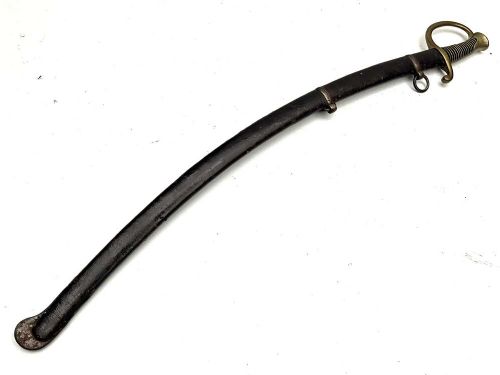
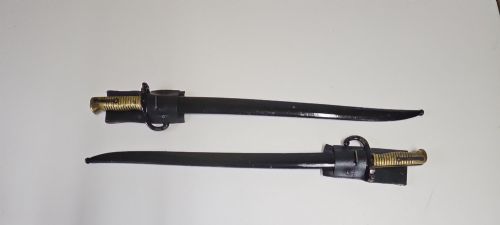
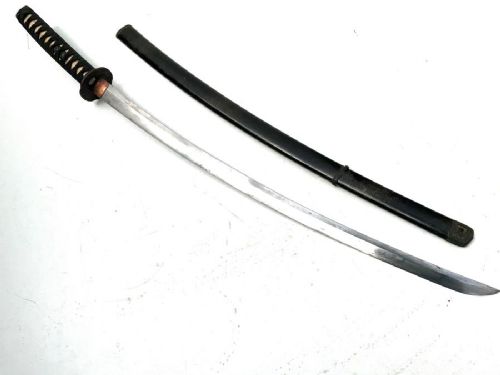
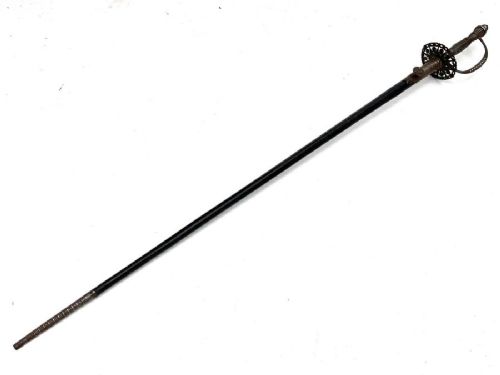


Black Steel Scabbard
These black steel scabbard examples protect historic edged weapons from centuries of military service, offering collectors solid historical edge and durability.
Black Steel Scabbard
A black steel scabbard houses military swords, bayonets, and daggers from periods spanning the sixteenth century through the mid-twentieth century. Buyers searching this phrase examine protective housings paired with edged weapons used across European and Japanese military campaigns.
The selections on this page most commonly feature nineteenth-century military patterns alongside earlier Japanese tachi swords and twentieth-century commando knives. Each piece demonstrates the utilitarian function required by cavalry troopers, infantrymen, and officers in the field.
Materials and construction
Makers formed these protective sheaths primarily from robust steel and carbon steel, often incorporating iron and brass fittings for reinforcement and suspension mounts. Leather and wood occasionally lined or wrapped the construction depending on the military specification and period.
Blackening treatments or dark finishes protected the base metal from corrosion during active service while reducing unwanted battlefield reflections. Workshops matched each scabbard precisely to the curvature and length of its corresponding blade.
Listings feature items spanning the 16th century, 1700, 1750, 1800, Victorian, 1850, and 1940 periods.
Judging quality and condition
Quality rests in the structural integrity of the metal housing, the crispness of any maker markings, and the snugness of the fit when the blade is sheathed. Superior examples retain their original surface finish without extensive pitting or structural distortion.
The balance between the protective scabbard and the weapon it holds dictates overall desirability. Pieces showing honest service wear without severe modification command greater appreciation among serious military historians.
H Wilkinson
The Black Steel Scabbard Glossary
- Scabbard
- A protective sheath for a sword, dagger, or bayonet. It is traditionally constructed from steel, leather, or wood.
- Tachi
- A traditional Japanese sword that is longer than a katana and worn suspended edge-down from the waist. These pieces date back to earlier feudal periods.
- Sabre
- A backsword with a curved blade intended primarily for slashing cavalry attacks. 19th-century patterns frequently utilise heavy steel housings.
- Bayonet
- A solid blade designed to fit onto the muzzle of a rifle for close combat. Examples often accompany standard infantry sidearms.
- Pattern
- An official military design specification adopted by armed forces for uniform equipment. Collectors use these designations to date specific arms.
Black Steel Scabbard: Frequently Asked Questions
What is a black steel scabbard?
A black steel scabbard is a protective metal sheath designed to hold military swords, sabres, or daggers. The dark finish served to prevent corrosion and reduce glare during military operations.
These housings were issued to cavalry, infantry, and officers across various centuries. They ensure the preservation of the edged weapon stored inside.
How do I date a scabbard?
Dating relies on matching the specific pattern style, metal composition, and associated sword type to known military history records. Details such as mounting rings and overall geometry provide clues.
Makers occasionally stamped names or pattern years directly onto the metal components. Comparing these markings with documented military ordnance records confirms the era.
Are these scabbards original military issue?
The listings on this page comprise historic military pieces originating from active service eras ranging from the sixteenth century to World War II. They reflect standard equipment used by various global armed forces.
Each piece bears the distinct characteristics of period manufacturing techniques. Collectors evaluate these traits to verify authenticity against known historical counterparts.
How should I display a sword and scabbard?
Displaying these items requires stable wall mounts or horizontal cabinet supports that distribute the weight evenly along the blade and scabbard. Ensuring proper ventilation prevents moisture accumulation against the metal.
Keep pieces away from direct sunlight and fluctuating humidity to preserve the steel and any associated leather or wood elements. Regular light maintenance keeps the metal surfaces stable.