


Black Profile Miniature Painting
Black profile miniature painting captures likenesses in stark monochrome, offering collectors intimate historical portraits housed in miniature frames and jewellery.
Black Profile Miniature Painting
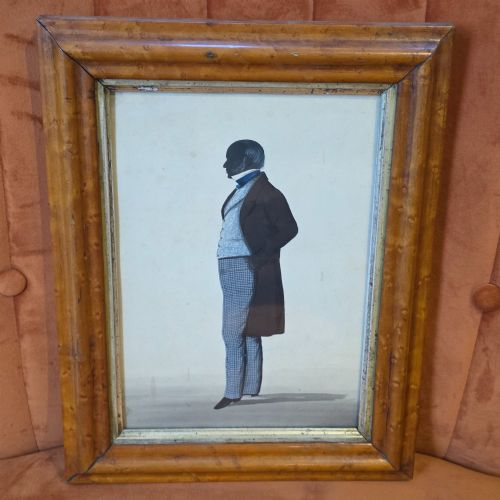
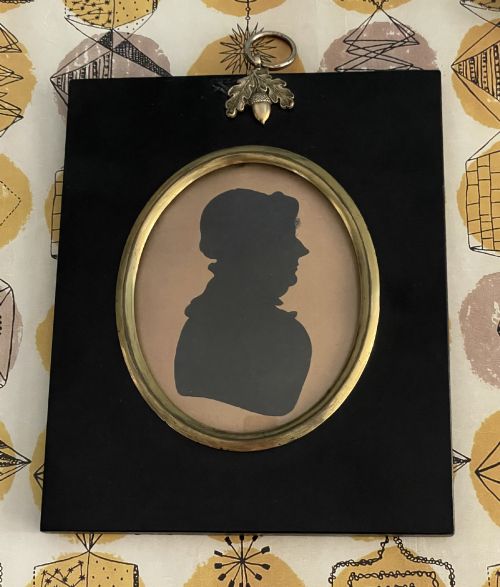
A black profile miniature painting presents a silhouette or dark profile portrait, often created as a personal keepsake or mourning piece. When you search for black profile miniature painting on this page, you encounter works spanning the Georgian, Regency, and Victorian periods.
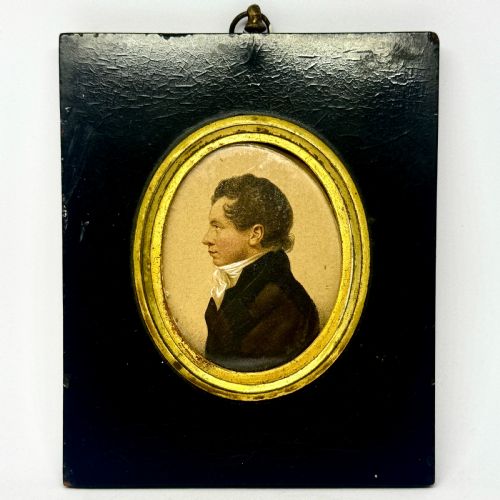
The pieces on this page take several forms, including framed wall art, miniature portraits, and jewellery pieces such as pendants. Most examples originate from the 18th century, the 19th century, and the Regency era, reflecting the height of profile portraiture popularity.
Makers such as John Miers dominate the traditional black profile form, whilst others worked in paint or reverse painting on glass. Buyers find full-length figures, bust portraits, and gilded silhouettes housed in ebonised wood or rosewood frames.
Materials and methods
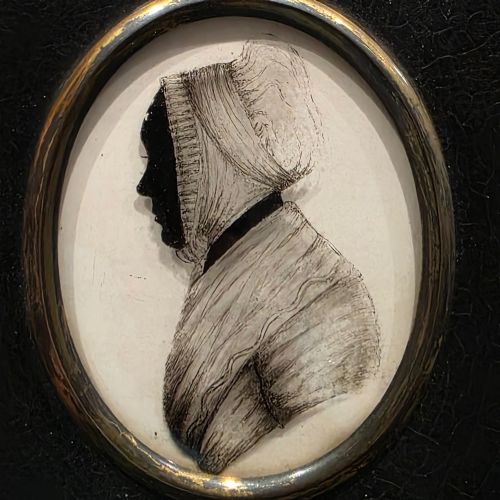
Artists worked on glass, paper, card, and plaster, applying ink or dark paint to create the sharp profile. Reverse painting on glass required precision, as the artist painted directly onto the reverse side of the glass pane to achieve a glossy finish.
Many silhouettes feature delicate added details in gold leaf, known as gilded highlights, to define hair ornaments, buttons, or lace collars. Framed works utilise ebonised wood or rosewood, whilst jewellery pieces incorporate brass, 18ct gold, pearl, and enamel.
Listings feature works executed on glass, paper, card, and plaster, reflecting the diverse experimental techniques of 18th-century and 19th-century profile artists.
Judging quality
Quality rests upon the crispness of the cutting or brushwork, the finesse of any added gilding, and the original state of the glass or paper support. Finer examples show precise anatomical observation in the profile line rather than generic outlines.
The survival of original framing, backing papers, and legible handwritten artist labels or provenance enhances the historical value of a piece. Lesser examples display blurred edges or later replacement frames that detach the work from its period context.
John Miers·J Deacon·John Smith of Edinburgh·Archibald Skirving·Frith
The Black Profile Miniature Painting Glossary
- Silhouette
- A portrait representation in profile, typically filled in solidly with a dark colour like black. The form gained widespread popularity in the 18th and 19th centuries before the invention of photography.
- Reverse painting on glass
- A technique where the artist paints on the back of a glass sheet so the image is viewed through the front. This imparts a deep gloss and protects the pigment from atmospheric damage.
- Ebonised wood
- Timber treated to imitate ebony, commonly used for dark framing. It provides the high-contrast border typical of profile miniature display.
- Gilded silhouette
- A black profile enhanced with applied gold leaf highlights. These details picked out jewellery, buttons, and hair ribbons with metallic brilliance.
- Portrait miniature
- A small-scale painting designed for private holding or personal wear. These works capture likenesses with microscopic precision using fine watercolours or oils.
Black Profile Miniature Painting: Frequently Asked Questions
What is a black profile miniature painting?
A black profile miniature painting is a small portrait showing a subject from the side, executed in dark ink, paint, or cut paper. These works capture the distinct facial outline of an individual with high contrast.
Created primarily during the Georgian, Regency, and Victorian eras, these miniature artworks served as portable likenesses of family members or friends before photography became common.
How do I identify a glass silhouette?
Glass silhouettes feature the portrait painted directly onto the glass panel, often with a light background showing through or a dark backing placed behind the glass to create depth. The smooth, reflective surface of the glass distinguishes these pieces from paper or card.
Many examples involve reverse painting, where the image appears glossy and protected behind the transparent pane. Examining the edges under magnification helps confirm the medium.
Where were these miniatures displayed?
Collectors originally hung these small works in tight clusters on parlour walls, often arranged in decorative brackets or symmetrical groupings. Their modest scale suited intimate domestic spaces.
Other examples take the form of pendant jewellery worn close to the body, allowing owners to keep the likeness of a loved one nearby throughout the day.
How are signed pieces identified?
Signed works often bear the handwritten signature, trade label, or blind stamp of the artist on the reverse of the frame or backing paper. Prominent profile artists like John Miers frequently applied trade labels detailing their studio addresses.
Such documentation provides secure attribution and helps date the piece accurately within the late 18th or early 19th century.