
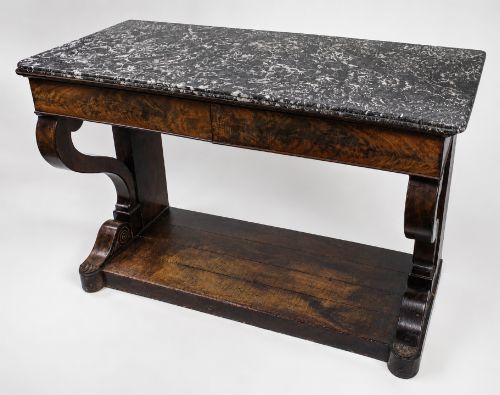


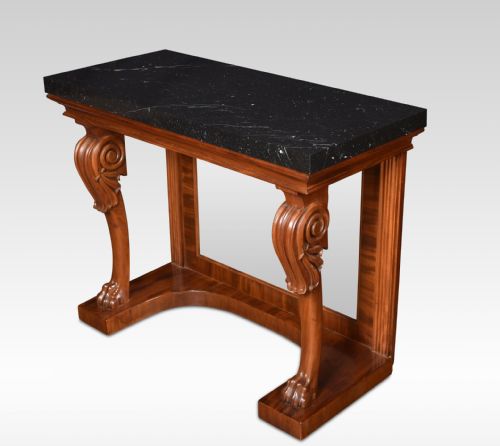


Black Marble Pier Table
A black marble pier table anchors a room with quiet mass, offering a cool surface and architectural weight.
Black Marble Pier Table
When you search for a black marble pier table, you look at console tables designed to stand against a wall, frequently bearing stone tops paired with wood or iron frames. The selections here span the nineteenth century and the Regency period, bringing together French, Swedish and English influences.
Most examples you meet on this page date from the nineteenth century, including Regency, French Empire and Charles X variants. They take the form of console tables, often featuring flame mahogany, satinwood, elm or painted and gilt timber beneath the stone surface.
What varies in quality
The distinction between ordinary and exceptional tables rests in the depth of the timber figuring and the precision of the joinery. Flame mahogany and satinwood veneers demand exact matching across the apron and legs.
Surface ornamentation introduces further variation, where hand-applied gilding, cast brass details or painted Chinoiserie motifs elevate the piece. The weight and finish of the stone top further separate standard workshops from ambitious cabinetmakers.
Listings here feature console tables spanning the nineteenth century, Regency era and nineteen-thirty, utilising marble, mahogany, wrought iron and brass.
The Black Marble Pier Table Glossary
- Console table
- A table designed to be fixed against a wall, frequently supported by two front legs and secured by brackets.
- Pier table
- A specific type of console table made to stand against the wall space between two windows.
- Flame mahogany
- A decorative mahogany veneer showing a distinctive flickering grain pattern resembling flames.
- Gilding
- The application of a thin layer of gold leaf or gold paint to a wooden or plaster surface.
Black Marble Pier Table: Frequently Asked Questions
Where do you place a pier table?
These tables belong against a flat wall, traditionally positioned in the architectural pier space between two tall windows.
In modern rooms, they work equally well in a hallway or living space where depth must remain minimal.
What is a console table used for?
Historically, console tables served to display decorative ornaments, clocks or porcelain figures without blocking interior traffic.
Today they provide a convenient surface for lamps, mirrors and everyday objects in reception rooms.
How do I identify a Regency console?
Regency tables typically display clean classical lines, architectural proportions and dark timbers like mahogany.
They often incorporate gilt highlights or brass inlay reflecting the tastes of the early nineteenth century.
Are marble tops original?
Stone tops on nineteenth-century tables were chosen for durability and coolness, fitted directly to the wooden frame.
Inspect the edges and undersides to understand how the heavy slab integrates with the base construction.