
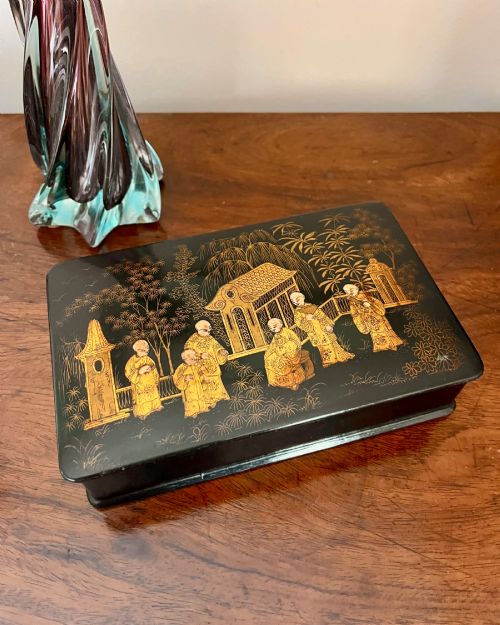
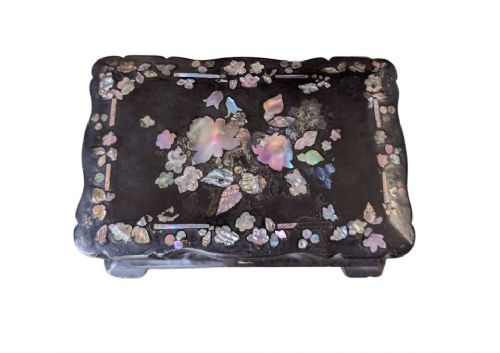
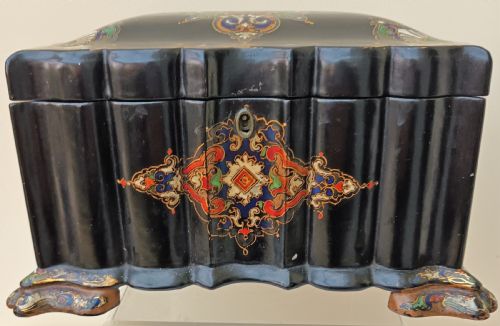
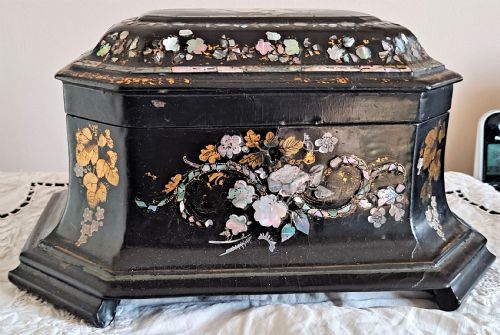


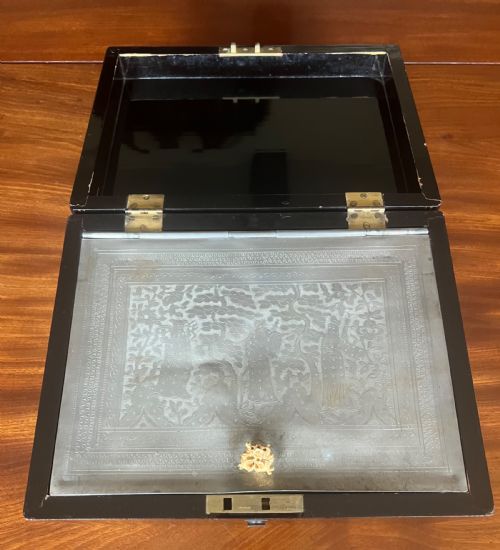


Black Lacquered Tea Caddy
These black lacquered tea caddy pieces bring dark, glossy surfaces and gilded detail into a room, holding the history of the tea trade in timber and lacquer.
Black Lacquered Tea Caddy
A black lacquered tea caddy sits on a table as a small box or canister designed originally to store dry leaf tea. When you search this phrase, you meet pieces originating from Regency and Victorian periods alongside Chinese export items.
The selection here includes items recorded as tea caddies, decorative boxes, and occasionally adapted table lamps. These pieces range from early nineteenth-century penwork boxes to mid-Victorian papier-mâché examples with inlaid decoration.
Materials and Construction
Maker workshops built these bodies from wood or papier-mâché before applying layers of black lacquer finish. Artisans then built up the surface using gold leaf, paint, and delicate penwork techniques.
Finer details often incorporate mother of pearl, bone, and brass fittings such as hinges and escutcheons. Chinese export pieces bring traditional hand-painted motifs, while Regency and Victorian examples utilise British penwork and japanning methods.
Some tea canisters found a second life as table lamps, shedding light on rooms they once kept caffeinated.
Assessing Quality and Execution
Quality rests in the crispness of the penwork and the depth of the black lacquer finish. Superior examples display intricate gold leaf application and tightly fitted lids that align smoothly with the main body.
The complexity of the decorative scheme, whether chinoiserie landscapes or floral motifs, distinguishes standard utility boxes from finely detailed pieces. Materials such as mother of pearl inlay and well-preserved brass hardware further elevate a piece.
The Black Lacquered Tea Caddy Glossary
- Japanning
- European imitation of East Asian lacquerwork, created by applying layers of varnish and heat-curing the surface. This technique produced the durable black gloss seen on many Regency boxes.
- Penwork
- Decorative technique using Indian ink applied with a fine pen to mimic carved ivory or elaborate inlay. It appears frequently on Regency boxes with intricate motifs.
- Papier-mâché
- Composite material made from paper pulp or layers of paper mixed with glue and pressed into moulds. It provided a smooth, stable base for lacquer and mother of pearl inlay in Victorian pieces.
- Escutcheon
- Protective plate surrounding a keyhole, usually made of brass on these boxes. It serves both a functional and decorative purpose on the front panel.
Black Lacquered Tea Caddy: Frequently Asked Questions
What is a black lacquered tea caddy?
It is a small lidded box finished with dark lacquer, used historically to keep precious tea leaves dry and secure under lock and key.
Today, these objects function as decorative table boxes and collector pieces, showing the craftsmanship of nineteenth-century workshops.
How do I date a tea caddy?
Dating relies on observing the materials, construction methods, and decorative styles present on the piece. Regency items often feature penwork and chinoiserie, while Victorian examples frequently utilise papier-mâché and mother of pearl.
Examining the interior compartments and hinges also helps determine whether a piece belongs to the early nineteenth century or the mid-Victorian era.
Where were these caddies made?
The evidence points to two main origins: British workshops producing Regency penwork and Victorian papier-mâché, and Chinese export makers supplying the Western market.
Both traditions utilised local timbers and specialised finishing techniques to create durable, highly decorated containers.
How do I care for lacquer?
Keep lacquer surfaces away from direct sunlight, excessive heat, and moisture to preserve the dark finish and gold leaf details. Dust gently with a dry, soft cloth rather than using liquid polishes or chemical cleaners.
Placing the box in a stable indoor environment protects the wood, papier-mâché, and delicate inlay work over time.