
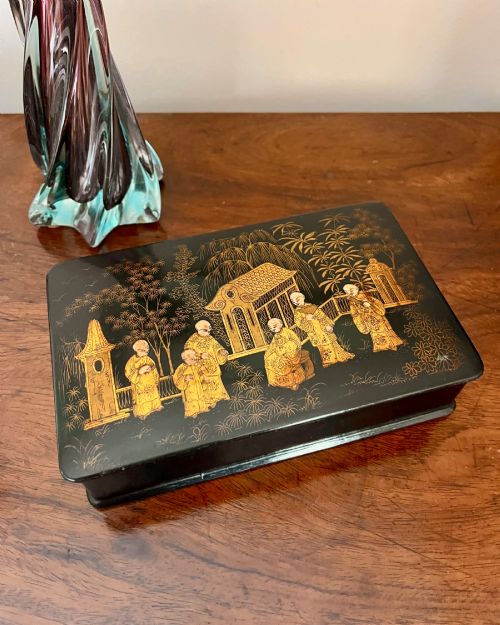
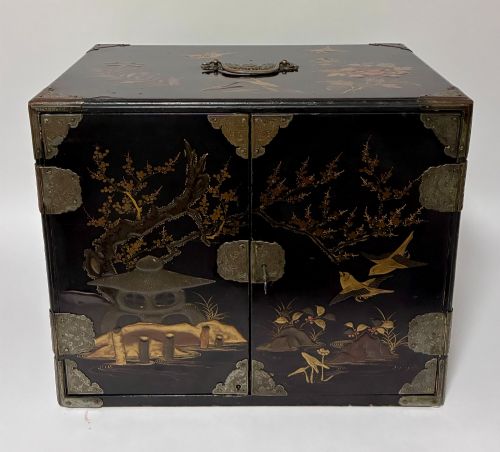


Black Lacquered Jewellery Box
These black lacquered jewellery box pieces bring a dark, lustrous surface and intricate decoration to any dresser.
Black Lacquered Jewellery Box
A black lacquered jewellery box serves as both a practical receptacle and a decorative object, taking forms from small trinket containers to substantial table cabinets. These pieces span the Georgian, Regency, and Victorian eras alongside Japanese Meiji and Taisho periods, reflecting diverse global traditions of dark surface finishes.
The most common examples on this page are nineteenth-century items, including English papier-mâché caskets and Japanese table cabinets decorated in the Chinoiserie style. Buyers encounter everything from simple trinket boxes to multi-drawer jewellery cabinets fitted with brass hardware.
Origins vary widely between English penwork creations, Russian hand-painted papier-mâché items, and Chinese Export or Japanese lacquerware. Each regional tradition imparts a distinct character to the surface, whether through fine gold leaf details, portrait painting, or intricate penwork designs.
How they were made
Layers of lacquer, varnish, and ink build the deep, dark surfaces characteristic of these pieces, often applied over wood or papier-mâché foundations. Artisans smooth these materials repeatedly to achieve a reflective ground suitable for subsequent ornamentation.
Decoration relies on contrasting elements such as gold leaf applied in gilded motifs, delicate penwork lines, and hand-painted portraits or figurative scenes. Brass fittings, including locks, hinges, and carrying handles, complete the construction of the larger cabinets and caskets.
Canines occasionally make an appearance, as seen in a Victorian papier-mâché jewellery box dedicated to dogs.
What varies in quality
The refinement of the surface finish and the complexity of the decoration separate standard examples from finer works. Superior pieces exhibit crisp, hand-painted details or precise penwork that remains sharp across the entire box or cabinet.
The integrity of the underlying structure, whether sturdy wood or well-moulded papier-mâché, dictates longevity alongside the preservation of the original varnish and gold leaf. Original brass hardware that functions smoothly and remains unaltered adds distinction to a piece.
The Black Lacquered Jewellery Box Glossary
- Chinoiserie
- European decorative style reflecting Chinese artistic influences, frequently seen in the gilded landscapes and figures on lacquer boxes.
- Penwork
- Decorative technique using pen and ink on wood, popular during the Regency period to create intricate monochrome designs resembling engravings.
- Papier-mâché
- Composite material made from paper pulp or layers of paper bound with glue, moulded and varnished to form durable lightweight boxes.
- Kodansu
- Traditional Japanese small portable cabinet featuring multiple drawers and compartments, often finished in black lacquer.
- Gilded
- Decorated with gold leaf or gold powder applied to the surface to highlight specific motifs and patterns.
Black Lacquered Jewellery Box: Frequently Asked Questions
How do I clean a lacquer box?
Dust the surface gently with a soft, dry cloth to prevent scratching the delicate finish. Avoid using water, household cleaners, or polishes that might damage the historical varnish.
Keep the box away from direct sunlight and excessive humidity to preserve both the wood and the lacquer layers over time.
Were these cabinets used for jewellery?
Many of these pieces were specifically designed for valuable trinkets, rings, and personal ornaments, featuring fitted interior trays and compartments.
Larger table cabinets served multiple purposes, holding letters, sewing implements, or small keepsakes alongside precious items.
How do I tell English penwork from Japanese lacquer?
English penwork relies on fine ink lines drawn on a light or dark ground, often depicting architectural views or classical motifs. Japanese lacquer employs resin layers with gold leaf and raised elements depicting traditional landscapes or figures.
The underlying material also differs, with English pieces frequently utilising wood or papier-mâché and Japanese works employing traditional tree sap lacquer over wood.
What is Chinese Export lacquer?
Chinese Export lacquer refers to items produced in China specifically for Western markets, combining traditional Asian techniques with European furniture forms.
These pieces typically feature dense black grounds decorated with gold or coloured scenes tailored to Western tastes of the eighteenth and nineteenth centuries.