

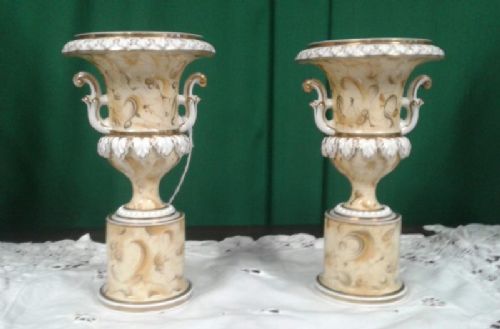


Beige Ceramic Decorative Vases
Beige ceramic decorative vases bring understated warmth to a room, offering tactile surfaces and sculptural presence across Victorian, Art Nouveau and Art Deco periods.
Beige Ceramic Decorative Vases
When you search for beige ceramic decorative vases, you encounter a refined selection of vessels shaped from earthenware, stoneware, porcelain and faience. These pieces span from the late Victorian era through the early twentieth century, taking the form of campana vases, jardinieres and baluster vessels.
The aesthetic centres on muted earthen tones, often enriched with hand painting, gilding or textured glazes. Makers ranging from English potteries to continental workshops produced these items for domestic display and interior adornment.
On this page, you are most likely to meet Victorian and early twentieth-century examples, including works by Doulton Lambeth and Mettlach Pottery. Their forms vary from miniature garlands to substantial floor-standing pieces designed to anchor a corner or mantelpiece.
How they were made
Potters shaped these vessels using traditional throwing and moulding techniques in stoneware, earthenware and porcelain bodies. The raw clay was fired before receiving liquid slip, enamel or specialised ceramic glazes to build the characteristic neutral surface.
Decoration relied heavily on hand painting, incised Slaters patent texturing and occasional gilding highlights applied before the final kiln firing. Stoneware pieces often utilised salt-glazing or matte finishes to achieve their characteristic tactile depth.
Beige Ceramic Decorative Vases Retail Price Guide 2026
Typical asking prices for beige ceramic decorative vases among the pieces listed under this phrase on Sellingantiques today, from the lower quarter to the upper quarter. They describe what is for sale here now, not the wider market.
Listings feature pieces spanning from the sixteenth century through the nineteen-forties, predominantly utilising stoneware and ceramic glaze.
What varies in quality
The distinction between standard production and exceptional work lies in the crispness of the modelled form and the control of the glaze. Superior pieces exhibit confident hand-painted details and intentional integration of texture across the ceramic body.
Signatures, factory culls and documented designer attributions elevate certain pieces above anonymous domestic wares. The ambition of the form, whether a complex Japanese jardiniere or a delicate miniature garland, dictates the level of artisan skill required.
Ridgeways·Mettlach Pottery·Doulton Lambeth·Gallilleo Chini·Makuzu Kozan II·Charlotte Rhead·Roger Guerin
The Beige Ceramic Decorative Vases Glossary
- Campana
- A classical bell-shaped urn or vase form with an everted rim, frequently utilised during the Victorian period.
- Faience
- Tin-glazed earthenware popular in European pottery traditions, providing an opaque white or cream ground for painted decoration.
- Jardiniere
- A large decorative pot or stand designed to hold live plants or floral arrangements, often displayed on pedestals.
- Stoneware
- A robust, vitrified ceramic fired at high temperatures, impervious to liquid and capable of holding rich, earthy glazes.
Beige Ceramic Decorative Vases: Frequently Asked Questions
How do I clean an antique ceramic vase?
Dust gently with a soft, dry brush to preserve fragile enamel or gilding on older surfaces.
Avoid immersing antique earthenware or faience in water, as moisture can penetrate porous unglazed bodies through historic hairline cracks.
Are these vases watertight?
Stoneware and fully glazed porcelain pieces generally hold water safely for fresh floral displays.
Earthenware and porous faience vessels require a discreet glass or plastic liner inside to prevent moisture damage to the antique ceramic body.
How do I identify Art Deco pieces?
Art Deco ceramics typically feature geometric motifs, stylised floral patterns and characteristic tube-lined glazes.
Forms from this era tend to be more streamlined and architectural compared to the ornate curves of preceding Victorian designs.
Where should I display them?
Place neutral ceramic vessels where natural light can catch the texture of matte glazes and subtle enamel work.
Pair contrasting forms, such as pairing a tall baluster vase beside a low jardiniere, to create depth on a sideboard or mantelpiece.