


Barley Twist Writing Bureau
These barley twist writing bureau pieces combine a practical fall-front writing surface with turned wooden supports, offering a useful workspace and period character.
Barley Twist Writing Bureau
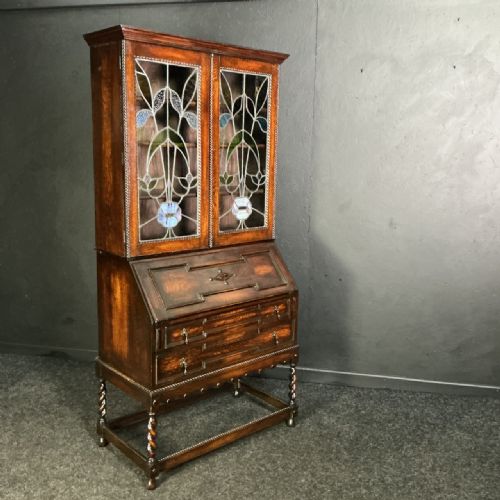
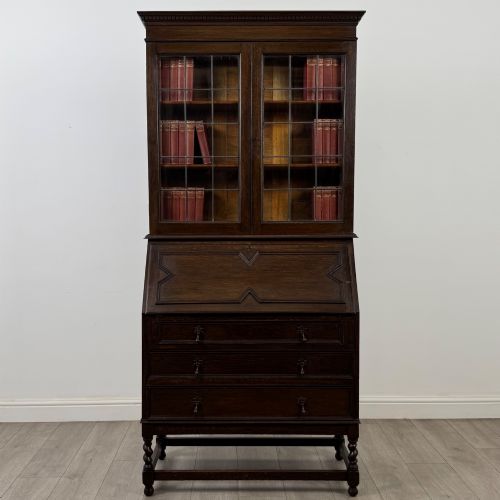
A barley twist writing bureau provides a dedicated writing space featuring a hinged fall-front panel that conceals internal compartments and drawers for stationery. These items emerge in forms such as compact writing desks, bureaux, and taller bureau bookcases.
The pieces on offer span multiple periods, ranging from seventeenth-century styling through Victorian iterations to Edwardian and nineteen-twenty examples. Oak serves as a primary structural timber, alongside walnut, mahogany, and oyster walnut veneer.
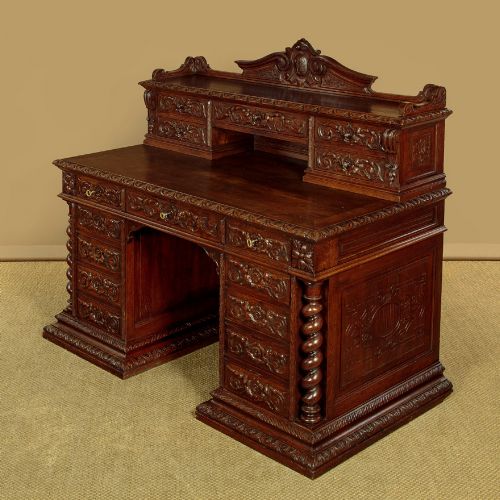
Revival aesthetics heavily influence the selection, with Jacobean revival, William and Mary, and Queen Anne styles appearing alongside Gothic taste and Biedermeier execution. Buyers most frequently encounter oak and walnut specimens displaying turned supports and carved detailing.
Materials and construction methods
Cabinet makers utilised solid timbers like oak, walnut, and mahogany, frequently applying decorative veneers such as oyster walnut to flat surfaces. Brass hardware appears on handles, while leather inserts line selected writing surfaces.
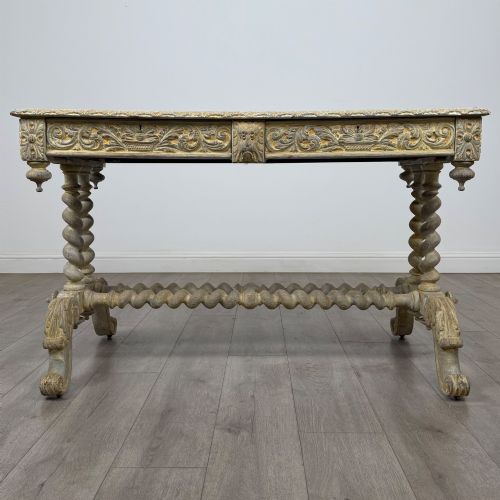
The characteristic spiral supports are turned from timber to create the helical twist effect. Joinery relies on traditional techniques to house drawers, fall-front desks, and internal pigeonholes securely within the frame.
Listings feature oak, walnut, and mahogany across periods spanning the seventeenth century, Victorian era, Edwardian period, and nineteen-twenty.
Distinguishing quality across the range
The standard of carving and the precision of the woodturning dictate the visual hierarchy of these desks. Crisp detailing on the barley twist legs and balanced proportions across the fall-front distinguish superior examples.
The choice of primary timber and secondary veneers impacts the overall finish, with figured walnut and dense oak representing the more elaborate end of the spectrum. Interior arrangement complexity, including secret compartments and fitted stationery sections, also elevates the construction standard.
Adriano Brambilla
The Barley Twist Writing Bureau Glossary
- Bureau
- A desk featuring a sloping hinged lid or fall-front that opens to reveal a fitted interior of small drawers and pigeonholes.
- Escritoire
- A writing cabinet or desk, often associated with seventeenth-century styles and fine veneer work.
- Oyster walnut veneer
- Thin slices of walnut branch wood cut across the grain to create circular or oval patterns resembling oyster shells.
- Jacobean Revival
- A nineteenth and twentieth-century style imitating the heavy, carved oak furniture of the early seventeenth century.
- Abattant
- A vertical cabinet with a drop-front writing flap, typical of continental European furniture like Biedermeier desks.
Barley Twist Writing Bureau: Frequently Asked Questions
How do I use a bureau desk?
Lower the hinged fall-front panel to create a horizontal writing surface, which simultaneously provides access to the internal pigeonholes and small drawers. When finished writing, fold the panel back up to conceal paperwork and restore the compact cabinet form.
Ensure the support arms for the fall-front are engaged properly to bear the weight while writing. Store stationery within the designated internal compartments to keep the main surface clear.
How do I date a barley twist desk?
Examine the timber species, construction methods, and stylistic revival cues to determine the likely era. Pieces range from seventeenth-century inspired designs through Victorian and Edwardian periods up to nineteen-twenty productions.
Stylistic markers such as Jacobean revival carving or Biedermeier cabinetwork provide further chronological context alongside the primary wood choice.
Where should I place a writing bureau?
Position the bureau in a study, living room, or bedroom where the fall-front can open fully without blocking room circulation. Allow sufficient clearance for a chair in front of the lowered writing flap.
Keep wooden items away from direct heat sources and strong sunlight to protect the timber finishes and veneers from drying out.