


Barley Twist Throne Chairs
Barley twist throne chairs are commanding seating with turned woodwork, offering historical presence and deep relief carving for any room.
Barley Twist Throne Chairs
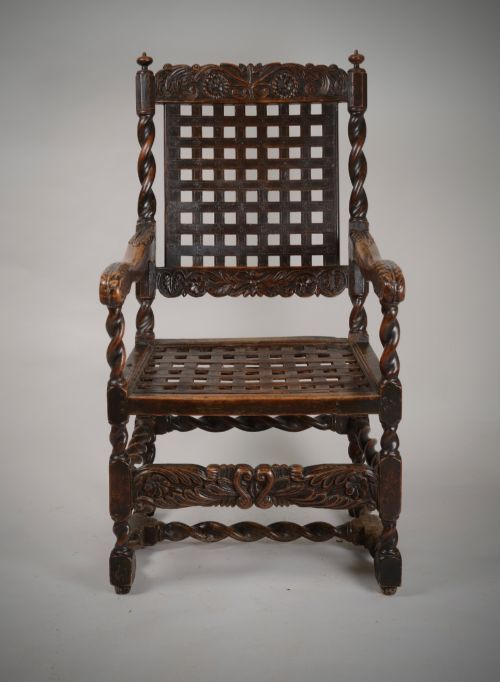
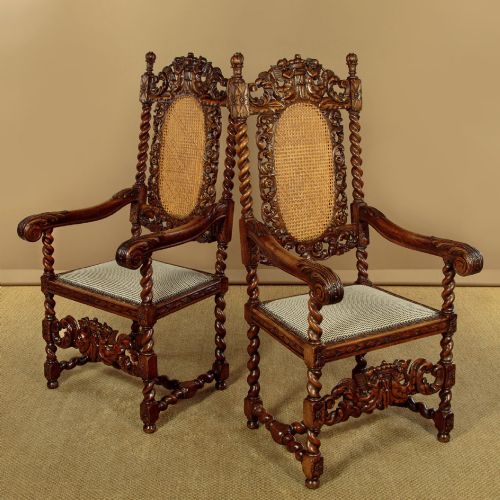
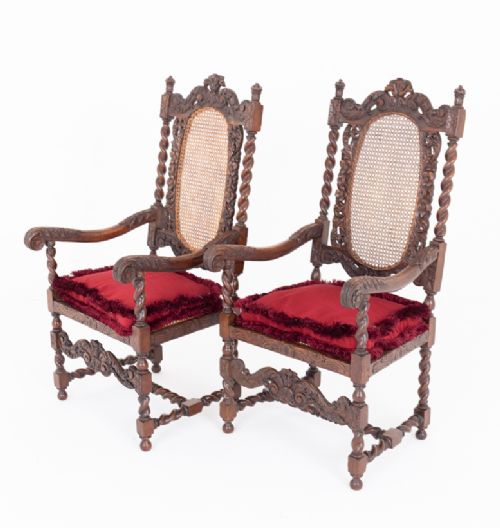
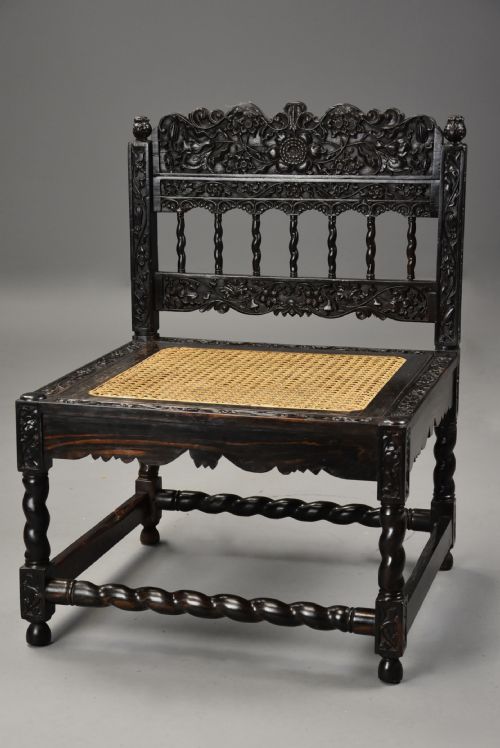
When you examine barley twist throne chairs, you encounter substantial seating built primarily as armchairs and side chairs. These pieces draw on historical forms from the seventeenth century through to later revivals in the Victorian era and the early twentieth century.
The versions most commonly met on this page span heavy oak constructions from the Victorian period alongside earlier walnut and laburnum examples. Makers across these periods channelled Jacobean, Carolean, and Gothic revival styles to create imposing silhouettes suited for halls and grand rooms.
How barley twist throne chairs were made
Carpenters constructed the primary frames of these chairs using solid timbers such as oak, walnut, and laburnum, sometimes incorporating ebony or bleached oak surfaces. These woods were shaped with hand tools to produce the distinctive helical turning known as the barley twist.
Upholstery and decorative details relied on materials like cane, rattan cane, brass, velvet, leather, and tapestry fabric. Carvers applied deep relief work, including green man motifs and figural designs, directly onto the wooden framework.
What varies in quality in barley twist throne chairs
The standard of carving sets the finer examples apart, where crisp relief work and balanced proportions show the hand of a skilled artisan. Heavy, solid timber frames with precise joinery retain their stability much better than lighter or hastily assembled alternatives.
The integrity of the original materials, from the tightness of the cane work to the depth of the walnut or oak grain, dictates the overall character of the piece. Period upholstery choices and well-preserved turning enhance the authenticity and visual impact of the chair.
The Barley Twist Throne Chairs Glossary
- Barley twist
- A form of wood turning resembling a twisted rope or barley sugar. It became popular in seventeenth-century furniture and saw a major revival during the Victorian period.
- Throne chair
- An imposing armchair with a high back and substantial arms, often heavily carved. These seats were designed to dominate a room and denote status.
- Green man
- A sculptural motif depicting a human face entwined with leaves, foliage, or vines. This symbol appears frequently in Victorian Gothic revival carving.
- Cane
- Strips of rattan or peeled plant material woven into an open pattern for chair seats and backs. It provides a lightweight yet durable surface.
Barley Twist Throne Chairs: Frequently Asked Questions
What is a barley twist chair?
A barley twist chair is a wooden seat featuring legs, stretchers, or uprights shaped into a helical, rope-like twist. This turning technique became a defining feature of seventeenth-century English joinery.
Craftsmen revived the style extensively during the nineteenth and early twentieth centuries, applying the distinct twisted columns to heavy oak and walnut armchairs.
How old are barley twist throne chairs?
Authentic seventeenth-century examples date back to the Jacobean and Carolean periods, often constructed from walnut or laburnum. Many chairs found today originate from Victorian revival periods spanning the mid nineteenth to early twentieth centuries.
Designers of the Victorian and Edwardian eras eagerly copied seventeenth-century forms, producing large carved oak throne chairs with deep relief work.
Where were barley twist chairs placed?
Historically, substantial throne chairs occupied the head of a long dining table, a hall, or a formal parlour to signal authority and status. Their imposing height and heavy framing meant they were meant to stand against walls rather than crowd a room.
Today, buyers use them as statement pieces in studies, living rooms, or hallways where their carved woodwork and turned members can be viewed clearly.
How do I identify a Victorian revival chair?
Victorian revival pieces often display machine-assisted precision in their carving and use darker, heavily waxed oak finishes. They frequently incorporate dramatic motifs like green man carvings alongside standard barley twist supports.
Earlier seventeenth-century originals typically show distinct tool marks, different timber seasoning, and construction methods characteristic of hand-built period joinery.