
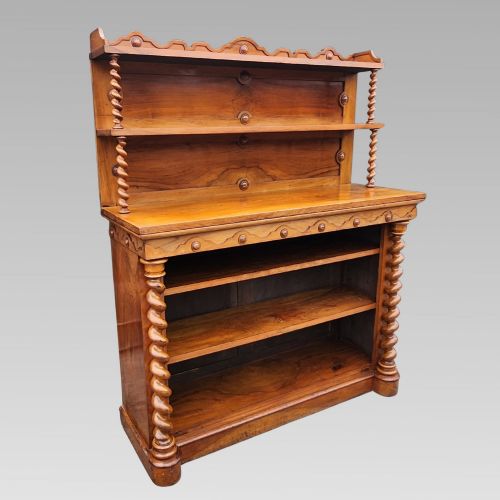


Barley Twist Shelf Unit
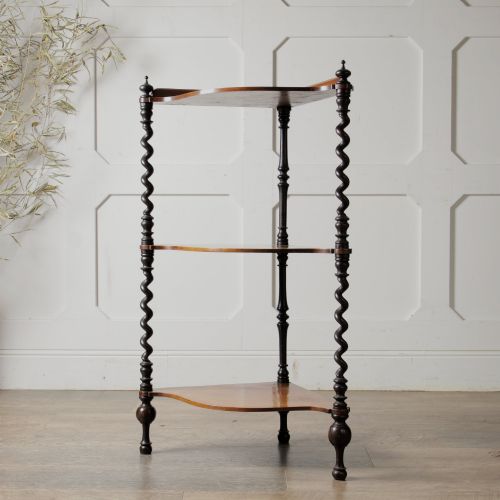
A barley twist shelf unit brings structural warmth and timber movement to a room, offering tiered display space shaped by spiralling turned columns.
Barley Twist Shelf Unit
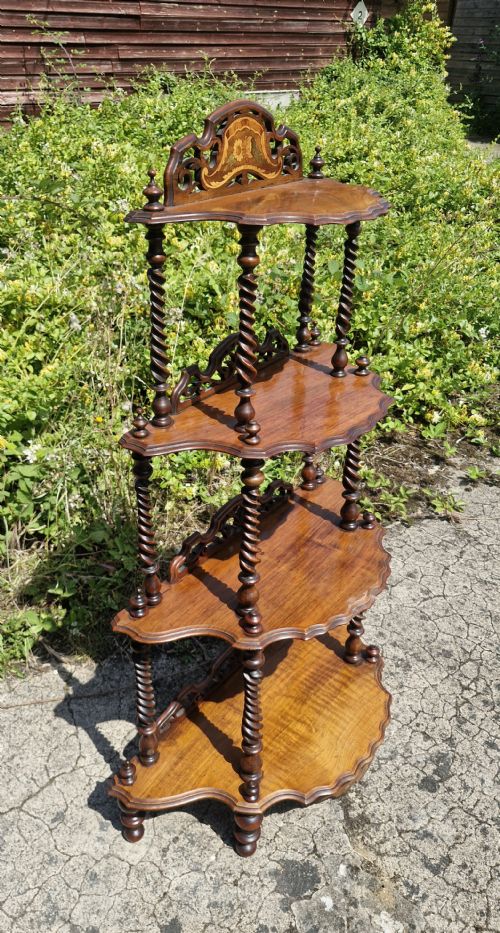
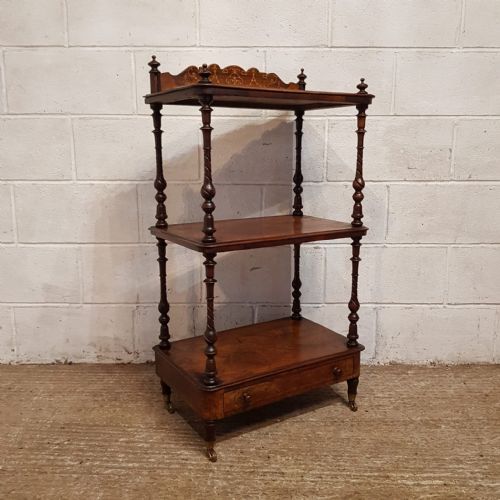
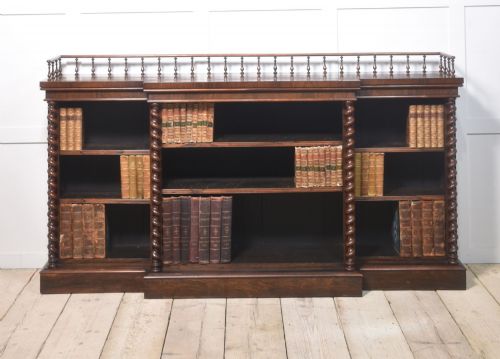
A barley twist shelf unit is encountered on this page through terms such as whatnot, etagere, display stand, and bookcase, spanning Victorian, Regency, and early twentieth-century periods. These pieces combine multi-tiered shelving with distinctive helical timber turnings, functioning as open display furniture for books, ceramics, and ornaments.
The prevailing examples on this page are walnut and mahogany whatnots from the nineteenth century, including corner configurations and multi-tiered vertical towers. Makers from these eras utilised turned barley twist columns to support graduated platforms, creating lightweight architecture designed to catch the light in domestic interiors.
Materials and construction
The construction relies heavily on dense timbers such as walnut, burr walnut, mahogany, and rosewood, selected for their rich grain patterns and structural stability. Turners shaped the characteristic barley twist columns on lathes, cutting continuous helical grooves that required precise hand-finishing.
Shelves are frequently supported by turned uprights or brass columns, whilst finer pieces incorporate burr walnut veneers, wood inlay, mirror glass backs, and carved friezes. Joints are traditionally pegged or tenoned to support the weight of stacked tiers without warping over time.
Judging quality in tiered shelving
Quality rests upon the crispness of the timber turning and the depth of figure in the selected veneers, particularly on burr walnut surfaces. Sharp, well-defined twists demonstrate superior lathe work and careful hand-carving compared to softer, shallower machine profiles.
The integrity of the structural joinery between shelves and uprights dictates stability. Pieces that retain their original timber patination, without excessive sanding or harsh chemical stripping, display the rich colour and grain variations intended by the maker.
The Barley Twist Shelf Unit Glossary
- Barley twist
- A decorative turning style featuring a spiralling, rope-like column that resembles twisted barley sugar. This motif gained popularity during the seventeenth century and saw a major revival in Victorian furniture.
- Whatnot
- An open multi-tiered piece of furniture designed for displaying ornaments, books, or knick-knacks. It became a staple of nineteenth-century drawing rooms.
- Etagere
- A French term for a piece of furniture consisting of a set of open shelves for displaying small objects. They often feature delicate uprights and multiple tiers.
- Demi-lune
- Half-moon shaped furniture designed to sit flat against a wall. These pieces often function as console tables or corner display units.
- Burr walnut
- Timber taken from the warted excrescences of a walnut tree, yielding highly figured swirling grain patterns. It was prized for luxury veneering on Victorian cabinets and whatnots.
Barley Twist Shelf Unit: Frequently Asked Questions
What rooms suit a barley twist shelf unit?
These tiered stands fit well in living rooms, hallways, or studies where vertical display space is needed without blocking light. Their open architecture prevents them from dominating smaller floor plans.
They serve as practical ledges for holding books, plants, or collections of small ceramics, blending easily with both period interiors and contemporary spaces.
How do I date a Victorian whatnot?
Dating relies on timber choices, turning profiles, and construction methods. Mid-nineteenth-century pieces often feature solid mahogany or rosewood, whilst later Victorian examples frequently employ burr walnut veneers and lighter pine carcasses.
Examining the screw types, backboards, and secondary timbers underneath the shelves provides further clues to the manufacturing decade.
Are corner whatnots stable?
Corner units utilise two adjoining walls to secure their triangular footprint, making them naturally stable when placed on level flooring. Their design was specifically engineered to utilise awkward room angles.
Heavier items should be placed on the lowest tiers to maintain a low centre of gravity and prevent any tipping movement.
How should I clean walnut shelving?
Maintenance requires dusting with a dry, soft cloth to prevent grit from scratching the polished wood surface. Avoid modern silicone sprays that build up and dull the antique finish.
Applying a traditional beeswax sparingly helps nourish the timber and preserves the natural lustre of the grain.