
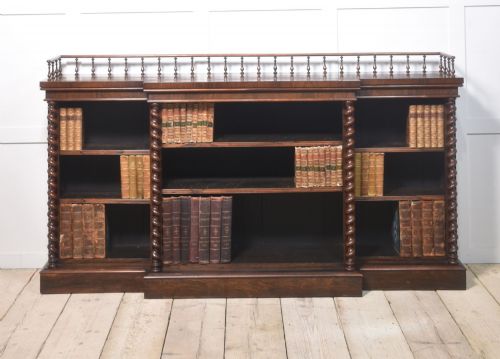


Barley Twist Rosewood Bookcase
These barley twist rosewood bookcase pieces bring rich timber grain and sculptural turned supports to domestic rooms, offering both display space and refined period character.
Barley Twist Rosewood Bookcase
A barley twist rosewood bookcase brings together rich dark timber and helical turned supports, taking form primarily as open shelving units, tiered whatnots, and enclosed side cabinets. Buyers exploring this category encounter furniture rooted in the nineteenth century, spanning the Regency, William IV, and Victorian periods.
Originating predominantly from the Victorian era alongside Regency and nineteenth-century examples, these items serve as both practical storage and focal points for period interiors. The integration of barley twist columns defines their architectural silhouette, marking them out from plain shelving alternatives.
How they were made
Construction relies heavily on dense rosewood, valued for its deep grain and dark figuration, shaped into structural framing and turned decorative elements. Timber components are frequently augmented with brass hardware, mirrored panels, and inset glass or specimen marble tops.
Makers utilised precision turning techniques to produce the characteristic barley twist columns that flank cabinets or support multiple tiers of shelving. Joinery methods of the period ensured that slender vertical supports could safely bear the weight of heavy timber shelves and displayed objects.
Every single barley twist column relies on a woodturner's steady eye and relentless foot-power at the lathe to achieve that perfect helical spiral.
What varies in quality
Quality reveals itself in the crispness of the timber turning and the depth of the rosewood grain, where superior examples exhibit sharp helical carving and harmonious colouration. The integration of secondary materials such as untouched brass fittings or fine specimen marble inserts further elevates a piece.
Proportion and structural integrity distinguish finer workshops from more utilitarian production, particularly in multi-tiered whatnots and cabinets where stability is paramount. The precision of the joinery around glazed doors and delicate shelves indicates the level of craftsmanship invested in the construction.
The Barley Twist Rosewood Bookcase Glossary
- Barley twist
- A spiral turning technique resembling a twisted rope, commonly utilised for columns and upright supports on nineteenth-century furniture. This sculptural detail adds movement and vertical emphasis to bookcases and cabinets.
- Whatnot
- A piece of freestanding open shelving with multiple tiers designed for displaying ornaments, books, or collections. These stands became popular in the nineteenth century for their tiered versatility.
- Etagere
- A set of open shelves for displaying small objects, closely related to the whatnot and often featuring delicate turned supports. They function as both decorative and practical furniture.
- Credenza
- A low side cabinet, frequently enclosed with doors and adorned with architectural columns or mirrors. In nineteenth-century interiors, these served storage and display purposes in principal rooms.
- Specimen marble
- Multi-coloured decorative stone inlaid into tabletops, showing various geological samples in geometric or pictorial arrangements. It provides a luxurious contrasting surface on nineteenth-century cabinets.
Barley Twist Rosewood Bookcase: Frequently Asked Questions
How were nineteenth century whatnots used?
Nineteenth century whatnots served as tiered display stands for ornaments, books, and collections in principal rooms. Their multiple open shelves allowed owners to exhibit decorative objects at various heights.
Over time, they evolved from simple utility stands into highly ornamental centerpieces of period interior design.
What distinguishes Victorian rosewood furniture?
Victorian rosewood furniture is characterised by the dark, richly figured timber and heavy reliance on traditional turning techniques. Makers frequently combined the dense wood with brass, glass, and marble inserts.
This period favoured ornate silhouettes, seen particularly in the barley twist supports of cabinets and etageres.
How do I care for rosewood shelving?
Rosewood shelving benefits from stable indoor humidity and protection from direct sunlight to preserve the deep timber grain. Regular dusting with a soft cloth maintains the polished finish without moisture damage.
Avoid placing items with damp bases directly onto the wooden surfaces to prevent marking.