

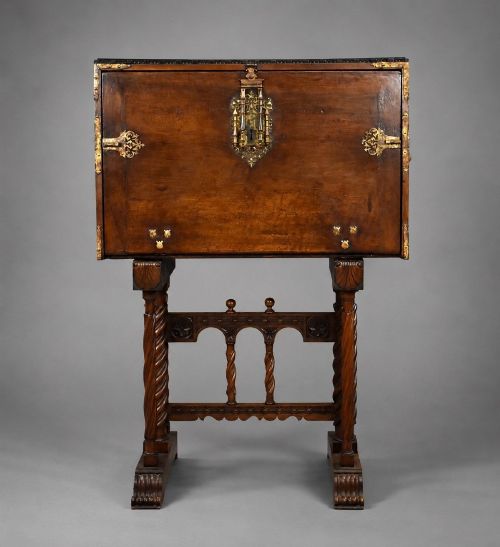
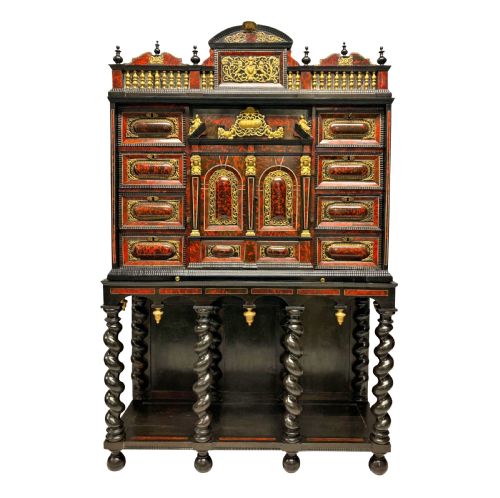


Barley Twist Cabinet Stand
These barley twist cabinet stand pieces combine raised display furniture with timber turning, offering elevated storage that draws the eye upward.
Barley Twist Cabinet Stand
A barley twist cabinet stand places a raised storage compartment upon a structural base, combining display surfaces with enclosed sections. When searching for a barley twist cabinet stand, expect to find forms ranging from walnut chests on stands to oak cupboards and rosewood etageres.
The listings span multiple centuries, showing examples from the seventeenth century through to the Victorian era and the nineteen-twenties. Walnut and oak dominate the selection, often accompanied by burr walnut, rosewood, brass, and glass elements.
Makers and craftsmen applied styles such as William and Mary, Flemish Baroque, and Gothic Revival to these elevated pieces. Cabinets on stands, chests on stands, and writing cabinets form the primary object types encountered across the page.
Materials and construction
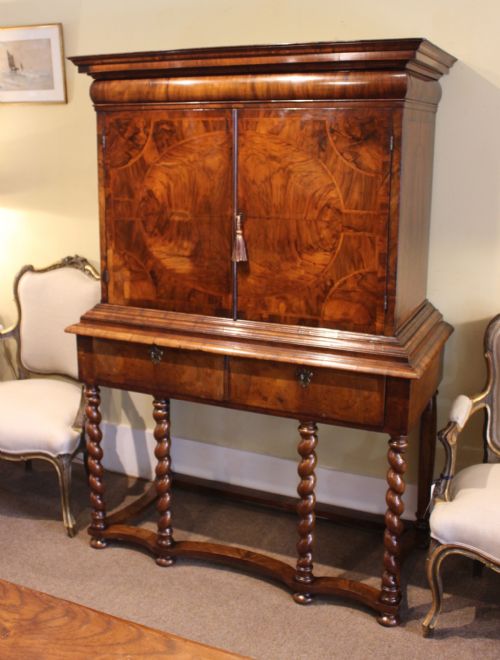
Carpenters utilised solid timbers like oak and walnut, frequently applying oyster veneer, marquetry, and burr walnut surfaces to the exterior panels. Brass hardware and mirrored glass appear alongside ebonised wood and tortoiseshell details in architectural examples.
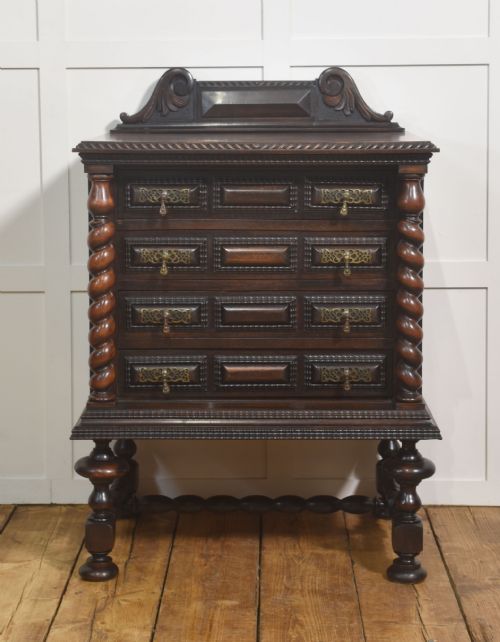
Turning lathes shaped the characteristic spiral supports from dense hardwoods, while hand-carving produced lion masks and relief panels on Flemish and Spanish pieces. Joinery techniques varied from early pegged frames to later Victorian carcass construction.
Barley Twist Cabinet Stand Retail Price Guide 2026
Typical asking prices for barley twist cabinet stand among the pieces listed under this phrase on Sellingantiques today, from the lower quarter to the upper quarter. They describe what is for sale here now, not the wider market.
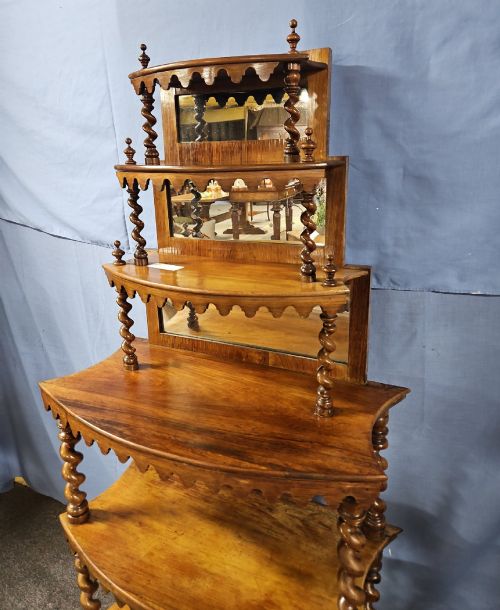
One towering six-tier display shelf relies on hollow barley twists to support its considerable walnut tiers.
Assessing craftsmanship and condition
Quality rests upon the precision of the timber turning and the crispness of any hand-carved ornamentation on the stand. Uniformity in spiral legs and tight joints between the cabinet body and its base indicate superior workmanship.
The choice and application of veneers dictate the visual depth of the piece, with matched oyster veneers and intricate marquetry separating standard joinery from finer examples. Preservation of original brass fittings and glass panels also influences the standing of an individual item.
Adriano Brambilla
The Barley Twist Cabinet Stand Glossary
- Barley twist
- A spiral turning resembling a twisted barley stalk, commonly used for the legs and supports of seventeenth-century and revival furniture. This technique requires precise lathe work to maintain uniform curves.
- Chest on stand
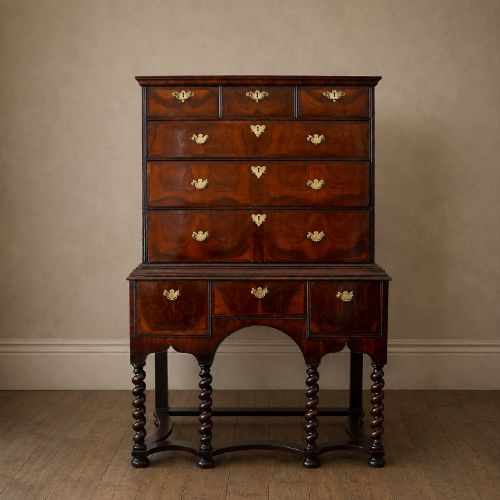
- A two-part furniture form comprising an upper chest or cabinet resting upon an elevated base with legs. This design lifts storage off the floor to protect textiles and valuables.
- Oyster veneer
- Thin slices of branch wood laid across a surface to create circular patterns resembling oyster shells. Cabinetmakers utilised this decorative technique extensively during the William and Mary period.
- Bargueño
- A portable writing cabinet originating in Spain, typically featuring a drop front and numerous small drawers. These pieces often rest upon carved stands or tables.
- Whatnot
- A set of open shelves supported by upright pillars, designed for displaying ornaments and books. Victorian examples frequently incorporate turned columns and corner brackets.
Barley Twist Cabinet Stand: Frequently Asked Questions
What is a barley twist cabinet stand?
A barley twist cabinet stand is an elevated storage or display unit supported by spiral-turned wooden legs. These pieces combine enclosed cabinet space or drawers with an open-framed underframe.
The listings show examples ranging from seventeenth-century walnut chests to Victorian rosewood display shelves and nineteen-twenties cocktail cabinets.
How were these cabinets used?
Historically, these elevated cabinets served to store valuable documents, collections, or textiles while keeping them away from damp floors. The raised surface also brought the interior contents to a more accessible height for standing users.
Over time, forms evolved from utilitarian storage into display furniture meant for parlours and drawing rooms, holding books, ceramics, and curiosities.
How do I identify a William and Mary piece?
William and Mary style pieces often feature walnut or oyster veneer surfaces, geometric marquetry, and architectural cornices. The stands typically employ turned legs connected by flat or curved stretchers.
Matching the construction details and timber choices to seventeenth-century methods helps distinguish authentic period pieces from later Victorian revivals.
Where should I place one in my home?
These pieces suit living rooms, hallways, or studies where their vertical proportions fill wall space without occupying a large floor footprint. Placing them away from direct sunlight and heat sources protects delicate veneers and polished timber.
Allowing sufficient clearance around the stand also highlights the turned legs and stretcher bases characteristic of the form.