



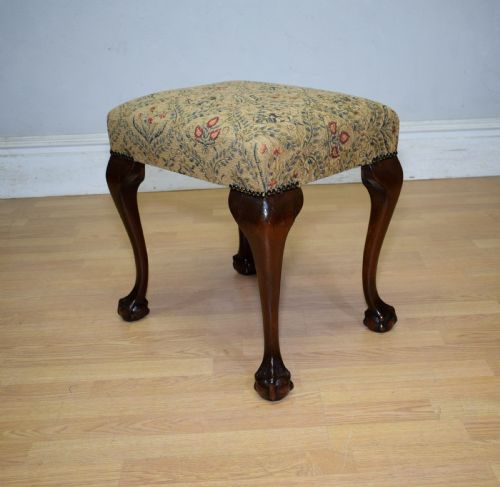


Ball and Claw Footrest
These ball and claw footrest pieces are solid timber footstools built in revival styles, offering sturdy seating and traditional carved details for period interiors.
Ball and Claw Footrest
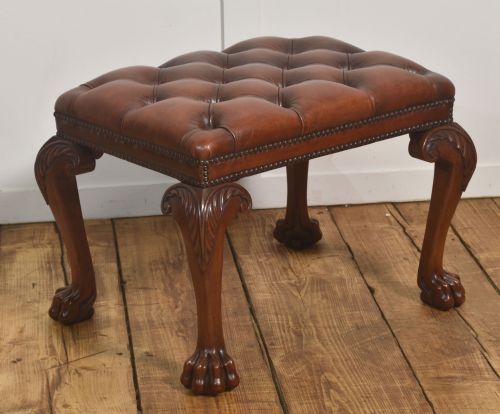
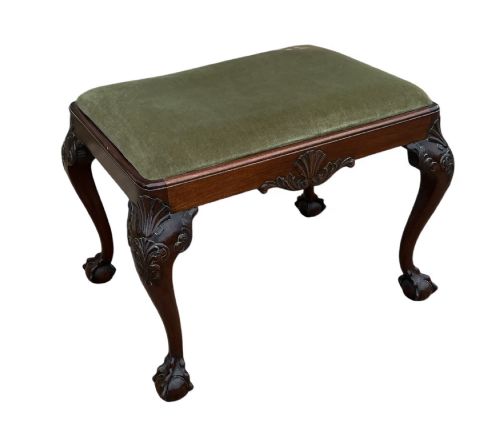
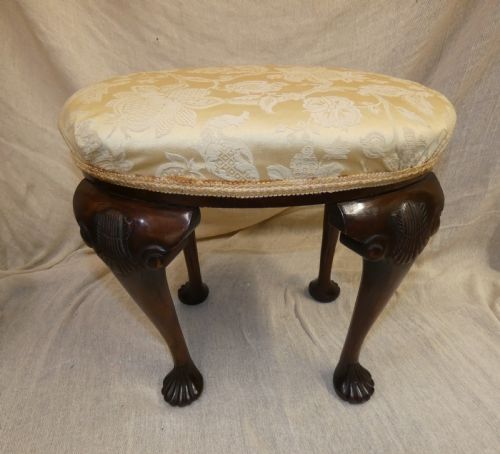
When you search for ball and claw footrest, you are looking at domestic stools and footstools designed primarily in Chippendale and Georgian revival styles. The pieces on this page span from the nineteenth century into the early twentieth century, showing substantial timber frames and upholstered tops.
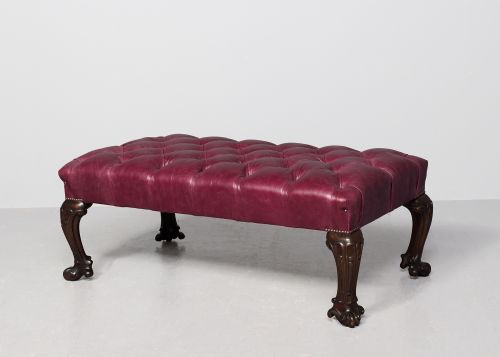
You are most likely to meet mahogany and walnut frames supporting leather, velvet, or damask fabric pads. Forms range from compact dressing stools to larger footstools and ottomans originating across the Victorian and Edwardian periods.
How they were made
Cabinetmakers constructed these frames using dense hardwoods like mahogany and walnut, frequently applying carved ornamentation to the wood. Joinery techniques ensured sturdy weight-bearing structures suitable for daily use as footrests and seats.
Upholstery methods utilised traditional stuffing materials beneath outer coverings of leather, wool, velvet, and damask fabric. Buttoned finishes appear on select red hide pads, secured tightly to the timber bases.
Ball and Claw Footrest Retail Price Guide 2026
Typical asking prices for ball and claw footrest among the pieces listed under this phrase on Sellingantiques today, from the lower quarter to the upper quarter. They describe what is for sale here now, not the wider market.
A painted finish occasionally sneaks onto these timber frames, proving that even serious period seating sometimes enjoyed a touch of whimsy.
What varies in quality
The degree of hand-carving on the wooden frame separates standard production from finer craftsmanship, particularly in the definition given to the structural legs. Timber selection also dictates grade, with deeply figured walnut and rich mahogany sitting at the higher end of the scale.
Upholstery execution alters the overall character, where traditional buttoning and premium hide or damask fabric indicate higher workshop standards. The integrity of the timber frame and the crispness of the revival styling determine the piece's standing.
The Ball and Claw Footrest Glossary
- Chippendale Style
- A revival design drawing on eighteenth-century English furniture patterns, typically featuring carved wooden frames and ornate legs. This aesthetic dominates many of the footstools found in this category.
- Buttoned Upholstery
- A technique where depressions are formed in the padded surface using tightly pulled buttons. This method secures the internal stuffing while creating a geometric pattern on leather or fabric.
- Red Hide
- A heavy cattle leather tanned and dyed to a distinct red shade. It provides a durable, wipe-clean surface frequently used on nineteenth-century footstools.
- Damask Fabric
- A reversible figured textile woven on a jacquard loom with patterns visible in contrasting matt and shiny surfaces. It serves as an ornamental covering for period dressing stools.
Ball and Claw Footrest: Frequently Asked Questions
What are ball and claw footrests used for?
These pieces function as footstools, ottomans, and dressing stools designed to support the feet or provide low seating. Their sturdy wooden frames allow them to sit comfortably in studies, bedrooms, and drawing rooms.
Historically, they accompanied armchairs and dressing tables within formal domestic interiors. Today, they continue to serve as practical furniture while adding traditional aesthetic value to a room.
How can I tell the period of a footstool?
Dating relies on observing timber characteristics, upholstery styles, and the specific revival movement referenced in the construction. Pieces from the nineteenth century often display heavier proportions and simpler carved details compared to later interpretations.
Makers working in the early twentieth century frequently revived earlier George II and Chippendale motifs with varying degrees of historic accuracy. Examining the underside and the wear on the wood helps clarify the age of the frame.
Are these footstools comfortable?
Comfort depends on the firmness of the internal padding and the type of upper material chosen for the top. Leather surfaces offer a firm, supportive rest, while fabric and velvet pads provide a softer feel.
Many examples feature traditional buttoning that keeps internal stuffings evenly distributed across the surface. This construction creates a stable platform suited for resting feet over extended periods.
How do I maintain leather and fabric stools?
Leather surfaces require occasional conditioning to keep the hide supple and prevent cracking over time. Gentle dusting and protection from direct sunlight preserve the original colour of the leather and fabric.
Fabric and velvet upholstery benefit from regular light vacuuming with a soft brush attachment. Avoiding harsh chemical cleaners ensures the surrounding timber frame and polished surfaces remain undamaged.