


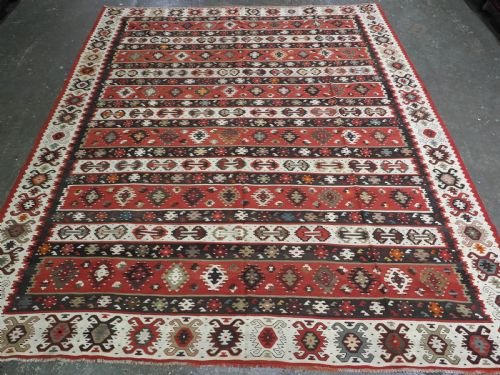
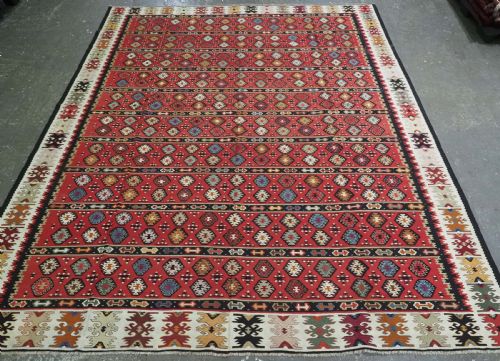


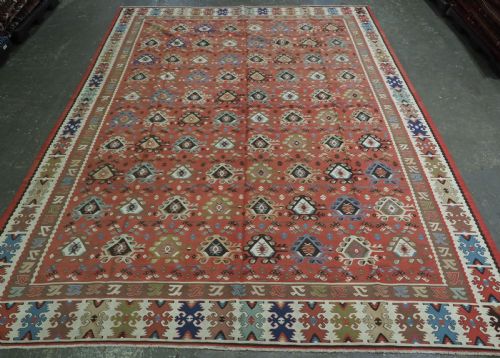


Balkan Wool Woven Carpet
A balkan wool woven carpet brings bold traditional pattern and deep texture to a floor, offering durable craft shaped by regional heritage.
Balkan Wool Woven Carpet
A balkan wool woven carpet sits within a tradition of flatweave textiles spanning rug and kilim formats. These pieces emerge primarily from periods around eighteen-sixty through nineteen-thirty, carrying distinct regional styles such as Balkan Folk Art and Ottoman Balkan.
Most examples encountered here appear as specific types like the Sarkoy and Pirot kilims, often displaying classic banded, repeat, or flowering tree designs. They function as area rugs and large room size floor coverings shaped by traditional village workshops.
How they were made
The construction relies fundamentally on wool and cotton fibres, combined through traditional flatweave techniques without a pile. Spinners and weavers prepared local materials by hand to produce strong, tightly packed textiles.
Dyes yielded warm soft colours, pastel tones, and deep reds that define the visual weight of these flatweaves. The absence of cut pile means the pattern builds directly through the interlacing of the warp and weft threads.
Early weavers sometimes hid tiny intentional irregularities in their geometric grids to ward off the evil eye.
What varies in quality
Quality rests on the precision of the flatweave structure and the balance of the composition. Finer examples display tightly packed threads and deliberate control over complex repeat or lattice motifs.
The choice and harmony of dye colours elevate certain pieces above standard production. Surviving textiles with well-preserved pastel or warm soft shades demonstrate superior visual impact.
The Balkan Wool Woven Carpet Glossary
- Kilim
- A flatwoven carpet or rug produced without a pile. These textiles rely on interlocking weft threads to form geometric and floral designs.
- Sarkoy
- A traditional style of flatweave associated with a specific weaving centre. These pieces frequently feature banded or classic repeat patterns.
- Pirot
- A recognised regional tradition known for finely executed flatweave carpets. They often incorporate elaborate borders and symbolic motifs.
- Flatweave
- A textile technique created by interweaving warp and weft threads directly on a loom. This method produces a thin, durable floor covering without surface pile.
- Warp
- The vertical foundation threads held under tension on a loom. Weft threads pass over and under these structural lines to build the fabric.
Balkan Wool Woven Carpet: Frequently Asked Questions
What is a balkan wool woven carpet?
A balkan wool woven carpet is a flatweave textile originating from southeastern Europe and surrounding regions during the nineteenth and twentieth centuries.
These pieces utilise wool and cotton to create durable floor coverings featuring traditional regional patterns.
How do I care for a kilim rug?
Protect the flatweave by placing a breathable rug pad underneath to prevent slipping and reduce friction against hard floors.
Vacuum gently without a rotating brush roll and consult a specialist for professional cleaning when necessary.
Where were these rugs made?
These textiles were woven in villages and towns across the Balkans, incorporating design elements influenced by Ottoman traditions.
Specific production centres included regions associated with Sarkoy and Pirot kilims.
How are periods identified?
Dating relies on stylistic markers, structural wear, and the specific chemical or natural dye palettes characteristic of nineteenth and early twentieth century production.
Comparisons with documented regional weaving types help narrow the timeframe.