



Bakshaish Wool Carpet
A bakshaish wool carpet brings bold northwest Persian tribal geometry and rich vegetal dye palettes directly onto your floor.
Bakshaish Wool Carpet
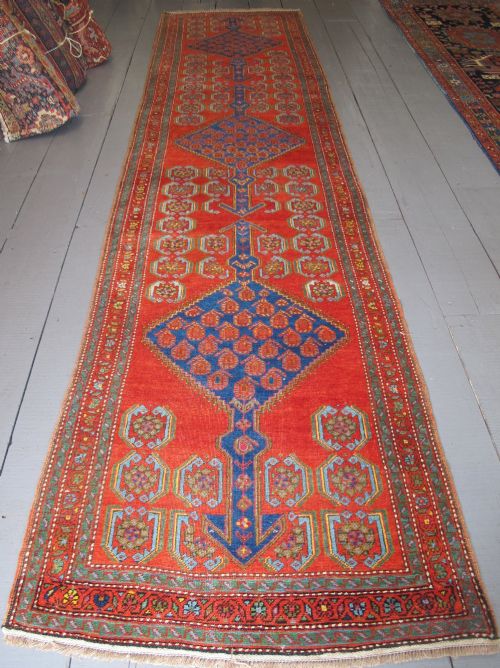
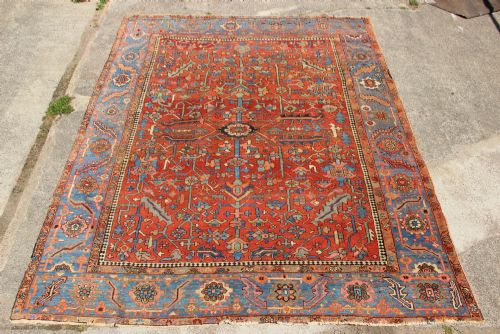
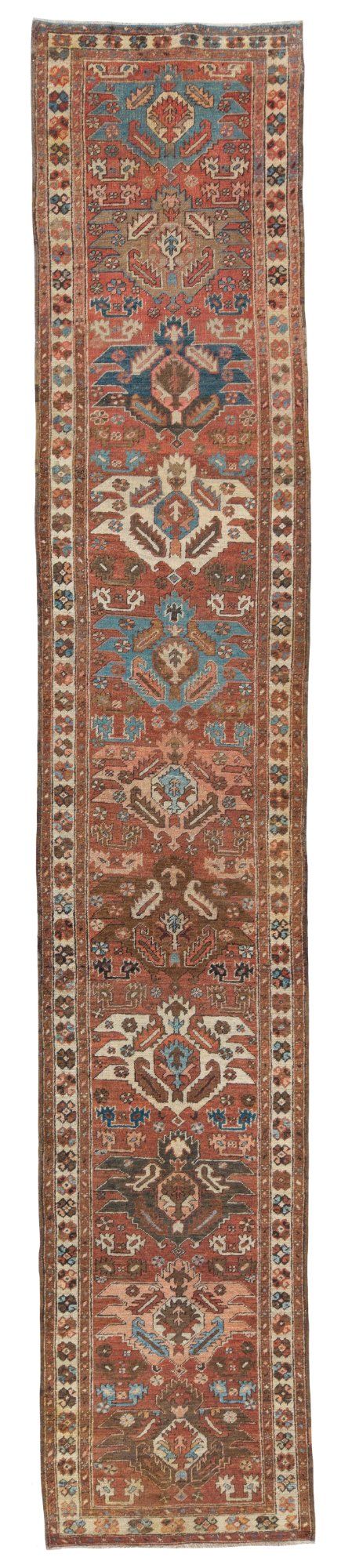
A bakshaish wool carpet represents a distinct weaving tradition originating from northwest Persia, spanning formats from large carpets down to village rugs and runners. The pieces encountered here cross several decades from the mid-nineteenth century into the early twentieth century.
Makers in this tradition favoured large-scale geometric motifs, stylized medallions, and open fields, sometimes linked to the wider Heriz district aesthetics including Serapi styles. The format ranges from compact area rugs measuring just over a metre to expansive floor coverings exceeding four metres in length.
Materials and construction
Every bakshaish wool carpet utilises natural wool pile knotted onto a sturdy cotton foundation. The hand-spun wool takes rich dyes that age with depth across the nineteenth and early twentieth centuries.
Weavers in northwest Persian villages employed traditional hand-knotting techniques to build durable pile surfaces designed for long-term domestic use. The combination of wool and cotton supports the structural integrity of runners, long rugs, and large carpets alike.
Bakshaish Wool Carpet Retail Price Guide 2026
Typical asking prices for bakshaish wool carpet among the pieces listed under this phrase on Sellingantiques today, from the lower quarter to the upper quarter. They describe what is for sale here now, not the wider market.
Current listings feature pieces spanning the period from 1850 to 1910, constructed from wool and cotton.
Assessing quality in these carpets
Quality in a bakshaish wool carpet rests upon the clarity of the northwest Persian tribal design and the handling of the palette. Strong proportions in the geometric layout and balanced abrasash across the wool pile separate finer village examples from standard production.
The handle of the wool and the crispness of the knotting dictate the tactile and visual success of the piece. Well-preserved foundations and even wear across the surface indicate robust original materials.
The Bakshaish Wool Carpet Glossary
- Bakshaish
- A village and weaving tradition in northwest Persia known for bold geometric patterns and spacious field designs. These carpets often display large-scale medallions or abstracted botanical motifs.
- Abrasash
- Variations in colour shading caused by changes in dye batches or hand-spun wool skeins. This tonal variation adds characteristic depth to antique Persian village rugs.
- Serapi
- A distinct trade designation often associated with room-size carpets from the Heriz region featuring spacious, monumental geometric designs. They share stylistic links with broader northwest Persian village weaving.
- Runner
- A long, narrow carpet format traditionally utilised in hallways, corridors, or alongside larger room layouts. These pieces maintain proportional scaling across extended lengths.
Bakshaish Wool Carpet: Frequently Asked Questions
How do I date a bakshaish wool carpet?
Dating relies on stylistic markers, wool characteristics, and structural evidence visible in the foundation. Pieces recorded here span from the mid-nineteenth century through the early twentieth century.
Changes in dye palettes and the evolution of northwest Persian tribal motifs help distinguish an 1850 piece from a 1900 village rug.
Where were these carpets made?
These textiles originate from the villages of northwest Persia, specifically within the sphere of Bakshaish and the wider Heriz district. Local weavers produced them using traditional household methods.
The regional supply of local wool and cotton shaped the tactile qualities of these distinctive floor coverings.
Are these carpets suitable for heavy traffic?
The robust construction combining a wool pile on a cotton foundation makes these rugs durable for everyday interior use. Traditional hand-knotting provides structural resilience.
Proper underlay helps protect the historic foundation fibres from excessive friction against hard flooring.
How do I care for an antique wool carpet?
Regular gentle vacuuming without a beater bar removes surface grit that can abrade the wool fibres over time. Professional cleaning tailored for antique textiles preserves the natural dyes.
Rotating the carpet periodically ensures even exposure to light and foot traffic.