
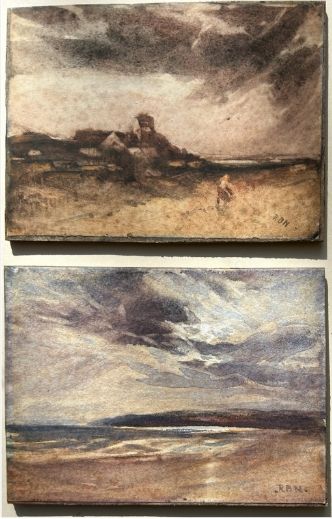
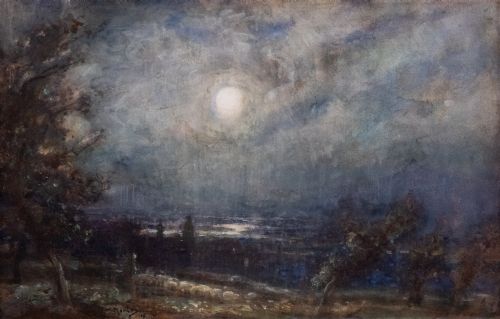


Atmospheric Watercolour Painting
An atmospheric watercolour painting captures fleeting light and weather, offering a quiet window into British landscapes from the nineteenth and twentieth centuries.
Atmospheric Watercolour Painting
An atmospheric watercolour painting brings together delicate pigments and paper to record coastal views, rivers, and historic towns. These works span the Victorian era, the Edwardian period, and mid-century British impressionism, each era interpreting light and weather in distinct ways.
Most pieces on this page represent landscapes, marine scenes, and topographical views by named British artists. A buyer typically encounters coastal harbours, sunset vistas, and river scenes that rely on loose brushwork to create mood.
The selection ranges from nineteenth-century cityscapes to mid-century rural views. Each piece uses washes of colour to evoke mist, dusk, and shifting weather over land and water.
Materials and technique
These works are created using watercolour pigment applied to paper, often framed behind glass within wooden surrounds. Artists build the image through transparent washes that allow the white of the paper to shine through for highlights.
Techniques range from detailed topographical drawing to rapid impressionistic brushwork designed to capture transient atmospheric conditions. Pigments are handled with varying opacity to describe water, stone, sky, and foliage.
Listings span the Victorian period through to the nineteen-sixties, focusing on paper, watercolour pigment, and wood frames.
Distinguishing quality
Quality rests in the artist's handling of light, tone, and atmospheric depth rather than mere fidelity to the subject. Stronger works demonstrate a confident control of wet washes to suggest mist, smoke, or fading sunlight.
The sensitivity of the composition and the preservation of the paper surface distinguish finer examples from standard topographical records. A skilled hand uses minimal brushstrokes to convey distance and movement in water or sky.
Thomas William Morley·Robert Leslie Howey·William Tuck·George Weatherill·Frank Wasley·Fred Lawson·Herbert John Finn·William A. Macdonald·Frederick William Jackson·William Kay Blacklock·Walter Duncan
The Atmospheric Watercolour Painting Glossary
- Watercolour
- A paint consisting of a pigment suspended in a water-soluble vehicle. It is traditionally applied to paper in transparent washes.
- Impressionism
- A style of painting emphasising the accurate depiction of light in its changing qualities, often using visible brushstrokes.
- Wash
- A thin, fluid layer of watercolour pigment spread evenly across the paper to create areas of sky, water, or shadow.
Atmospheric Watercolour Painting: Frequently Asked Questions
How should I frame a watercolour painting?
Watercolours require protection behind glass and conservation mounting to prevent direct contact with the glazing. Acid-free materials preserve the paper over time.
Keep these works away from direct sunlight to prevent the pigments from fading.
What subjects are common in these paintings?
Common subjects include marine scenes, coastal harbours, and river views around London and the north of England. Artists frequently recorded castles, cathedrals, and rural meadows at dusk or dawn.
Topographical accuracy often combines with atmospheric effects like mist and sunset.
How do I date an atmospheric watercolour?
Dates often rely on artist signatures, framing evidence, or stylistic markers associated with British impressionism and the early twentieth century. Subject matter like shipping vessels or historic architecture can also provide clues.
Pigment analysis and paper characteristics help confirm the period.
Are these works original paintings?
The pieces listed are original works painted by hand directly onto paper using watercolour pigments. Each is a unique creation rather than a reproduction.
Brush textures and pigment pooling indicate the direct touch of the artist.