


Atmospheric Landscape Watercolour
These atmospheric landscape watercolour works capture coastal scenes, rivers, and historic architecture through delicate washes and pigment on paper.
Atmospheric Landscape Watercolour
An atmospheric landscape watercolour presents views ranging from Yorkshire abbeys and Lake District lakes to Venetian canals and London landmarks, capturing specific light and weather conditions. These works date from the Victorian era and the nineteenth century through to the mid-twentieth century, including pieces from the nineteen-twenties, nineteen-forties, and nineteen-fifties. The selection encompasses British Impressionism, Edwardian art, and the twentieth-century British school.
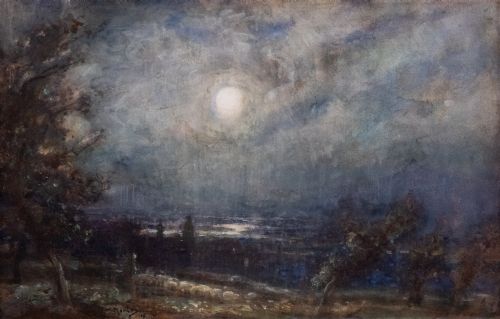
Buyers encounter subjects such as moonlit coasts, marine scenes with cobles, and evening river views over the Thames. The primary forms include paintings, fine art, and wall art created by established regional and national artists. Most pieces depict identifiable British and European locations recorded with characteristic topographical detail.
The compositions rely on the fluid properties of watercolour paint to evoke mist, sunset, and twilight. Works from this group demonstrate how painters utilised paper surfaces to suggest light bouncing off water and ancient stone.
Distinguishing quality
Quality rests in the artist's ability to command the watercolour medium to convey light and depth without heavy reworking. Stronger examples demonstrate confident brushwork and precise control over pigment density on paper.
The sophistication of the composition and the artist's handling of atmospheric conditions such as evening light or marine mist elevate certain works above standard topographical records.
Artists frequently braved chilly North Sea gales in Yorkshire fishing villages just to capture the exact spray on a coble's hull.
Thomas William Morley·Robert Leslie Howey·William Tuck·George Weatherill·Frank Wasley·Frederick William Jackson·Fred Lawson·Herbert John Finn·William Kay Blacklock·Walter Duncan
The Atmospheric Landscape Watercolour Glossary
- Watercolour
- A paint consisting of colour suspended in a water-soluble vehicle, applied to paper to create transparent or translucent passages.
- British Impressionism
- A painting style developed in Britain focusing on light, colour, and everyday landscape subjects rather than strict academic finish.
- Topographical
- Representing specific places accurately, often recording historic buildings, rivers, and recognizable towns.
- Coble
- A traditional type of open fishing boat with a flat bottom, commonly found in North East England marine watercolours.
- Wash
- A thin, fluid layer of diluted watercolour pigment spread evenly across paper to create skies or water.
Atmospheric Landscape Watercolour: Frequently Asked Questions
How should I frame a watercolour?
Watercolours require framing behind glass with acid-free mounts to prevent the paper from touching the glazing. This barrier protects the pigments from humidity and airborne pollutants.
Keep framed works away from direct sunlight to prevent the watercolour pigments from fading over time. Proper conservation framing ensures the delicate paper support survives for decades.
What subjects do these paintings show?
The works depict British and European scenes including marine harbours, rivers, cathedrals, and rural landscapes. Artists recorded specific locations from Yorkshire, the Lake District, Venice, and London.
Many pieces capture transient moments such as sunset over Whitby Abbey, moonlit coasts, or evening views across the Thames. These topographical and atmospheric details anchor each painting in a recognisable setting.
How do I date an antique watercolour?
Dating relies on artist biographical dates, stylistic markers from movements like British Impressionism, and framing materials. Signatures and titles inscribed on the work often provide direct clues to the period.
Victorian and Edwardian pieces exhibit distinct palettes and framing styles compared to mid-twentieth-century works from the nineteen-forties and nineteen-fifties. Comparing the paper type and pigment application helps narrow down the decade of creation.
Are these works originals?
Every piece listed is an original unique painting created by hand using watercolour pigment on paper. Artists applied brushstrokes directly to the sheet rather than producing mechanical reproductions.
Close inspection reveals the texture of the paper and the individual brush marks left by the painter. This authenticity distinguishes original fine art from later prints.