


Arts and Crafts Relief
These arts and crafts relief pieces bring hammered metal, carved oak and glazed ceramic into interiors through wall plaques, mirrors and vessels.
Arts and Crafts Relief
When you search for arts and crafts relief, you encounter domestic objects where ornament rises from the surface through hand-hammering, carving or moulding. The examples on this page span the late nineteenth century into the Edwardian period, drawing on Victorian arts and crafts and art nouveau movements.
You will find copper vessels, carved oak panels, wall plaques and ceramic tiles alongside larger furnishings such as firescreens and overmantel mirrors. These works capture the era's preference for expressive surface texture in everyday interiors.
Materials and techniques
Makers shaped sheet copper into twin-handled vases, firescreens and decorative trays, raising designs from the reverse to create tactile relief patterns. Oak provided the substantial ground for carved wall panels, overmantel mirrors and framed plaques.
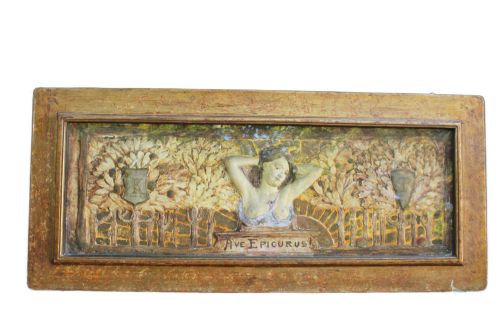
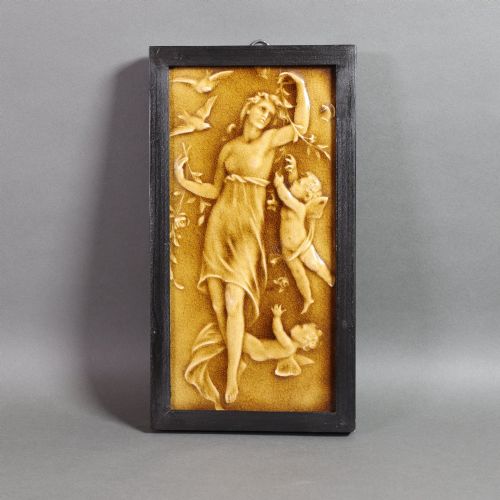
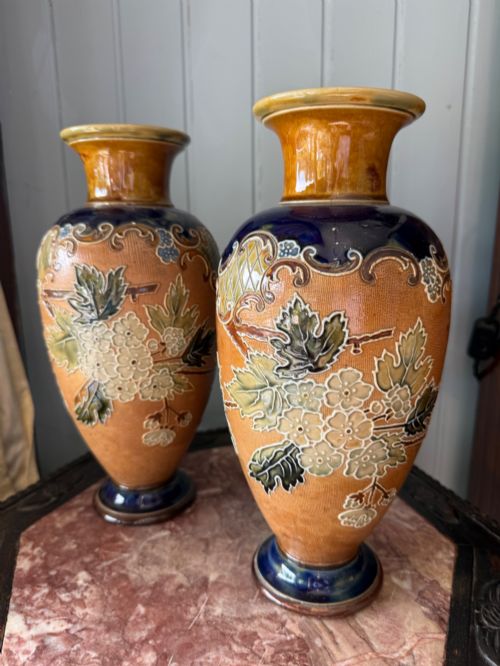
Ceramics relied on stoneware, earthenware and faience, finished with glazes that pooled in the recesses of modelled surfaces. Plaster and walnut also appear, shaped into framed figural plaques and wall art.
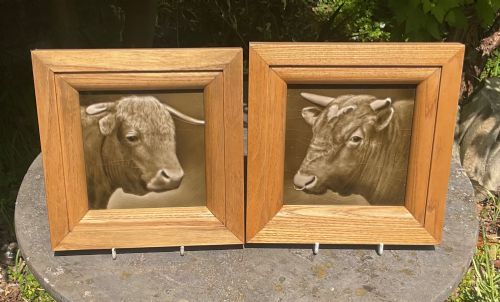
Domestic animals make unexpected appearances, including a framed tile pairing a bull and a cow.
What separates the grades
Quality rests in the crispness of the hand-worked detail and the surety of the modelling. A sharply struck copper panel or a deeply carved wooden relief reveals the maker's control over the medium.
Glaze distribution marks the distinction in ceramic pieces. Successful firings allow rich colours to pool evenly across modelled figures and floral motifs without obscuring the underlying form.
Royal Doulton·Sherwin and Cotton·Keswick·Emma Shute·Reginald Robert Tomlinson·Burmantofts Faience
The Arts and Crafts Relief Glossary
- Relief
- Ornament that projects from a flat background surface. This sculptural approach defines the wall plaques and copper vessels found here.
- Faience
- Tinsmith or potter's earthenware decorated with opaque coloured glazes. Burmantofts produced notable examples in this medium.
- Overmantel
- A decorative mirror or panel designed to hang above a fireplace mantel. Several examples incorporate carved oak frames.
- Stoneware
- A dense, vitreous ceramic fired at high temperatures. It forms the body of many jugs and vases from this period.
Arts and Crafts Relief: Frequently Asked Questions
How do I hang a heavy copper firescreen or mirror?
Heavy copper firescreens and carved oak overmantel mirrors require secure wall fixings suited to their substantial weight.
Ensure screws anchor directly into wall studs or employ appropriate masonry fixings to support the wooden frames safely.
How should I clean antique copper relief work?
Dust antique copper gently with a soft, dry cloth to preserve the natural oxidation built up over decades.
Avoid abrasive metal polishes that strip away the authentic surface character and diminish the definition of the raised design.
What rooms suit an arts and crafts wall panel?
Carved oak panels and framed plaster reliefs suit hallways, living rooms and studies where natural wood tones complement interior woodwork.
Positioning them away from direct heat sources protects both the timber panels and the plaster reliefs from cracking.
How do I identify a Burmantofts ceramic piece?
Burmantofts pieces typically display characteristic faience glazes applied to heavy earthenware bodies, often taking the form of vases or stick stands.
The modelling combines naturalistic floral elements with the distinct surface textures favoured by late Victorian art potteries.