


Arts and Crafts Candle Holders
These arts and crafts candle holders bring honest metalwork and tactile design into modern interiors through enduring craftsmanship.
Arts and Crafts Candle Holders
When you search for arts and crafts candle holders, you meet sturdy metal forms designed to celebrate utilitarian purpose with hand-finished integrity. The selections here span the late nineteenth century through to the Edwardian period and beyond, drawing on British, continental, and American workshops.
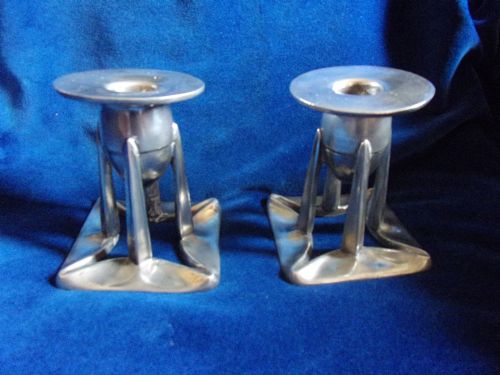
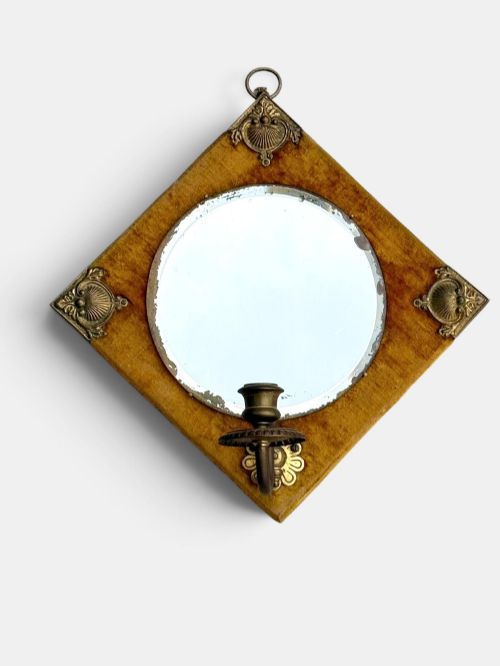
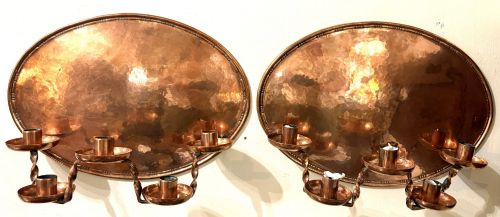
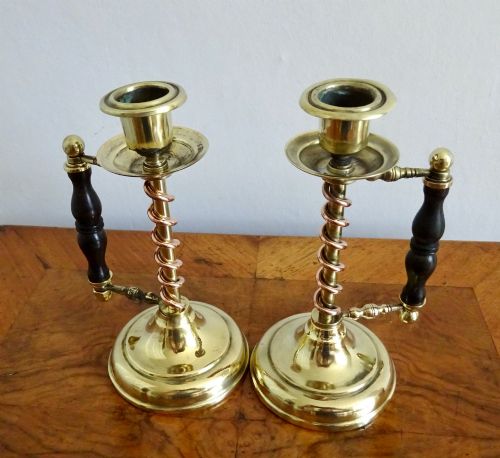
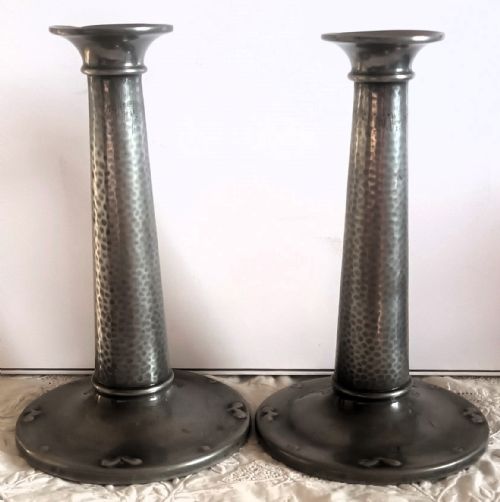
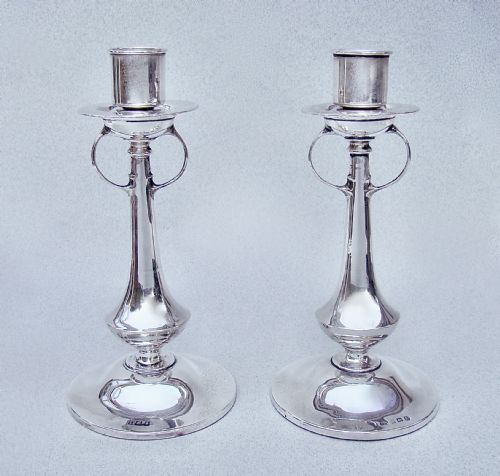
Candlesticks dominate the selection, often appearing in balanced pairs alongside chambersticks, wall sconces, and multi-light candelabra. Brass, pewter, and copper examples prevail, frequently displaying the hammer marks and riveted construction characteristic of the movement.
Continental pieces introduce Amsterdam School and Secessionist influences, while domestic items lean towards Liberty and Co productions or regional guild aesthetics. Oak, wrought iron, and silver also surface, providing diverse textures for collectors of period lighting.
Materials and Technique
Makers shaped sheet copper and brass by hand, utilising planishing hammers to leave distinct facets across the surface of the metal. Cast brass and spun pewter components were assembled with visible rivets and structural joins rather than hidden adhesives.
Pewter items often relied on complex moulds, yielding substantial vessels with soft grey patinas that aged gracefully. Wrought iron elements were heated and beaten at the forge, resulting in robust wall sconces and heavy pricket bases.
Enamel plaques and inset cabochons occasionally provided spots of intense colour against dull metallic grounds. Oak bodies added warmth, combining turned wooden shafts with protective metal drip pans.
Materials range from traditional brass and copper to sterling silver, glass, and oak.
Judging Quality
Quality rests in the crispness of the hand-beaten surface and the intentional weight of the object. Superior items display deliberate construction choices where structural brackets double as decorative motifs.
Lighter, mass-produced commercial pieces lack the satisfying heft and individual tool marks found on workshop-made examples. The depth of the patination and the integrity of applied enamel work further separate standard commercial items from distinguished studio output.
Archibald Knox·Liberty and Co·James Fenton·Birmingham Guild of Handicraft·Hugo Berger Goberg·Royal Doulton·Doulton Lambeth
The Arts and Crafts Candle Holders Glossary
- Pricket
- A sharp metal spike set in the centre of a drip pan to hold a candle upright. This form appears frequently on continental altar-style candlesticks.
- Chamberstick
- A low candle holder fitted with a shallow pan and a loop handle for carrying room to room. These domestic items were essential before electric lighting.
- Planishing
- The process of smoothing or shaping sheet metal with a hammer with small flat faces. This technique leaves a subtle, undulating texture across the surface.
- Tudric
- The trade name used by Liberty and Co for their high-grade Pewter ware. Pieces bearing this mark often involve notable designers such as Archibald Knox.
- Secessionist
- A style associated with Central European artists breaking away from academic traditions. It relies on geometric abstraction and stylised organic motifs.
Arts and Crafts Candle Holders: Frequently Asked Questions
How do I clean antique brass and copper?
Gentle dusting with a soft dry cloth preserves the historical patination developed over a century. Aggressive metal polishes remove the aged dark tones valued by collectors.
Avoid chemical dipping entirely, as it strips away the subtle surface textures left by the original maker's hammer.
Were these items meant for daily use?
Workshops produced these pieces for functional domestic illumination before electric lighting became universal in homes. Heavy bases and wide drip pans ensured safety during transport around dark rooms.
Modern owners can continue to burn standard taper candles in them safely with careful monitoring.
How do I distinguish Arts and Crafts from Art Nouveau?
Arts and Crafts design prioritises visible construction, honest materials, and functional utility with straightforward geometric or medieval inspiration. Art Nouveau leans into flowing, whiplash plant lines and asymmetrical naturalism.
Many pieces bridge both movements, combining structural metalwork with stylized floral enamel panels.
What is the significance of Liberty and Co?
Liberty and Co championed avant-garde design and brought modern craftsmanship to a wider commercial public in London. Their collaboration with designers like Archibald Knox defined British pewter production.
Marked pieces from this firm remain highly sought after by decorative arts enthusiasts.