



Art Nouveau Turquoise Jewellery
Art nouveau turquoise jewellery brings together organic forms and bright blue stones, offering distinct character for the modern collector.
Art Nouveau Turquoise Jewellery
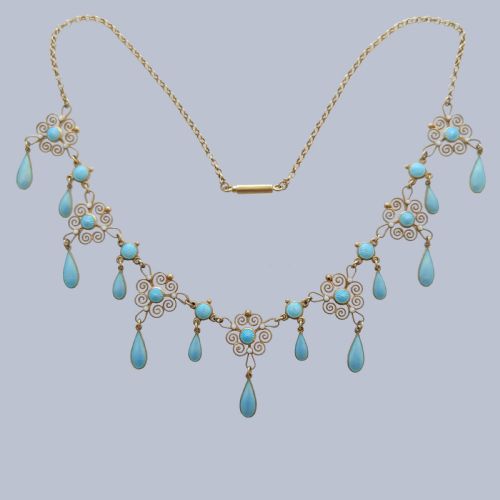
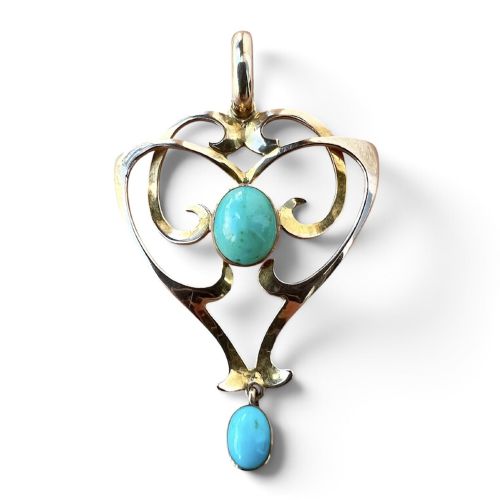
Buyers encountering this category will most commonly find pendants and necklaces executed in silver or gold, frequently paired with enamel, pearls, and turquoise matrix. Pieces range from delicate filigreed silver mounts to substantial gold work bearing the hallmarks of notable makers. The grouping spans from the 1890s through to the 1930s, capturing the transition of design styles over four decades.
How they were made
Maker's workshops utilised precious metals including silver, 9ct rose gold, 9ct gold, and 15ct gold to form the structural mounts and chains. Metalwork techniques encompass fine filigree work alongside solid casting and sheet construction, providing secure settings for the stones.
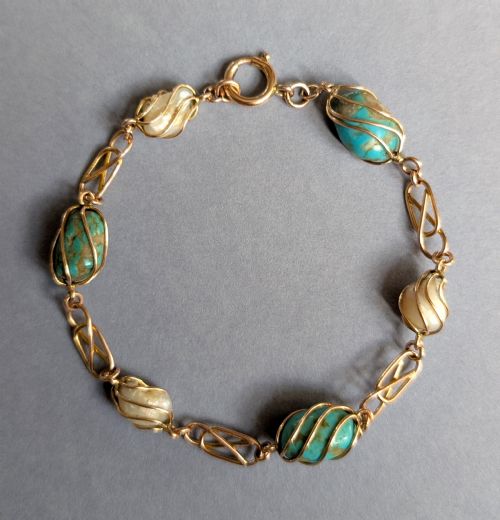
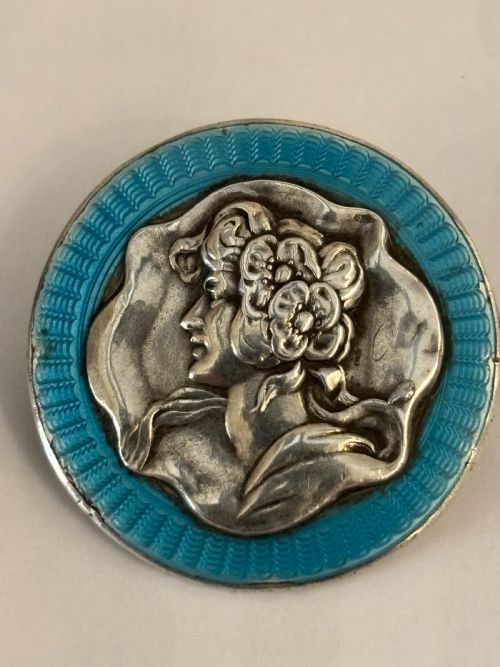
Turquoise stones, occasionally in matrix form, are combined with pearls and vibrant guilloche enamel to add colour and texture to the designs. Enamel work is fused to metal surfaces, while pearls and turquoise cabochons are bezel-set or pinned into organic, flowing motifs.
Art Nouveau Turquoise Jewellery Retail Price Guide 2026
Typical asking prices for art nouveau turquoise jewellery among the pieces listed under this phrase on Sellingantiques today, from the lower quarter to the upper quarter. They describe what is for sale here now, not the wider market.
Even a matching parure cannot prevent someone from losing an earring down a Victorian floorboard.
What varies in quality
Quality in these pieces is dictated by the finesse of the metalwork and the integration of enamel and stones. Superior examples display intricate filigree, crisp enamelling, and harmonious stone selection that elevates the entire composition.
The distinction between standard workshop production and masterwork output rests on the artistic ambition of the design and the precision of its execution. Works associated with named makers or specific design movements often reveal a higher degree of sculptural refinement.
Deakin and Francis·Murrle Bennett·Dorrie Nossiter·Liberty and Co
The Art Nouveau Turquoise Jewellery Glossary
- Art Nouveau
- A design style characterised by fluid, organic lines and floral motifs that dominated the turn of the twentieth century. This aesthetic rejected historic revivalism in favour of dynamic, nature-inspired forms.
- Arts and Crafts
- A movement focused on traditional craftsmanship, simple forms, and visible maker input. It often utilised silver alongside semi-precious stones and enamel.
- Guilloche enamel
- A decorative technique where enamel is applied over metal engraved with a repetitive mechanical pattern. This method creates translucent waves of colour and texture.
- Turquoise matrix
- Turquoise stone that retains portions of its host rock, displaying web-like veins running through the blue material. This variety offers a distinct earthy pattern compared to uniform blue stones.
- Parure
- A matched set of jewellery designed to be worn together, typically including pieces such as earrings, rings, and necklaces. Such suites ensure a cohesive appearance for the wearer.
Art Nouveau Turquoise Jewellery: Frequently Asked Questions
What periods do these pieces date from?
The items span from the late nineteenth century through the Edwardian era and into the 1930s. This period covers the height of the Art Nouveau and Arts and Crafts movements.
Designs shift from nineteenth-century organic silver work toward later geometric influences, while maintaining a consistent focus on turquoise and enamel embellishment.
How do silver and gold pieces differ?
Silver examples often feature detailed filigree work and colourful guilloche enamel, aligning closely with Arts and Crafts ideals. Gold items, rendered in nine or fifteen carat variants, frequently highlight the stones within richer, warmer metal mounts.
Both metals were utilised by prominent workshops, meaning the choice often depends on the desired visual weight and metal colour of the jewellery.
Are matched sets common?
Complete sets, known as parures, appear occasionally alongside individual necklaces, pendants, and bracelets. These sets might combine earrings, rings, and necklaces sharing identical turquoise matrix and silver construction.
Finding a complete ensemble offers a direct view into how period jewellery was collected and worn as a unified group.
What stones accompany the turquoise?
Pearls and enamel are the most frequent companions to turquoise in these designs. Pearls appear as drops or accent beads, while enamel provides colourful backdrops in shades of blue and green.
These complementary materials enhance the organic themes central to both Art Nouveau and Arts and Crafts aesthetics.