


Art Nouveau Bedside Table
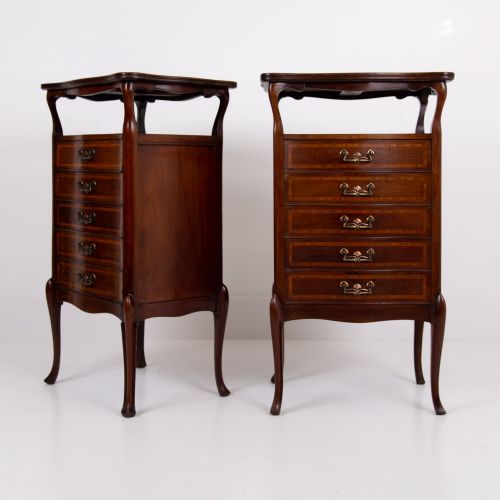
These art nouveau bedside table pieces bring sweeping floral lines and rich timber into the bedroom.
Art Nouveau Bedside Table
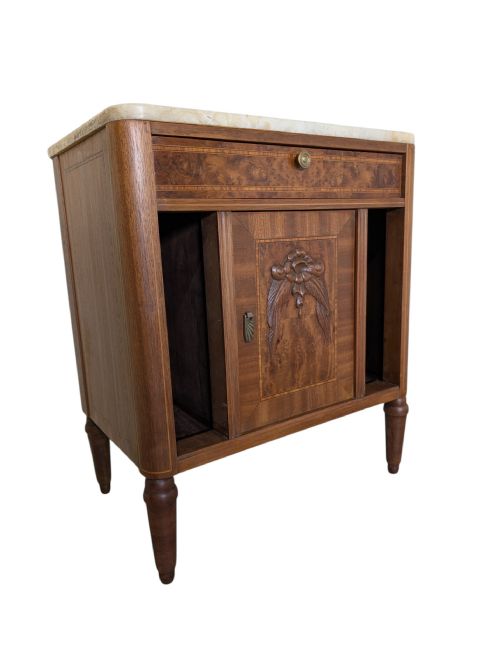
An art nouveau bedside table sits beside the bed, holding small nocturnal necessities while displaying organic craftsmanship from the turn of the twentieth century. Buyers seeking this style encounter mahogany and walnut cabinets alongside occasional side tables paired with marble tops.
The aesthetic bridges several related design movements visible in the evidence, encompassing French variants and Secessionist influences. Pieces originate predominantly from the Edwardian era and the late nineteenth century.
Cabinets often feature dedicated drawers for storage, while some listings pair these items directly with matching beds or broader bedroom suites. The selection ranges from simple timber cupboards to pieces embellished with intricate carved woodwork.
Materials and construction
Cabinet makers utilised dense hardwoods such as mahogany and walnut, frequently selecting figured grains to enhance the visual appeal of the bedside furniture. Marble slabs served as durable, cool surfaces fitted to the tops of French side cabinets.
Joinery techniques combined traditional cabinet-making methods with the characteristic fluid, asymmetrical carving of the period. Brass hardware and occasional metal mounts completed the structural assembly.
Judging quality
Quality rests upon the crispness of the carved ornamentation and the selection of timber veneers. Superior examples display deeply sculpted botanical motifs that integrate smoothly into the structural frame rather than appearing as applied decoration.
The integration of original stone tops and intact hardware distinguishes finer cabinets from more utilitarian workshop output. Matching pairs command greater attention than isolated pieces salvaged from larger suites.
The Art Nouveau Bedside Table Glossary
- Secessionist
- A Central European offshoot of the movement that favoured geometric austerity alongside organic curves. This style appears on brass light fittings and metalwork.
- Ormolu
- Gilded bronze used for decorative mounts and decorative highlights on French furniture. It adds a metallic lustre to timber cabinets.
- Coromandel
- A dense, dark timber with contrasting light streaks imported from Asia. Cabinet makers utilised this exotic wood for high-status surfaces.
- Spelter
- A zinc alloy cast into decorative figures and lamp bases, often given a bronze-like finish. It provided an economical alternative to solid bronze during the period.
- Cabochon
- A polished gemstone or glass insert cut with a convex, unfaceted surface. These elements frequently decorate metal lamp bases.
Art Nouveau Bedside Table: Frequently Asked Questions
What defines an art nouveau bedside table?
These tables incorporate organic, plant-inspired motifs, flowing asymmetrical lines, and rich hardwoods typical of turn-of-the-century design.
They serve practical bedside storage while introducing distinctive decorative character to a bedroom scheme.
How do French cabinets differ from English ones?
French variants frequently incorporate inset marble tops and ormolu mounts, reflecting continental tastes of the late nineteenth and early twentieth centuries.
English pieces tend to rely more strictly on carved timber surfaces and traditional cabinet proportions.
Can I match a single table with an existing bed?
Many listings include pairs or matching suite components, but individual cabinets can function effectively alongside dissimilar beds as contrasting accent pieces.
Scale and timber tone remain the primary considerations when mixing antique bedside furniture.
What woods were used for these cabinets?
Makers predominantly worked with mahogany and walnut, sometimes employing exotic timbers like coromandel for high-end commissions.
These dense woods provided a stable canvas for deep, flowing sculptural carvings.
How do I identify the period of a table?
Dating relies on the presence of characteristic design vocabulary, such as whip-line plant stems, combined with period construction methods.
Most pieces date from the Edwardian decade and the surrounding transition between centuries.