
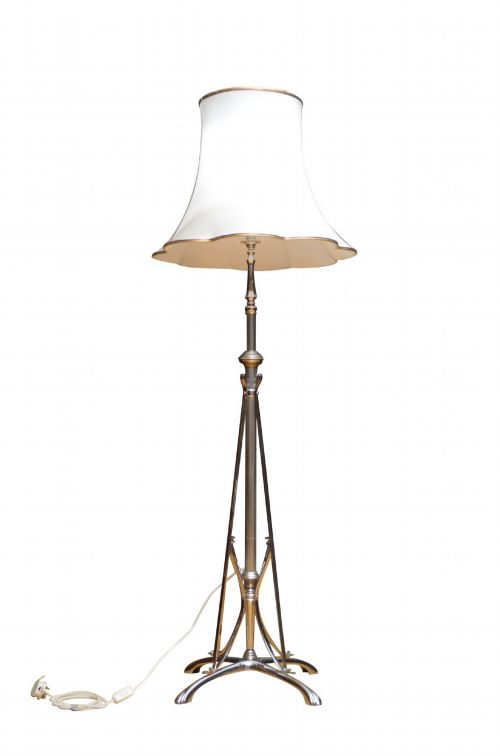


Art Deco Tall Lamp
An art deco tall lamp brings upright vertical presence and geometric styling to a room, offering both focused task lighting and ambient illumination.
Art Deco Tall Lamp
When you search for an art deco tall lamp, you are looking at upright lighting fixtures designed primarily during the 1920s and 1930s. These pieces range from towering floor standards and torchieres to substantial desk and table lights with significant vertical height.
The selections available here include standard lamps, uplighters, and desk models. Alongside dedicated lighting, the record shows related tall occasional forms like torcheres and plant stands that share the same aesthetic vocabulary.
Materials and construction
Makers of the period utilised a mix of metals including brass, chrome, and copper for structural uprights and bases. These metals were frequently paired with rich woods such as walnut, mahogany, oak, ebony, and maple.
Lighting components incorporated specialist glass elements like frosted, opaline, and controlled bubble Murano glass, often paired with fabric shades. Some constructions also integrated marble or early plastics like catalin bakelite.
Listings feature pieces spanning the 1900s through the 1930s, constructed in brass, chrome, copper, walnut, mahogany, oak, ebony, and glass.
What separates examples
Quality in these upright lamps rests upon the integrity of the materials and the precision of the geometric assembly. Superior examples display substantial weight in the base and seamless transitions between contrasting elements like metal shafts and timber columns.
The sophistication of the design execution, whether following a streamlined modernist path or a more decorative revival style, dictates the distinction between standard production and exceptional manufacture.
Harry and Lou Epstein
The Art Deco Tall Lamp Glossary
- Torchere
- A tall freestanding light fixture designed to direct illumination upwards toward the ceiling. These pieces often feature slender shafts supported by heavy decorative bases.
- Uplighter
- A lamp engineered to cast light upward, creating ambient room illumination rather than direct downward task lighting.
- Standard lamp
- A British term for a tall freestanding floor lamp used beside seating or in corners.
- Opaline glass
- A milky, semi-translucent glass type frequently utilised in period shades to diffuse light evenly without harsh glare.
- Amsterdam School
- An early twentieth-century architectural and design movement known for expressive brickwork, organic forms, and rich timber detailing.
Art Deco Tall Lamp: Frequently Asked Questions
How do I light a room with a standard lamp?
Tall floor lamps provide ambient uplighting or focused illumination depending on the shade and positioning. Placing them in corners or beside seating areas balances the room's light levels.
They work effectively alongside lower table lamps to create layered illumination across different heights.
Are these lamps suitable for low ceilings?
Standard lamps and desk lights are freestanding and height-independent, meaning room ceiling height does not restrict their placement. Torcheres direct light upward, which can visually lift a low ceiling by washing it with brightness.
Choose models with adjustable height or focused shades if clearance is tight.
How do I identify a 1930s lamp?
Look for characteristic materials such as chrome, frosted glass, and contrasting exotic woods like ebony and walnut. The silhouettes lean toward geometric lines, stepped bases, and streamlined vertical forms.
Peculiar material combinations, such as bakelite paired with metal, also point directly to this era.
Can I use modern LED bulbs in these?
Most vintage lamp holders accommodate modern LED bulbs provided the wattage and fitting match the original socket specifications. Ensure the wiring is inspected and updated by a professional before regular use.
Low-heat LEDs protect fragile vintage glass and fabric shades from thermal damage.