



Art Deco Sapphire Solitaire
An art deco sapphire solitaire centres a single striking gemstone, offering sharp geometric lines and vibrant colour that define early twentieth-century design.
Art Deco Sapphire Solitaire
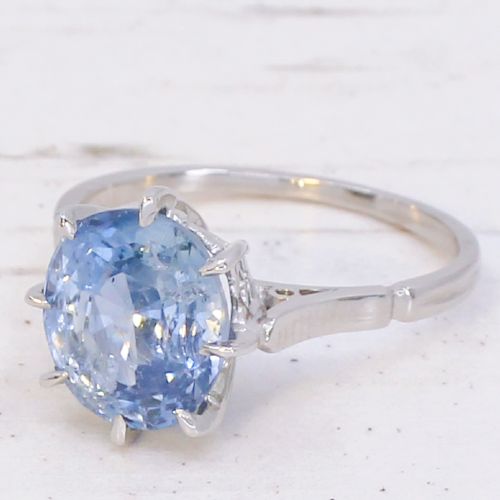
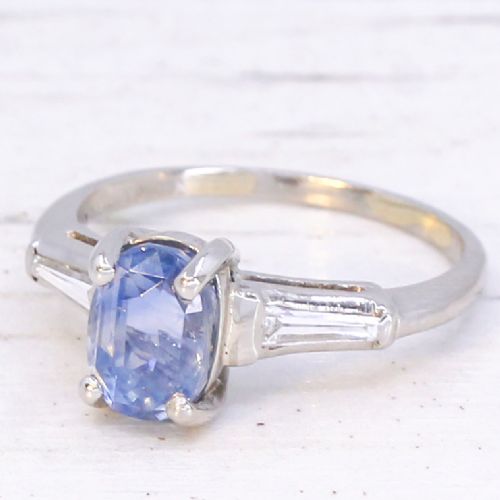
An art deco sapphire solitaire focuses attention upon a single central gemstone, most commonly encountered as a ring alongside occasional pendants. These pieces originate predominantly from the 1920s and 1930s, though examples stretch from the 1910s through to later revival periods.
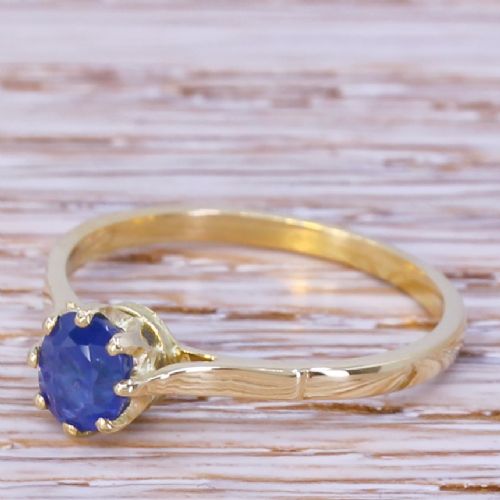
The stones themselves display remarkable variety in origin and tone, ranging from deep blue Burmese and Ceylon specimens to unusual purple, yellow, green, and padparadscha varieties. Natural stones share the stage with occasional synthetic sapphires set in similar geometric mounts.
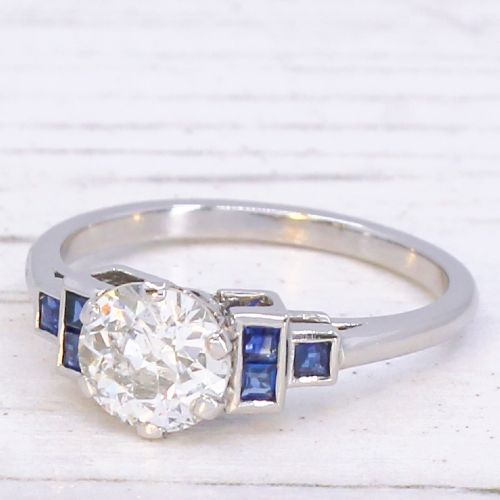
Platinum serves as the dominant precious metal for these mountings, frequently paired with old cut or transitional cut diamonds, while 9ct gold provides an alternative setting for specific coloured stone variations.
Materials and construction
Platnum mounts dominate the construction of these jewels, providing the necessary strength for intricate, fine-wire settings while maintaining a bright white finish that complements the central stones. Gold appears primarily in lower carat weights for specific coloured varieties.
Central sapphires are shaped into emerald, rectangular, pear, and cabochon cuts to maximise their optical depth and colour distribution. These are frequently accented by old cut or transitional cut diamonds set directly into the shoulders.
Some 1920s rings ventured into vibrant orange and green-yellow sapphires, proving that geometric glamour welcomed a riot of unexpected rainbow hues.
Evaluating quality and character
Quality rests significantly upon the geographic origin and thermal history of the sapphire, with unheated stones from sources such as Ceylon, Kashmir, and Burma commanding particular attention from collectors. The saturation, uniformity, and natural vibrancy of the colour dictate the visual impact of the centre stone.
The precision of the platinum work and the integration of supporting diamond accents determine the overall refinement of the mount. Pieces that balance substantial carat weight with clean geometric proportions represent the pinnacle of the period's output.
The Art Deco Sapphire Solitaire Glossary
- Solitaire
- A piece of jewellery featuring a single set gemstone without companion stones of the same type. This setting style concentrates visual interest entirely on the central gem.
- Unheated
- A gemstone that has undergone no thermal enhancement to improve its natural colour or clarity. Such stones are documented for their pristine geological state.
- Old Cut
- A diamond cut predating modern brilliant standards, characterised by a smaller table, higher crown, and open culet. These stones display a distinctive soft candlelit sparkle under low lighting.
- Transitional Cut
- A diamond faceting style bridging old mine cuts and modern round brilliants, produced primarily during the 1920s and 1930s. It combines a smaller table with modern pavilion angles.
- Cabochon
- A gemstone cut with a smooth, rounded, convex upper surface rather than faceted planes. This style highlights the internal lustre and depth of coloured stones.
Art Deco Sapphire Solitaire: Frequently Asked Questions
What defines an art deco sapphire solitaire?
These pieces feature a single prominent sapphire set within a geometric platinum or gold mount, often accented with small diamonds.
Originating mainly from the 1920s and 1930s, they showcase the clean lines and architectural motifs characteristic of the period.
Are all the sapphires natural?
The majority of stones are natural, originating from historic sources such as Ceylon, Burma, and Kashmir, with varying degrees of colour saturation.
Selected pieces incorporate synthetic sapphires, which were used experimentally and artistically during the early twentieth century.
How do I care for a platinum setting?
Platinum is a remarkably durable and dense metal that resists wear well, making it ideal for securing valuable centre stones over generations.
Routine cleaning with warm soapy water and a soft brush maintains the polish without harming the structural integrity of the fine claws.
Can I wear these rings every day?
Sapphire ranks nine on the Mohs hardness scale, meaning it withstands daily wear exceptionally well when mounted securely.
Care should be taken with antique settings and delicate platinum shoulders to avoid heavy impacts during manual tasks.