


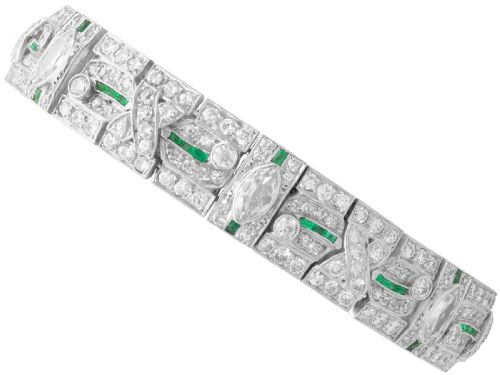


Art Deco Diamond Bangle
An art deco diamond bangle combines geometric precision with enduring elegance, offering a sophisticated wrist ornament for any collector.
Art Deco Diamond Bangle
An art deco diamond bangle represents a distinct period of design spanning the 1910s through the 1940s and into the 1950s. These bracelets take the form of hinged bands or line bracelets featuring geometric layouts.
Most examples found on this page display the characteristic symmetry and clean lines of the Art Deco style, frequently paired with the 1940s Retro aesthetic. Bracelets in the evidence utilise various gold purities alongside platinum settings.
Buyers encounter numerous variations incorporating gemstones alongside diamonds, including sapphires, emeralds, rubies, pearls, and seed pearls. These versatile ornaments serve as wristwear that transitions effortlessly from day to evening attire.
Materials and construction
Makers constructed these pieces using platinum and various gold alloys, including 18ct yellow gold, 18ct white gold, 15ct rose gold, and 8ct rose gold. Platinum served as the preferred metal for securing intricate diamond layouts during the height of the Art Deco period.
Craftsmen set old cut diamonds alongside calibrated rubies, sapphires, and emeralds into rigid bands or flexible hinged bangles. Metalwork techniques prioritized secure stone settings while maintaining geometric clarity and structural balance.
Art Deco Diamond Bangle Retail Price Guide 2026
Typical asking prices for art deco diamond bangle among the pieces listed under this phrase on Sellingantiques today, from the lower quarter to the upper quarter. They describe what is for sale here now, not the wider market.
Listings feature periods spanning from 1910 to 1950, including 1940s Retro and Art Deco styles.
Assessing quality and craftsmanship
Quality rests upon the proportion and brilliance of the diamond carat weights relative to the metal framework. Pieces with substantial stone weight mounted in platinum occupy the upper tier of the range.
The precision of the geometric layout and the integration of coloured stones such as sapphires, emeralds, and rubies distinguish finer examples. Original elements like fitted boxes also elevate a piece's standing.
Baume Mercier
The Art Deco Diamond Bangle Glossary
- Art Deco
- A design style characterised by geometric shapes, symmetry, and sleek lines, prominent from the 1910s to the 1940s. This aesthetic defines the primary visual appeal of these bracelets.
- Old Cut Diamond
- A diamond cut by hand before modern facet standards were established, displaying smaller tables and higher crowns. These stones provide a softer, deeper luminescence under candlelight.
- Platinum
- A dense, durable, and white precious metal utilised extensively in jewellery manufacturing for its strength. It allows artisans to create delicate settings that securely hold heavy stone weights.
- Line Bracelet
- A flexible bracelet featuring a continuous line of gemstones set sequentially around the wrist. This form showcases uniform diamond or coloured stone arrangements.
- Hinged Bangle
- A rigid bracelet incorporating a hinge and clasp mechanism to secure the band around the wrist. This construction keeps the geometric design properly oriented.
Art Deco Diamond Bangle: Frequently Asked Questions
How do I wear a bangle?
Slide the hinged band over the wrist and secure the clasp carefully. These pieces sit comfortably alongside other wristwear or stand alone as a statement.
Ensure the safety chain or locking mechanism remains fastened during wear to prevent loss.
Are these bangles solid platinum?
Many listings feature platinum construction, particularly those from the height of the Art Deco period. Other examples utilise 18ct yellow gold, 18k white gold, or rose gold.
Review the specific material details in each listing to confirm the metal composition.
What stones accompany the diamonds?
Sapphires, emeralds, and rubies frequently appear alongside diamonds in these designs. Seed pearls and pearls also decorate specific period pieces.
Colourful gemstones provide contrast against the neutral tones of platinum and gold.
How do I date these bracelets?
Dating relies on stylistic markers such as geometric Art Deco motifs or 1940s Retro forms. Period evidence spans from the 1910s through the 1950s.
Examining the metal choices and stone cuts helps place each piece within its specific decade.