


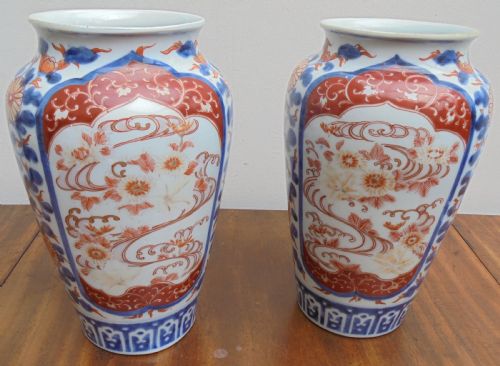
Arita Export Porcelain Vases
These arita export porcelain vases are remarkable works of Japanese craftsmanship that bring centuries of history and striking ceramic artistry into your home.
Arita Export Porcelain Vases
When you search for arita export porcelain vases, you encounter pieces spanning from the late seventeenth century through the Edo and Meiji periods to the early twentieth century. These vessels range from blue and white trumpet-shaped beaker forms to large lidded vessels and spill vases decorated in the Imari palette.
You are most likely to meet Japanese Imari examples on this page, alongside earlier blue and white pieces and Fukagawa porcelain vases complete with stands. The forms vary from shaped pairs and garnitures to single large vessels, reflecting the diverse output exported from Arita.
The historical scope extends from the seventeenth century through the nineteenth century, capturing both early Kano designs and later Meiji period production. Each piece demonstrates the enduring traditions of Japanese porcelain manufacture tailored for international trade.
How they were made
Potters shaped fine porcelain clay into vessels before applying cobalt blue underglaze for foundational patterns. Artisans then added overglaze enamel and gold leaf or gilding to create the rich colour palettes seen on Imari and Kano design pieces.
Kiln firing fused the glazes and enamels to the hard porcelain body, often supplemented by delicate hand-painting techniques. Selected pieces also integrated wooden elements such as hardwood stands to support the finished vases.
Arita Export Porcelain Vases Retail Price Guide 2026
Typical asking prices for arita export porcelain vases among the pieces listed under this phrase on Sellingantiques today, from the lower quarter to the upper quarter. They describe what is for sale here now, not the wider market.
Early potters occasionally loaded kilns with such enthusiasm that pieces fused together, leaving us with stubborn pottery scars to ponder.
What varies in quality
The refinement of the cobalt blue underglaze and the precision of the overglaze enamel work define the upper tier of these pieces. Superior examples display crisp brushwork, balanced composition, and well-preserved gilding that remains vibrant across the porcelain surface.
The complexity of the form and the integrity of the porcelain body also distinguish finer items. Complete garnitures, matched pairs, and pieces retaining original lids or fitted hardwood stands demonstrate higher manufacturing ambition and better survival.
Fukagawa
The Arita Export Porcelain Vases Glossary
- Arita
- The Japanese town in Hizen province where porcelain production began in the early seventeenth century. This centre became the primary source for exported Japanese ceramics.
- Imari palette
- A distinctive decorative scheme utilising cobalt blue underglaze, iron red overglaze, and gold leaf. This colourful combination defined much of the export ware destined for European markets.
- Edo period
- The historical era in Japan lasting from 1603 to 1868, characterised by economic growth and stable governance. Many early export pieces date from the latter half of this period.
- Meiji period
- The era of Japanese history spanning from 1868 to 1912, noted for rapid modernization and increased decorative arts exports. Vases from this time often exhibit bold colours and detailed ornamentation.
- Garniture
- A set of three or more matching vases designed to be displayed together on a mantelpiece or cabinet. These coordinated groups were popular in European interiors during the seventeenth and eighteenth centuries.
Arita Export Porcelain Vases: Frequently Asked Questions
How do I date an Arita vase?
Dating relies on stylistic clues, decorative palettes, and the specific characteristics of the porcelain body. Seventeenth-century pieces often feature blue and white Kano designs, whereas later nineteenth-century examples frequently employ the richer Imari palette.
Examining the potting technique and glaze characteristics helps distinguish Edo period productions from Meiji period items. Comparing forms with documented examples provides further confirmation of age.
Were these vases made for export?
Yes, these ceramics were produced primarily for export to European markets through trading ports like Nagasaki. Western tastes heavily influenced the shapes and decorative schemes adopted by Japanese kilns.
This international demand led to the creation of large garnitures, lidded vessels, and striking Imari patterns tailored for foreign interiors. Consequently, most surviving examples trace their provenance to collections outside Japan.
How do I display a large porcelain vase?
Large vases and pairs require stable placement on sturdy furniture, low tables, or dedicated stands to support their weight safely. Positioning them away from high-traffic areas prevents accidental knocks while allowing proper appreciation of the detailed hand-painted surfaces.
Keeping pieces out of direct sunlight preserves the brilliance of the overglaze enamels and gold leaf. Matching pairs look striking when balanced symmetrically on either side of a fireplace or cabinet.