
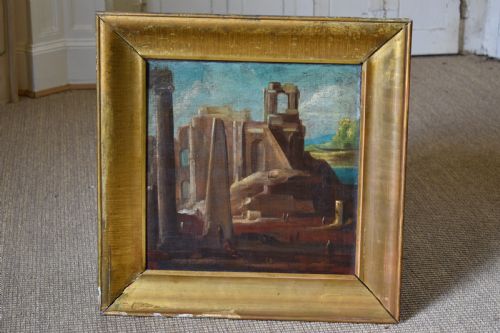


Architectural Ruin Painting
An architectural ruin painting captures the enduring weight of history, offering any interior a profound sense of classical melancholy.
Architectural Ruin Painting
An architectural ruin painting portrays decayed classical structures, crumbling abbeys, and ancient Italian landscapes from periods spanning the Georgian era to the mid twentieth century. When searching for an architectural ruin painting, collectors encounter both sweeping oil canvases and delicate works on paper.
The most common examples on this page are Grand Tour watercolours depicting famous classical sites such as Pompeii and Rome, alongside British views of ruined abbeys and castles. These works range from tightly rendered topographical studies to atmospheric Impressionist and Modern British interpretations.
How they were made
Makers utilised watercolour pigment on paper for detailed topographical views, often mounting them behind glass within gilt wood frames to protect the delicate medium. Oil paint was similarly applied to canvas or wood panels, allowing artists to build richer textures and deeper shadows across crumbling stone.
Techniques varied between the precise draughtsmanship required for classical monuments and the looser brushwork seen in later landscape paintings. Gilding with gold leaf was occasionally employed on frames to enhance the visual weight of the artwork.
Several watercolours show intrepid nineteenth-century travellers peering into the very same Roman baths we visit today.
What varies in quality
Quality rests upon the artist's command of perspective, light, and the textural decay of masonry, distinguishing masterly composition from mere illustration. Stronger pieces convey a palpable atmosphere and structural integrity, whereas weaker examples rely on formulaic repetition without depth.
The sophistication of the palette and the preservation of the medium, particularly regarding the vibrancy of watercolours on paper or the stability of oils on panel, determine the standing of an individual piece within the wider field.
Giovanni Paolo Panini·John Sowden·Peter Toft·Fred Lawson·Tom Dudley·William Crouch·Lamorna Birch R.A.
The Architectural Ruin Painting Glossary
- Grand Tour
- A traditional travel itinerary undertaken by European nobility to study classical antiquities. Paintings from this context frequently focus on Italian remains and classical architecture.
- Topographical
- A style of art dedicated to the accurate depiction of specific places and buildings. These works served as visual records before the widespread use of photography.
- Gilt wood
- Wood that has been treated with a thin layer of gold leaf or metallic powder. It frames many of the oil paintings and works on paper from the eighteenth and nineteenth centuries.
- Panel
- A flat piece of wood used as a rigid support for oil painting. This substrate predates the common use of stretched canvas.
- Watercolour pigment
- A colourant suspended in a water-soluble binder, applied to paper. It allows for translucent washes and fine illustrative detail.
Architectural Ruin Painting: Frequently Asked Questions
What is an architectural ruin painting?
These works depict decaying ancient structures, classical temples, and medieval abbeys. They reflect a fascination with the passage of time and classical antiquity.
Subjects range from Italian sites visited during the Grand Tour to British abbeys captured by local painters.
How were these paintings displayed?
Most works were framed in wood, frequently incorporating gilt details to complement the romantic subject matter. Watercolours were placed under glass on paper to prevent environmental damage.
Larger oil canvases hung in formal reception rooms, while smaller watercolours formed part of private studies.
How do I date a ruin painting?
Dating relies on the medium, the style of the frame, and the costume of any figures present. Georgian and nineteenth-century pieces often favour classical precision.
Later works from the twentieth century adopt looser modernist or impressionist approaches to the same subject.
Why did artists paint ruins?
Ruins symbolised the transience of human endeavour and the enduring power of nature. They became central motifs for artists influenced by romanticism and the Grand Tour.
Viewers found both moral reflection and aesthetic pleasure in the juxtaposition of wild foliage and crumbling stone.