

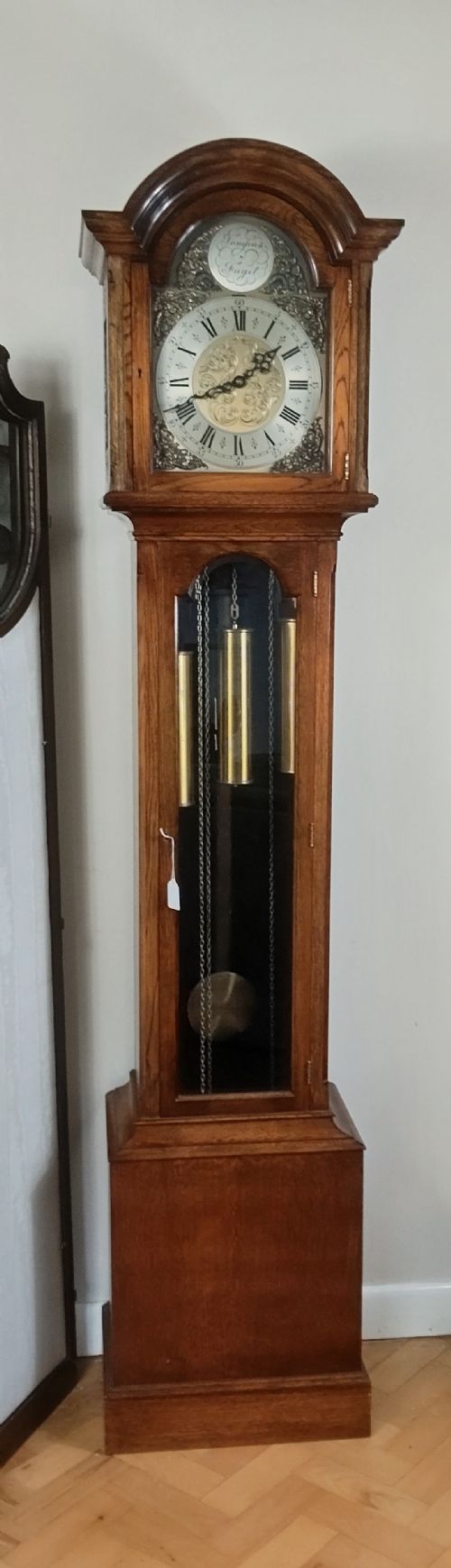
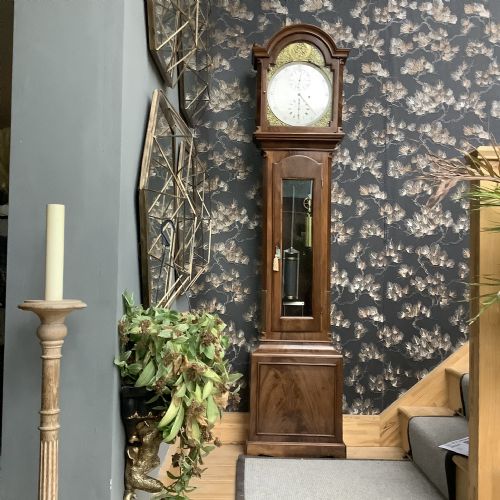


Arched Hood Floor Clock
An arched hood floor clock stands tall in a hallway, bringing centuries of mechanical timekeeping and cabinetmaking straight into a modern room.
Arched Hood Floor Clock
When you search for an arched hood floor clock, you are looking at tall case timepieces featuring distinct rounded pediments above the dial. The examples listed on this page span several centuries, including Georgian, Victorian, Regency, and early twentieth-century periods.
The forms appear under various descriptions such as longcase clocks, grandfather clocks, and smaller grandmother clocks. Most pieces originate from English makers working in mahogany, oak, and walnut, often with detailed dial work in brass and enamel.
You are most likely to meet nineteenth-century mahogany and oak versions on this page, alongside musical and chiming movements from the 1920s and 1930s. Proportion varies noticeably between the grander London examples and smaller provincial pieces.
How they were made
Cabinetmakers constructed the tall wooden cases using solid timbers like oak and mahogany, frequently applying flame mahogany veneer to the door panels and hoods. Glazed dial doors protected the painted or brass faces, while iron and brass weights provided the driving force for the gear trains.
Dial construction combined engraved brass plates with silvered chapter rings, or later iron dials painted with numerical markers and subsidiary seconds. Movements relied on intricate brass gear trains and pillars, designed by makers to support striking, chiming, or silent pull mechanisms.
Listings here feature mahogany, oak, and walnut woods across Georgian, Victorian, Regency, and twentieth-century periods.
What varies in quality
The architectural execution of the arched hood separates standard production from finer work, particularly in the crispness of the mouldings and the selection of veneer. Cabinets built with figured flame mahogany or quarter-veneered walnut display a much higher degree of cabinetmaking skill.
Movement complexity shifts the standing of a clock considerably, moving from simple time-only gear trains up to quarter-chiming mechanisms and musical cylinders playing multiple tunes. Signed brass dials by noted makers add further weight to the standing of the piece.
Priory of Dundee Scotland·Bravingtons·LISTER & SONS·Dwerrihouse & Carter·Richard Gibbs London·Ganthony Of London·ROWNING OF NEWMARKET·JOHN HARVEY OF WEYMOUTH
The Arched Hood Floor Clock Glossary
- Hood
- The upper part of the case that encloses the dial and movement, often featuring an arched pediment in this category. It typically slides forward or lifts off to grant access to the hands and face.
- Longcase clock
- The formal term for a tall pendulum clock housed in a protective wooden case, commonly known as a grandfather clock. These standing timepieces measure head height or taller.
- Pillar
- One of the vertical brass posts connecting the front and back plates of a clock movement. Five-pillar movements offer greater structural rigidity for the gear train.
- Chapter ring
- The metal ring fixed to the dial that bears the hour and minute numerals. It is frequently silvered and engraved to stand out against the dial plate.
- Quarter chiming
- A movement complication that sounds the quarters of the hour on bells, gongs, or chimes. This system requires additional gear trains beyond a standard time-and-strike setup.
Arched Hood Floor Clock: Frequently Asked Questions
Where should I place a floor clock?
These tall timepieces need a stable, level floor away from direct sunlight and heavy draughts to protect the wooden veneers and keep the pendulum swinging evenly. A hallway or reception room with sufficient ceiling clearance works best.
Ensure the case can be secured safely to a wall if necessary, especially in homes with active household movement. Stability ensures the mechanical beat remains consistent over time.
What is a grandmother clock?
A grandmother clock is simply a smaller version of the traditional longcase or grandfather clock, usually standing lower in overall height. These proportions became popular during the twentieth century for homes with lower ceilings.
Despite their reduced scale, they house functioning pendulum movements and traditional wooden cases. They offer the presence of a floor clock in a more compact footprint.
How do I tell an 18th-century clock from a 19th-century one?
Earlier eighteenth-century cases often display simpler, robust proportions in solid oak or mahogany with square or arched brass dials. Nineteenth-century examples frequently incorporate richer veneers, painted iron dials, or more ornate architectural hood designs.
Examining the construction methods inside the case and the style of the dial lettering helps clarify the period. Cabinet styles shifted across the Georgian and Victorian eras to reflect prevailing interior tastes.