

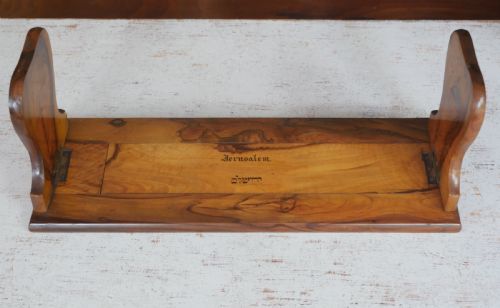


Antique Wooden Book Slide
These antique wooden book slide pieces keep your working library tidy on the desk with hinged or telescoping action.
Antique Wooden Book Slide
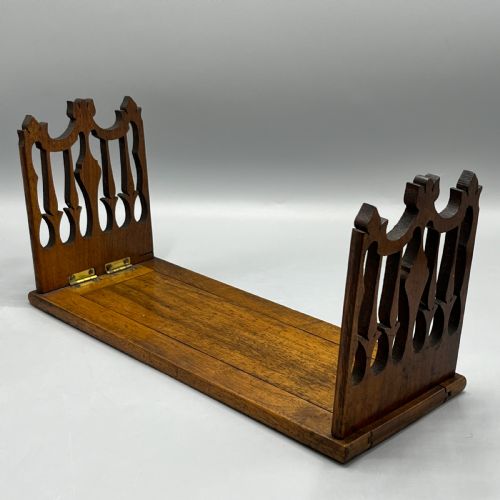
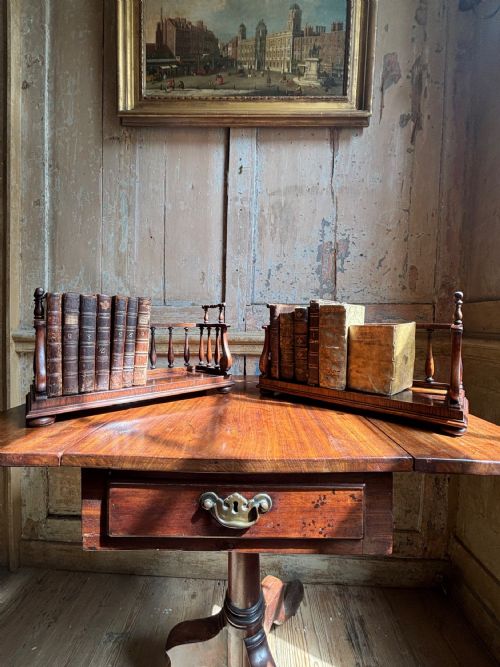
An antique wooden book slide provides an extending or hinged rack to hold a row of volumes upright on a desk, table or shelf. Most examples you encounter span the Victorian and Edwardian periods, stretching from simple domestic book rests to elaborate library accessories.
Makers shaped these utilitarian desk accessories from dense timbers, frequently incorporating folding ends, expanding scissor actions or sliding wooden bases. You will find standard forms described as book stands, book troughs, or book racks alongside extendable slides.
The materials reflect the taste of the nineteenth and early twentieth centuries, drawing on native oaks and walnuts alongside imported rosewood, coromandel and teak. These varied timbers served both home libraries and office desks.
Materials and construction
Cabinetmakers constructed these pieces from hardwoods such as oak, walnut, mahogany and rosewood, often pairing the timber with brass hinges, mounts and extending actions. Some examples utilise exotic woods including olive wood, coromandel and ebony to create striking visual contrast.
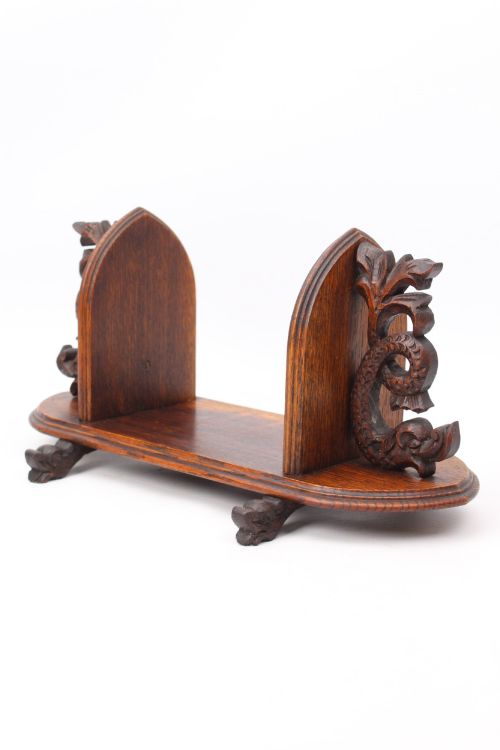
Surface decoration ranges from brass mounts and inlaid Tunbridge ware mosaics to hand-painted ceramic plaques and carved details. Joinery relies on traditional housing joints and dovetails to ensure the sliding mechanisms withstand daily use.
Decorative techniques visible across the selection include Tunbridge ware mosaics, brass mounts, carved teak, and hand-painted ceramic plaques.
Assessing craftsmanship and finish
Quality depends upon the precision of the extending mechanism and the selection of the timber grain. Finer examples display figured veneers, burr walnut, or meticulous Tunbridge ware patterns that require immense skill to assemble.
Superior pieces incorporate robust brass mountings and solid framing that prevent the wooden tracks from warping over decades of expansion and contraction. Lesser examples rely on plain timber with simpler joints and minimal decorative enrichment.
Gillows·Tiffany & Co
The Antique Wooden Book Slide Glossary
- Tunbridge Ware
- A form of woodworking where small pieces of coloured woods are arranged to create mosaic pictures, often geometric or floral, applied to the surface of the slide. This technique originated in the Kent town of Tunbridge Wells during the nineteenth century.
- Extending book slide
- A desk accessory featuring overlapping wooden bases that pull apart or slide together to accommodate varying numbers of books. The mechanism usually includes a stop to keep the expanding sections aligned.
- Gothic Revival
- An architectural and decorative style popular during the Victorian era that drew inspiration from medieval design. Pieces in this style frequently feature pointed arches, quatrefoils and heavy carved oak.
- Coromandel
- A dense, heavy timber imported from Asia, prized for its dark brown colour and dramatic black grain stripes. Cabinetmakers used it sparingly for luxury Victorian desk accessories.
- Book trough
- A stationary open box form designed to hold books upright without an extending mechanism. These often sit directly on a tabletop or bureau.
Antique Wooden Book Slide: Frequently Asked Questions
How do extending book slides work?
Extending book slides use overlapping wooden channels or sliding platforms that pull outward to lengthen the base as you add more volumes. Brass runners or wooden guides keep the moving sections stable and parallel.
When pushed together, they form a compact unit that takes up minimal space on a desk or shelf. The friction fit or built-in stops prevent the slide from pulling entirely apart during adjustment.
What woods were used for these?
Cabinetmakers utilised a wide selection of native and exotic timbers depending on the desired finish and period. Common choices include oak, walnut, mahogany and rosewood, alongside decorative options like burr walnut, olive wood and coromandel.
Ebonised wood and boxwood also appear frequently, particularly on pieces featuring contrasting inlay or Tunbridge ware decoration. Each timber offered different structural and aesthetic qualities suited to nineteenth-century desk furniture.
Are these suitable for modern books?
Most antique book slides handle standard octavo hardbacks and paperbacks comfortably when extended to an appropriate length. However, extremely heavy modern art folios may exceed the weight capacity of delicate nineteenth-century hinges or sliding mechanisms.
Measuring the base length and checking the depth of the end supports helps ensure your specific volumes fit securely between the bookends.
How do I date an antique book slide?
Dating relies on examining the timber, the style of decoration, and the complexity of any brass hardware or mechanical action. Victorian examples often display Gothic Revival carving, Tunbridge ware, or heavy brass mounts, while Edwardian versions tend toward simpler oak designs.
Patina on the wood and the construction methods used on the underside or interior tracks provide additional clues to the era of manufacture.