




Antique Waterfall Oil Artwork
These antique waterfall oil artwork pieces capture rushing rivers and mountain cascades on canvas within period gilt frames.
Antique Waterfall Oil Artwork
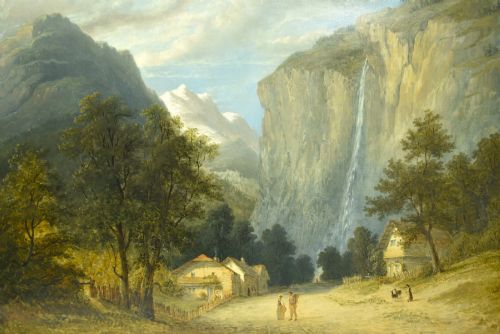
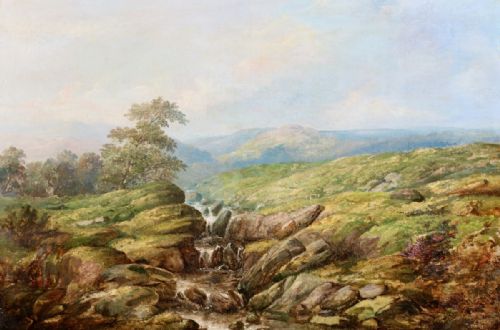
An antique waterfall oil artwork represents a landscape tradition focusing on moving water, rivers, and cascades across the nineteenth century. These works capture specific sites such as Swiss valleys, North Wales, and North American landmarks like Niagara Falls.
The pieces appearing here are predominantly Victorian oil paintings on canvas, often housed in original gilded wood or gesso frames. They span British, Continental, and Italianate schools, presenting naturalistic views or romantic vistas with travellers and anglers in the foreground.
Materials and technique
Artists painted using oil on canvas, applying pigment to build depth in landscape scenes featuring rocks, foliage, and rushing water. Brushwork ranges from precise nineteenth-century realism to broader Romantic treatment.
Frames are constructed from wood and gesso, finished with surface gilding to complement the canvases. These gilded wood surrounds are frequently original to the Victorian period.
An anonymous Victorian painter once captured a cascade so hurriedly that the falling water seems to have splashed onto the gilt frame.
Evaluating quality
Quality rests upon the handling of light and movement within the water, alongside the fidelity of the surrounding landscape. Skilled brushwork distinguishes a compelling topographical record from a generic studio composition.
The presence of the original gilt frame contributes significantly to the integrity of the piece. Frames exhibiting intricate gesso moulding elevate the presentation of the canvas.
Alexandre Le Bihan·Clarence Henry Roe·William Mellor·John Syer junior·Frederick Richard Lee·James Poole·Peter de Wint
The Antique Waterfall Oil Artwork Glossary
- Oil on Canvas
- Pigment mixed with drying oil applied to a stretched woven fabric support. This combination allowed artists to achieve rich colour saturation and subtle tonal gradations.
- Giltwood
- Wood carved and covered with a thin layer of gold leaf or metal foil. It provided opulent framing for nineteenth-century fine art.
- Gesso
- A paint mixture consisting of a binder mixed with chalk, gypsum, or pigment. It served as a smooth preparation layer for gilding on wooden frames.
- Romanticism
- An artistic movement emphasising emotion, individualism, and awe of nature. It often manifested in dramatic depictions of waterfalls and mountainous terrain.
- Continental School
- A broad designation for artists trained in mainland Europe rather than Britain. These painters often brought distinct landscape traditions to their handling of alpine cascades.
Antique Waterfall Oil Artwork: Frequently Asked Questions
Are the frames original?
Many examples retain their original gilded wood or gesso frames from the nineteenth century. These surrounds often feature decorative moulding suited to Victorian display.
Examining the construction of the wooden frame helps determine its period relationship to the canvas.
How are the periods identified?
Dating relies on stylistic markers of nineteenth-century realism and Victorian naturalism, alongside artist signatures and biographical dates. Canvas stamps and frame construction also offer chronological clues.
Many pieces are attributed to specific Victorian painters active between eighteen-fifty and nineteen-hundred.
Where should I hang one?
These large landscape paintings suit principal reception rooms or studies with sufficient wall space to accommodate heavy gilded frames. Position them away from direct sunlight to protect the oil pigments.
Pairing the artwork with period interior furnishings complements the traditional aesthetic of nineteenth-century canvases.