
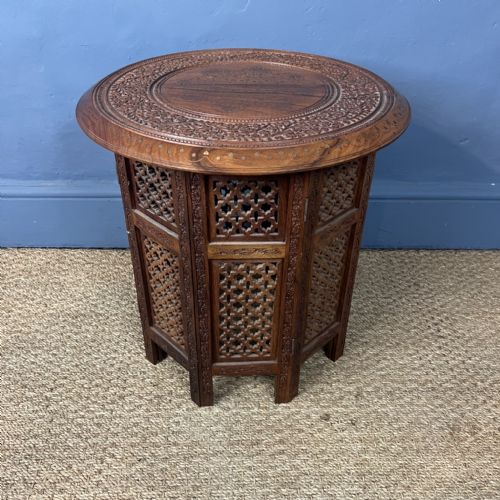


Antique Teak Folding Stand
An antique teak folding stand brings portable craftsmanship and intricate carving into the home, offering versatile surfaces and book holders designed for travel or compact living.
Antique Teak Folding Stand
An antique teak folding stand encompasses portable furniture pieces designed to pack flat or collapse for convenience, originating largely from Victorian and early twentieth century workshops. Buyers searching for an antique teak folding stand will encounter a diverse array of forms, from occasional side tables and campaign serving tables to reading desks, book slides, and newspaper racks.
The majority of these pieces originate from Anglo-Indian or Burmese traditions, reflecting colonial trade and travel utility. Side tables, washstands, and folio stands dominate the selection, often featuring hinged or removable X-frame bases alongside intricate surface ornamentation.
Originating across the nineteenth and early twentieth centuries, these stands served travellers, scholars, and officers who required functional furniture that moved easily. The survival of these pieces demonstrates the robust nature of dense tropical hardwoods when shaped by skilled regional cabinet makers.
What varies in quality
Quality rests primarily in the crispness and depth of the carved ornamentation, distinguishing master craftsmanship from repetitive workshop output. Finer examples display meticulous symmetry and undercut relief work that retains sharp edges, whereas simpler items show softer, shallower detailing.
The integrity of the folding mechanism and the precision of the joinery further define the tier of a piece. Superior stands close flush and lock rigidly into position using well-fitted brass pins or stable scissor actions that withstand repeated assembly.
Scholar's reading stands and travelling trader's altars reveal how historical owners ensured their study and devotion travelled comfortably.
The Antique Teak Folding Stand Glossary
- Campaign furniture
- Portable pieces built for military officers or travellers, designed to fold, dismantle, or pack efficiently into transit chests. These items utilise brass fittings and sturdy hinges to endure frequent relocation.
- Anglo-Indian
- A descriptive term for furniture made in India during the British colonial period, combining traditional local craftsmanship with British domestic forms. These pieces often showcase dense carving and inlaid decorative elements.
- Folio stand
- A vertical or adjustable rack designed to hold large books, newspapers, or art prints securely for reading and display. They frequently incorporate folding mechanisms for easy storage.
- Inlay
- A decorative technique where contrasting materials such as brass wire or bone are set flush into the surface of the primary timber to form geometric or floral patterns. This ornamentation enhances the visual depth of the wood.
- Hoshiarpur
- A region in India renowned for specialised woodwork, particularly intricate carved tables and screens featuring dense floral motifs. Pieces from this tradition often combine teak with bone or brass elements.
Antique Teak Folding Stand: Frequently Asked Questions
Were these stands made for travel?
Many of these pieces were constructed as campaign furniture or travelling equipment for officials and merchants moving across the British Empire. Their collapsible designs allowed them to be packed into crates alongside other personal effects.
Other domestic variants served in British homes as flexible occasional furniture that could be stored away when space was required. Both origins resulted in portable items built to withstand regular movement.
How do I care for carved teak furniture?
Maintain the timber by applying natural beeswax sparingly with a soft brush to lift dust from deep carved recesses. Avoid silicon-based polishes that build up within the intricate grooves and dull the natural grain of the wood.
Keep the stand away from direct heat sources and strong sunlight to prevent the dense hardwood and any inlaid bone or brass from drying and splitting. Stable room humidity preserves both the timber and the historical metal fittings.
How can I tell the age of a stand?
Dating relies on examining the construction methods, the style of the carving, and the materials used in the hinges and fixings. Victorian and nineteenth century examples often display hand-cut joinery and heavy brass campaign hardware.
Later pieces from the early twentieth century may incorporate simpler mechanical joints or lighter framing. Comparing the decorative motifs to documented Anglo-Indian and Burmese design periods helps narrow the manufacturing era.