


Antique Table Clock Set
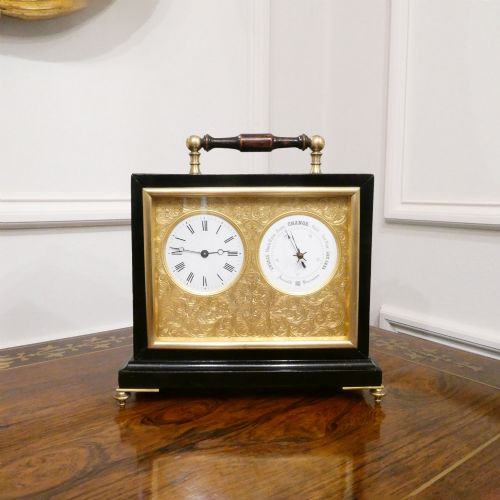
An antique table clock set brings a room together with balanced proportion, matching side garnitures or barometers alongside the central timepiece.
Antique Table Clock Set
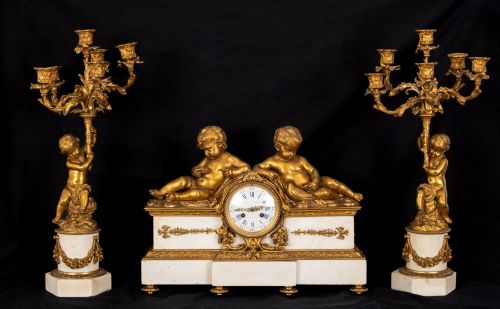
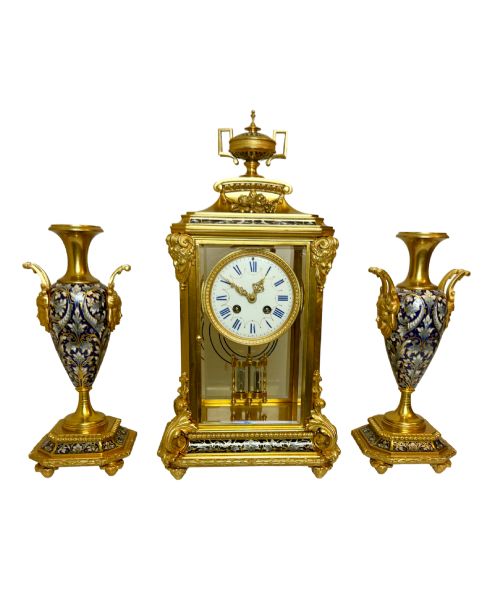
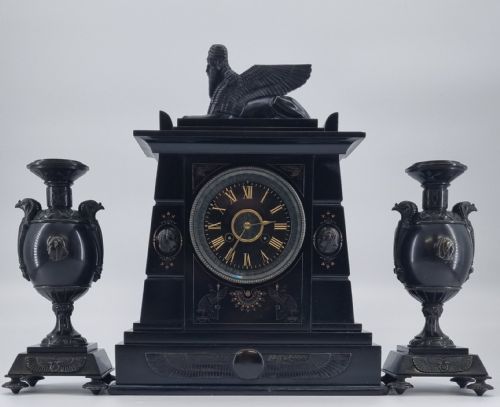
An antique table clock set comprises a central mantel timepiece accompanied by matching side pieces such as garnitures, urns, barometers, or thermometers designed to display in unison on a surface. The examples gathered here span from the nineteenth century into the Edwardian and Art Deco periods, bringing together Victorian, Louis XVI Revival, and French Empire styles.
Most pieces encountered on this page originate from French workshops or English makers, taking the form of clock garniture sets or desk compendiums. The materials range from black slate and white marble to gilt bronze, ormolu, and champleve enamel, often pairing a striking clock with matching side ornaments.
How they were made
Maker workshops utilised cast ormolu, gilded brass, and bronze mounts secured to heavy bases of black slate, white marble, or green onyx. Metalwork involved intricate chasing and fire gilding, while dials frequently incorporated enamel panels or specialised phases of the moon displays.
Side garnitures and matching instruments relied on identical stone carving and metal casting techniques to mirror the central clock case. Glass panels were integrated into four-glass models, and champleve enamel added coloured detail to brass and bronze surfaces.
What varies in quality
The standard of an antique table clock set rests upon the crispness of the bronze casting and the depth of the hand-chased ornamentation on ormolu mounts. Superior sets display cohesive design across all three pieces, where the side garnitures share the exact stone veining and decorative vocabulary of the central clock.
Movement execution and dial refinement also separate standard examples from finer works, particularly where complex enamel work or specialised mechanisms like penny moon dials are present. The quality of the marble or slate housing, from simple block forms to ornate Rococo and Neo-Classical shapes, dictates the visual weight of the set.
A.D Mougin·Deniere Paris·Japy Freres·Samuel Marti
The Antique Table Clock Set Glossary
- Garniture
- A set of ornaments, typically comprising a central clock flanked by two matching side pieces such as vases, urns, or candelabra designed to sit together on a mantelpiece.
- Ormolu
- Gilded bronze, produced by applying a mercury and gold amalgam to a bronze casting and heating it to drive off the mercury.
- Champleve enamel
- A technique where troughs or cells are hollowed out in the surface of metal and filled with vitreous enamel powder before firing.
- Black Slate
- A dense metamorphic rock utilised extensively for Victorian clock cases, prized for its dark uniform appearance and ability to take a high polish.
- Desk Compendium
- A multi-instrument desk object combining a clock with related instruments such as a barometer, thermometer, or compass.
Antique Table Clock Set: Frequently Asked Questions
What is included in a clock garniture?
A clock garniture typically includes a central mantel timepiece accompanied by two matching side ornaments, such as urns or vases, designed to coordinate visually as a complete set on a mantel or table.
In some instances, the side pieces incorporate working barometers or thermometers to create a functional desk compendium or matched scientific set.
How do I care for marble and ormolu?
Marble and slate surfaces require gentle dusting with a soft cloth and should be kept away from direct heat and moisture to preserve the stone polish. Ormolu mounts need similar care without abrasive cleaners or metal polishes that can strip the historic gilding.
Regular movement servicing by a qualified horologist keeps the internal mechanism running smoothly without disturbing the outer case.
Where were these clock sets made?
The majority of these sets originate from French workshops in Paris and surrounding regions, produced by notable clockmakers and bronze founders during the nineteenth and early twentieth centuries.
English makers also produced striking mantel sets and desk compendiums, particularly during the late Victorian and Edwardian eras, using domestic marble and imported movements.
How can I tell the period of a set?
Stylistic cues such as heavy black slate point toward mid to late Victorian production, while ormolu and marble combinations often reflect French Louis XVI Revival or Second Empire tastes.
Later pieces from the early twentieth century adopt clean lines characteristic of the Art Deco period, utilising materials like grey breccia marble and silver plated bronze.