
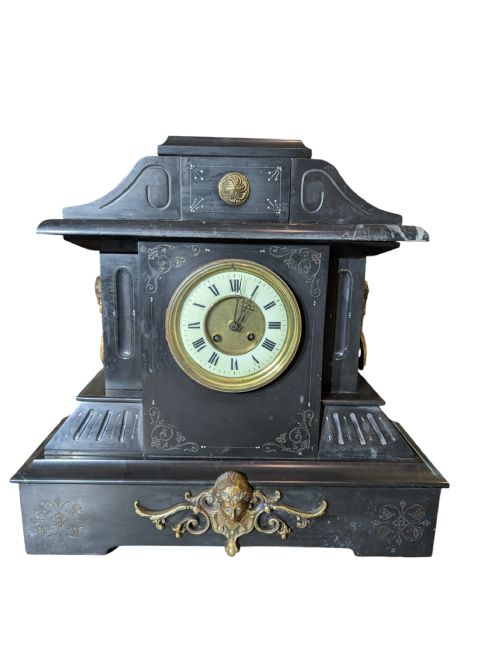


Slate and Marble Clock
A slate and marble clock brings heavy architectural presence to a mantelpiece, combining industrial heft with classical refinement.
Slate and Marble Clock
When you search for a slate and marble clock, you are looking at substantial timepieces built primarily during the nineteenth century, particularly the Victorian era. These objects function as domestic centrepieces, designed to sit firmly on a mantelpiece with considerable physical weight.
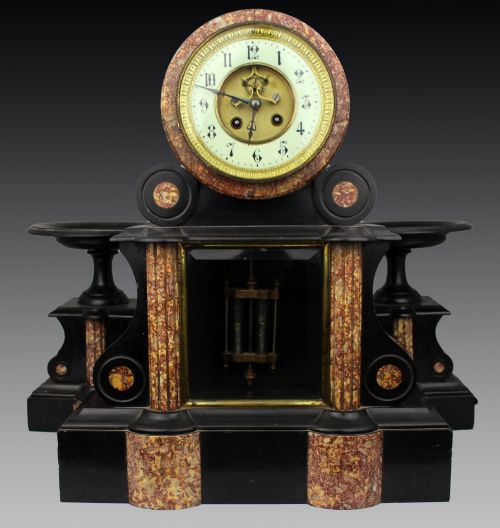
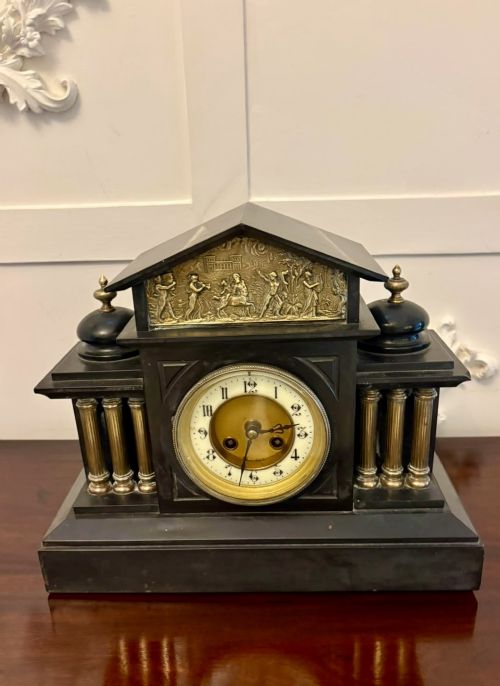
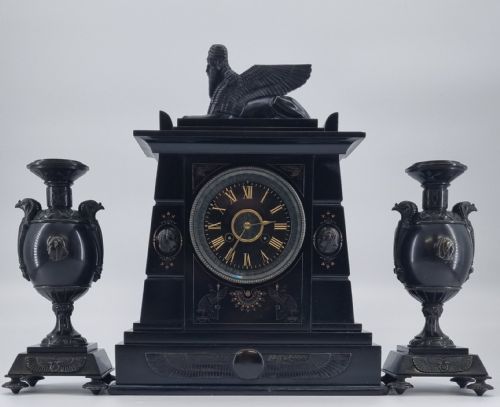
The versions you are most likely to meet on this page include Victorian architectural models, French garniture sets, and drumhead clocks. Many incorporate stylistic influences such as Egyptian Revival, Neoclassical, and Louis XVI motifs, often accompanied by matching side urns or garnitures.
The origins span British workshops and continental makers, with French and Belgian slate frequently utilised alongside domestic production. Forms range from simple drumhead silhouettes to elaborate temple-like facades with incised marble inlay and bronze mounts.
How they were made
The construction relies heavily on dense black slate and various marbles, shaped into architectural blocks and polished to a smooth finish. Brass and bronze components, including bezel rings, dials, and figural mounts, are integrated into the stone chassis.
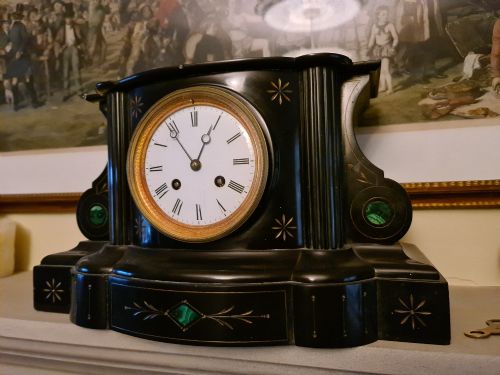
Gilding and enamel feature prominently on the clock faces, with Roman numerals painted on circular dials behind protective glass covers. Incised geometric or floral patterns on the stone are frequently filled with contrasting coloured pastes to mimic pietra dura work.
The internal mechanics house eight-day spring-driven movements, sometimes featuring complex additions such as perpetual calendars or bell-striking mechanisms. Fusee movements appear in specific English examples, requiring a chain to regulate the pull of the mainspring.
Listings demonstrate a strong predominance of Victorian production, alongside eighteenth-century Louis XVI examples and early twentieth-century French garnitures.
What varies in quality
The distinction between ordinary production and top-tier execution lies in the ambition of the architectural design and the crispness of the stone cutting. Superior examples display intricate inlaid marble work, balanced proportions, and high-grade cast bronze or gilt brass enrichments rather than plain, unadorned slate.
The movement itself dictates the standing of the piece, with signed French or London makers indicating higher grade engineering. A comprehensive garniture set that retains its original matching side pieces maintains greater coherence than a single isolated clock body.
Japy Frères·Philippes Paris·Sacre·Baby and Jannings·D. Munsey of Cambridge·Achille Brocot·Barraud and Lund London
The Slate and Marble Clock Glossary
- Garniture set
- A clock accompanied by matching decorative side pieces, such as urns or vases, designed to sit together as a mantle display. These sets often share the same marble and bronze detailing as the central timepiece.
- Drumhead clock
- A timepiece featuring a circular clock housing shaped like a drum mounted upon a rectangular slate or marble base. This specific silhouette is common in Victorian domestic interiors.
- Fusee movement
- A conical pulley mechanism designed to equalise the power of the mainspring as it winds down, ensuring consistent timekeeping. This technical inclusion points to higher grade English clockmaking.
- Egyptian Revival
- A design style inspired by ancient Egyptian art and architecture, featuring hieroglyphic motifs, obelisk forms, and sphinx supports. It appears frequently on nineteenth-century mantel clocks.
- Enamel dial
- A clock face made by fusing powdered glass onto a copper or brass plate at high temperatures. These dials provide a durable, glossy surface for painted numerals.
Slate and Marble Clock: Frequently Asked Questions
How heavy are slate and marble clocks?
These timepieces possess significant weight due to the dense solid stone used for the chassis and architectural casing. Lifting one requires care, and the mantelpiece must be sturdy enough to bear the continuous load.
Because of this mass, they remain stable in position but demand two hands and a secure grip whenever they are moved during cleaning or relocation.
What is a clock garniture set?
A garniture set includes the main clock flanked by matching decorative objects, typically a pair of urns or vases made from the same slate and marble materials. They were designed to create a balanced symmetrical arrangement across a fireplace mantel.
Finding a complete surviving set adds considerable visual harmony to a room display compared to owning the clock alone.
How do I wind an eight day movement?
An eight-day movement requires winding via a dedicated key inserted into the dial holes once a week to maintain tension on the internal springs. Care must be taken not to overwind the mechanism beyond the natural stop.
Keeping to a regular weekly schedule helps maintain the accuracy of the strike and the general health of the brass gears.
How do I identify Egyptian Revival clocks?
Egyptian Revival pieces incorporate distinct architectural motifs drawn from ancient Nile civilisations, such as pyramid shapes, lotus capitals, and bronze sphinx figures. These details are applied directly onto the black slate and marble bodies.
Such styling became particularly fashionable during the mid-nineteenth century following archaeological discoveries and international exhibitions.
Did these clocks run on pendulums?
Most of these mantel clocks utilise an internal pendulum swinging behind the glass door to regulate the escapement and maintain accurate time. The pendulum length is adjusted via a small nut on the suspension spring to speed up or slow down the beat.
Setting the clock up on a completely level surface ensures the pendulum swings evenly without catching on the case interior.