

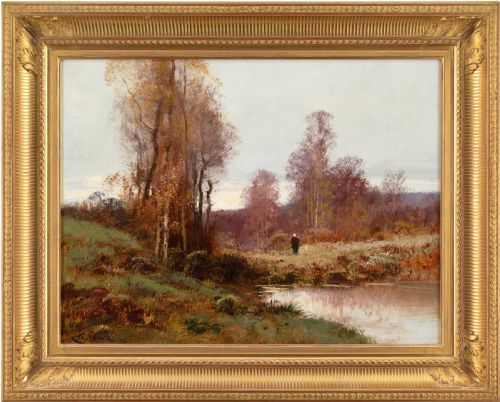


Antique Style Countryside Painting
These antique style countryside painting works capture pastoral vistas and river scenes through traditional brushwork.
Antique Style Countryside Painting
An antique style countryside painting brings historical rural views into an interior, depicting scenes such as river banks, pastoral pastures, and woodland cottages. These artworks typically date from the eighteenth century through to the mid twentieth century, reflecting shifting tastes in landscape depiction.
Buyers encounter oil on canvas works alongside delicate watercolours on paper. The selection includes both signed pieces by named artists and unsigned examples from the British and French schools.
The subjects range from quiet winter snow scenes with stagecoaches to bustling river landscapes with figures on boats. Such paintings suit traditional display spaces where historical character is desired.
Materials and Techniques
Artists painted primarily with oil paint on canvas or panel, or utilised watercolour on paper for lighter atmospheric effects. These traditional media were applied using fine brushes to build up depth in skies, foliage, and water.
Listings feature works spanning from the mid eighteenth century through to the mid twentieth century, created using oil on canvas, panel, and watercolour on paper.
Assessing Quality and Execution
The standard of an antique style countryside painting depends upon the fidelity of the perspective and the handling of light across the landscape. Superior examples display confident brushwork that defines foliage, water reflections, and animal anatomy with convincing realism.
The retention of original framing adds distinction to a piece, particularly when the moulding matches the period of the artwork. Finer works often bear legible signatures or clear attribution to established schools and known painters.
Richard Sebastian Bond·Charles Clair·Frederick Septimus Lewis·James de Rijk·Frederick Waters Watts·Thomas Sydney Cooper·Gudrun Sibbons·Claude Cardon·John Richard Worsdale·Robert John Hammond·E Van Drielst·Thomas Jones
The Antique Style Countryside Painting Glossary
- Oil on Canvas
- A painting medium where pigments suspended in oil are applied to a stretched woven fabric support. This combination allows for rich colour blending and textured brushwork.
- Watercolour Painting
- An artwork created using water soluble pigments on paper. This technique produces translucent washes that capture soft light and gentle atmospheric effects.
- British School
- A classification for artists working within Britain who share stylistic traits or training traditions. It encompasses generations of landscape and portrait painters.
- Barbizon Influence
- A stylistic approach derived from the French landscape painters who worked near the village of Barbizon. It emphasises direct observation of nature and moody atmospheric tones.
- Gilt Wood
- Timber framing or ornamentation covered with a thin layer of gold leaf or metal powder. This finish enhances the visual separation between the canvas and the wall.
Antique Style Countryside Painting: Frequently Asked Questions
How do I date an old landscape painting?
Dating relies on examining the canvas preparation, stretcher construction, and framing styles alongside any visible signatures or inscriptions. Stylistic clues within the clothing of figures or architectural details also help narrow the timeframe.
Comparison with documented works by similar regional schools provides further confirmation of the period during which the piece was produced.
What is the difference between oil and watercolour?
Oil paint uses a drying oil binder to hold pigments, creating a durable, opaque surface that can be layered thickly. Watercolour uses a water soluble binder on paper, resulting in transparent washes that require protective glass framing.
Oils generally offer heavier texture and deeper tones, while watercolours excel at capturing luminous skies and delicate rural light.
Where should I hang a pastoral painting?
These works suit dining rooms, libraries, or living spaces where traditional furniture and neutral wall colours can complement the natural palette of the scene. Direct sunlight should be avoided to prevent fading of watercolours and varnishes.
Placement at eye level allows viewers to appreciate the fine brushwork and intricate details of the rural composition.
How should I clean a framed canvas?
Dusting the frame and the surface of the canvas requires a soft, dry brush used with a gentle touch. Moisture and household cleaners must be kept away from both the painted surface and the paper.
Professional conservators should handle deeper cleaning or the removal of accumulated grime to protect the integrity of the original paint layers.