


Antique Silver Medal
An antique silver medal is a tangible piece of past competition, service or commemoration, offering a direct link to the social history of the nineteenth and twentieth centuries.
Antique Silver Medal
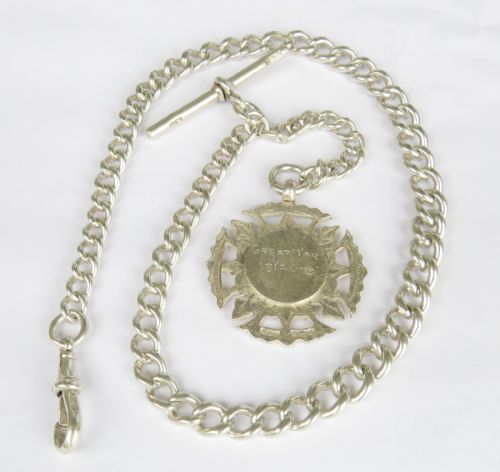
When you search for an antique silver medal, you encounter small metallic tokens of achievement, military service and civic participation spanning from the Georgian era through to the Art Deco period. These pieces frequently surface attached to pocket watch chains and fobs or mounted as individual pendants.
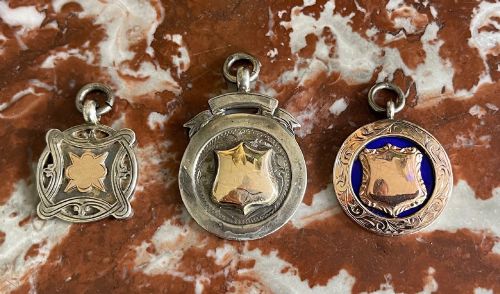
The version you are most likely to meet on this page is the sports medallion or civic prize from the Edwardian and early twentieth century. Football, cricket, cycling and curling all generated silver medallions, often dated and engraved with the winner's name or the specific competition.
Military medals also appear, recording service from the nineteenth century through the First World War. Alongside these lie commemorative pieces, such as coronation issues and agricultural show awards, reflecting the diverse occasions that warranted striking silver.
Materials and production methods
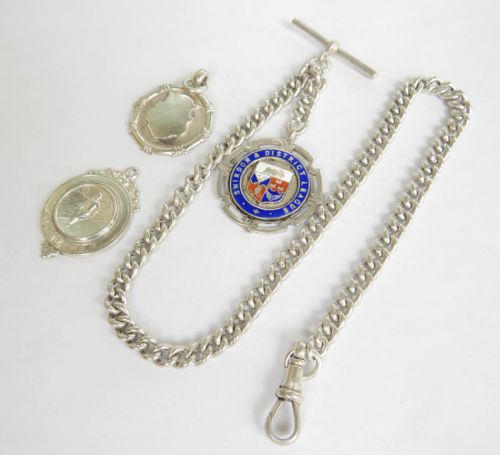
The foundation of these pieces is solid silver or sterling silver, occasionally enriched with rose gold detail or rendered as vermeil. Makers struck these medals from dies, sometimes incorporating vitreous enamel to highlight crests, text or sports equipment.
Many medallions retain their original silk, satin or velvet ribbons, while others connect directly to pocket watch chains and fobs using dog clips and jump rings. Hand-engraving frequently personalises the reverse with recipient names and dates.
Listings span multiple decades from the Georgian era through to the Art Deco period, incorporating silver, enamel, silk and velvet.
Distinctions in quality
Quality rests upon the crispness of the original die-stamping and the depth of the relief work. Pieces with high-relief modelling and intricate hand-engraving stand apart from simpler, flat-stamped awards.
The survival of original components also dictates desirability. Medals that retain their coloured enamel work undamaged, or remain mounted to their original silk ribbons and matching watch chains, represent the more complete examples.
David McGregor·Frederic Boucheron
The Antique Silver Medal Glossary
- Sterling silver
- A silver alloy containing 92.5 percent silver by mass, forming the primary material for the majority of these pieces.
- Albert chain
- A type of pocket watch chain worn across a waistcoat, frequently suspending medals and fobs.
- Vermeil
- Sterling silver coated with a thin layer of gold, seen on select commemorative coins and medals.
- Dog clip
- A spring-loaded clasp attached to watch chains and fobs for securing medals and pocket watches.
- Hallmark
- An official stamp indicating the purity of the metal, the assay office, and often the year of manufacture.
Antique Silver Medal: Frequently Asked Questions
What were these medals originally given for?
These medals rewarded achievements in local sports leagues, agricultural shows, fire brigade drills and military campaigns. Civic bodies and clubs commissioned them to mark specific victories or periods of service.
They served as portable honours that recipients could display on their watch chains or keep within presentation boxes as personal mementos.
How do I wear or display an antique silver medal?
Many collectors mount these medals onto pocket watch chains to replicate how owners wore them on waistcoats during the Victorian and Edwardian periods. Others display them flat in shallow frames or keep them within their original fitted boxes.
When wearing them as pendants, ensure the suspension rings and jump rings are secure to prevent loss during daily use.
How can I tell the age of a medal?
Assay hallmarks stamped into the silver provide the most reliable guide to a medal's age, pointing to specific towns and years of manufacture. Many pieces also feature hand-engraved dates on the reverse corresponding to the year of competition.
Stylistic indicators, such as the geometric lines of Art Deco pieces or the ornate borders typical of Victorian designs, offer additional chronological clues.
What is the difference between a fob and a medal?
A fob is an ornamental accessory attached to a pocket watch chain, while a medal is a struck piece created to commemorate an event or reward a feat. In practice, many medals were manufactured specifically to be worn as fobs.
On this page, the two terms often overlap as sports and civic medals were routinely fitted with loops to serve as watch chain pendants.