



Antique Serpentine Knife Boxes
Antique serpentine knife boxes are elegant Georgian dining room pieces in mahogany and satinwood that collectors prize for their curving profiles and refined craftsmanship.
Antique Serpentine Knife Boxes
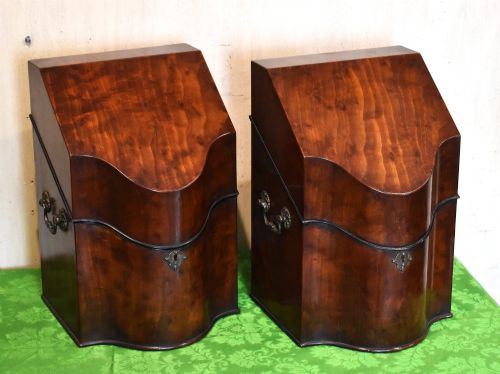
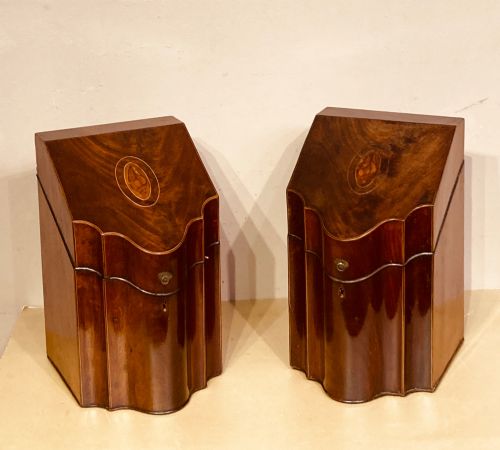
Antique serpentine knife boxes are sloping wooden containers designed to hold cutlery on the sideboard during Georgian dining. When collectors search for antique serpentine knife boxes, they encounter handsome examples dating from the eighteenth century, particularly the George III and Sheraton periods. The pieces appearing here predominantly feature the distinctive undulating front profile that defines the form.
Makers shaped these items primarily as knife boxes, though many have since found new life as stationery boxes or storage cabinets. The listings show forms ranging from single boxes to matched pairs, often incorporating brass fittings and delicate wood inlay. Mahogany dominates the selection, occasionally supplemented by satinwood and boxwood details.
Most examples originate from the eighteenth century around seventeen ninety, representing a high point in British cabinet making. Buyers meet both plain timber constructions and richly figured varieties displaying sophisticated serpentine curves. These containers reflect the formal dining practices of the period when silver cutlery required dedicated storage.
Materials and construction methods
Cabinet makers built antique serpentine knife boxes using solid mahogany and figured mahogany veneers over secondary timbers. The serpentine contour required considerable skill to shape from solid wood or to bend and veneer onto a shaped core. Workshops frequently added boxwood and satinwood stringing or pictorial inlay to accentuate the sweeping lines of the front.
Metalwork played a vital structural and decorative role, with brass handles, escutcheons and hinges fitted to the exterior. Interiors often retained traces of their original compartments or velvet linings designed to cradle steel and silver cutlery securely. Silver mounts occasionally appeared on higher status pieces from the Sheraton period.
The sloping lid operated on brass hinges, opening to reveal a stepped interior fitted with dividers for individual knives and forks. Craftspeople joined the carcase using precise dovetail joints at the corners to ensure stability across the curving profile. Bone and metal details completed the interior fittings of select boxes.
Antique Serpentine Knife Boxes Retail Price Guide 2026
Typical asking prices for serpentine knife boxes among the pieces listed under this phrase on Sellingantiques today, from the lower quarter to the upper quarter. They describe what is for sale here now, not the wider market.
Several items in this selection have been successfully converted from cutlery storage to house modern stationery.
Markers of quality and execution
The choice of timber underpins the visual appeal, with heavily figured mahogany and crisp satinwood inlay distinguishing finer items from plain variants. Cabinet makers who selected timber with vibrant grain patterns achieved a more striking play of light across the serpentine curve. The precision of the inlay work, particularly fine stringing and floral motifs, signals superior workshop execution.
Hardware integrity separates standard examples from exceptional ones, especially the presence of original brass fittings and escutcheons. The fluidity and symmetry of the serpentine front curve demonstrate the maker's proficiency with complex shaping. Well preserved interior dividers and original locking mechanisms further elevate the standing of a piece.
The Antique Serpentine Knife Boxes Glossary
- Serpentine
- A furniture front profile characterised by a central convex curve flanked by two concave curves. This contour requires advanced woodworking skill to execute cleanly on a vertical plane.
- George III
- The period of British history spanning from seventeen sixty to eighteen twenty, associated with refined mahogany furniture design. Pieces from this era often display classical proportions and restrained ornamentation.
- Sheraton
- A neoclassical furniture style popular in the late eighteenth century, named after designer Thomas Sheraton. It is identifiable by the use of satinwood veneers, contrasting inlay and delicate geometric forms.
- Inlay
- A decorative technique where pieces of contrasting wood, bone or metal are fitted into recessed pockets in the primary surface. This method creates flat ornamentation across the exterior of the box.
- Escutcheon
- A protective metal plate surrounding a keyhole, usually cast in brass on these containers. It serves both a functional purpose and a decorative role on the sloping lid.
Antique Serpentine Knife Boxes: Frequently Asked Questions
What were antique serpentine knife boxes used for?
These boxes originally sat on sideboards in grand dining rooms to store handled cutlery when not in use on the table.
Servants retrieved the knives and forks from the sloping containers as each course required during formal meals.
How do I identify a George III knife box?
George III examples typically feature solid mahogany construction, sloping lids, and characteristic serpentine front profiles dating from the late eighteenth century.
Look for period brass hardware, dovetailed corner construction and interior partitions designed specifically for cutlery storage.
Can I use an antique knife box for stationery?
Many surviving boxes have been adapted over the centuries to hold writing paper, letters and small desk accessories.
The internal partitions and sloping lids lend themselves naturally to organising stationery on a modern desk.
Why do some knife boxes come as pairs?
Dining room etiquette in the eighteenth century often dictated symmetrical arrangements on the sideboard, requiring matching pairs of containers.
One box held table knives while the other accommodated forks and serving implements for guests.
What is satinwood inlay?
Satinwood inlay involves setting pale, lustrous exotic timber into dark mahogany backgrounds to create decorative borders and motifs.
This technique gained popularity during the Sheraton period to brighten furniture exteriors.